
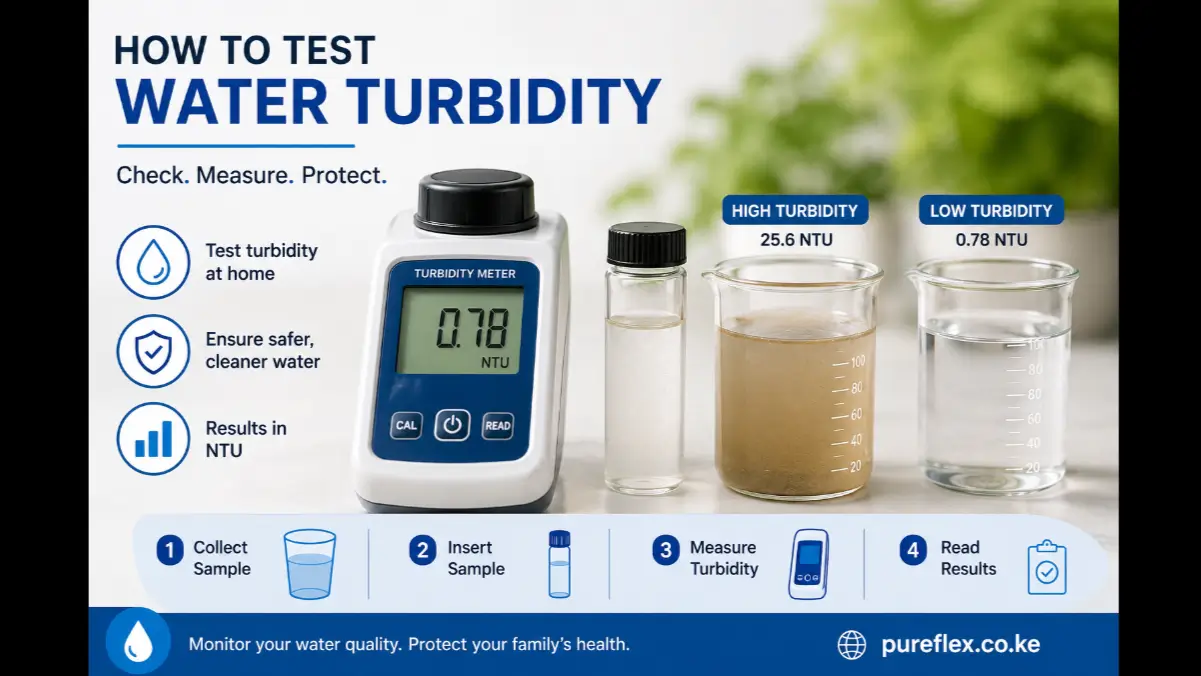
Water can look clean in a glass and still contain suspended particles that affect its quality. If your tap water, borehole water, rainwater, or stored water looks cloudy, learning how to test water turbidity can help you understand what is happening and determine whether additional treatment may be necessary.
Turbidity measures how cloudy or hazy water is because of suspended particles. These particles can include clay, silt, organic matter, microorganisms and other materials.
For households in Kenya, turbidity testing can be particularly useful when dealing with borehole water, rainwater harvesting systems, water tanks, river water, or changes in municipal water quality.
This guide explains what turbidity means, how to test it at home, how turbidity is measured in NTU, what high turbidity may indicate, and how water filtration systems can help reduce suspended particles.
What Is Water Turbidity?
Water turbidity is a measure of how cloudy or hazy water is because of suspended particles.
When light passes through clean water, it can travel relatively easily. Suspended particles scatter the light, making the water appear cloudy.
Common causes of turbidity include:
- Soil and clay particles
- Sand and silt
- Organic matter
- Algae
- Microorganisms
- Rust and corrosion particles
- Disturbed sediments
- Poorly maintained storage tanks
- Runoff entering a water source
The World Health Organization (WHO) identifies turbidity as an important parameter for drinking-water quality and water-treatment processes. High turbidity can also interfere with effective disinfection because particles may protect microorganisms from disinfectants.
Why Should You Test Water Turbidity in Kenya?
Turbidity can vary significantly depending on where your water comes from.
A household using treated piped water in Nairobi may have different turbidity concerns from a household using borehole water in Kiambu, rainwater in Nakuru, or surface water in rural areas.
Testing can be especially useful when:
- Borehole water suddenly becomes cloudy
- Rainwater appears dirty after collection
- A water tank has accumulated sediment
- Water changes colour after heavy rainfall
- A new borehole has been installed
- Water develops visible particles
- You are installing a water filtration system
- You want to monitor the performance of a filter
- You use untreated or partially treated surface water
The Water Resources Authority (WRA) monitors water quality and pollution in Kenya and conducts field and laboratory analyses of physical, chemical and biological water-quality parameters.
How Is Water Turbidity Measured?
Turbidity is commonly measured in NTU, which stands for Nephelometric Turbidity Units.
A turbidity meter, also called a nephelometer, measures how light is scattered by particles in a water sample.
Generally:
Lower NTU = clearer water
Higher NTU = more suspended particles
However, NTU is not a measurement of every contaminant in water. A low turbidity reading does not prove that water is safe to drink, because dissolved chemicals and microorganisms may still be present.
How to Test Water Turbidity at Home
There are several ways to assess turbidity, but they vary considerably in accuracy.
1. Start With a Visual Check
The simplest method is to examine the water in a clean, transparent glass.
Hold the glass against a light background and look for:
- Cloudiness
- Suspended particles
- Sediment
- Discolouration
- Floating material
You can also leave the sample undisturbed and observe whether particles settle at the bottom.
This method can help identify obvious turbidity, but it does not provide an NTU reading.
Water can also contain enough suspended material to affect quality without appearing obviously cloudy.
According to WHO guidance, turbidity below about 4 NTU may only be detectable using instruments, meaning visual inspection alone is not sufficient for accurate turbidity measurement.
2. Use a Turbidity Tube
A turbidity tube provides a simple field method for estimating turbidity.
The tube is filled with a water sample, and a reference mark or pattern at the bottom is viewed through the water.
As turbidity increases, it becomes harder to see the reference pattern.
This method can be useful for basic screening, particularly where laboratory equipment is unavailable.
However, turbidity tubes are generally less precise than electronic turbidity meters.
3. Use a Digital Turbidity Meter
For more accurate home or field testing, a digital turbidity meter is a better option.
A typical meter works by directing light through a water sample and measuring the amount of scattered light.
A basic testing process is:
- Collect the water sample in a clean container.
- Use the sample container supplied or recommended by the meter manufacturer.
- Mix the sample gently if required.
- Avoid creating unnecessary bubbles.
- Place the sample into the meter.
- Follow the manufacturer’s calibration and measurement procedure.
- Record the NTU reading.
- Repeat the measurement if the result appears unusual.
For reliable results, the equipment should be properly calibrated and the sample container kept clean and free from scratches, fingerprints and residue.
Can You Test Turbidity With a TDS Meter?
No.
A TDS meter and a turbidity meter measure different properties.
A TDS meter estimates total dissolved solids based on electrical conductivity.
A turbidity meter measures the scattering of light caused by suspended particles.
This distinction matters because water can have:
- High TDS but low turbidity
- Low TDS but noticeable turbidity
- High TDS and high turbidity
- Low TDS and low turbidity
Therefore, if you want to assess both dissolved substances and suspended particles, you may need different testing instruments.
If you are interested in broader household water testing, see our guide on how to test water quality at home.
What Is a Good Turbidity Level for Drinking Water?
There is an important distinction between water that looks clear and water that meets appropriate drinking-water-quality targets.
WHO’s current guidance for small water supplies identifies less than 1 NTU as a target for effective disinfection, while noting that where this is not achievable, the aim should be to keep turbidity below 5 NTU. Turbidity above approximately 4 NTU can also become visibly noticeable.
These values should not be interpreted as a single universal “safe/unsafe” cutoff. Turbidity is only one part of drinking-water quality.
For Kenyan households, the applicable national requirements and the characteristics of the specific water source should also be considered.
Kenya’s drinking-water guidance describes potable water as being fairly clear, with low turbidity, and notes that surface water generally requires appropriate treatment before it becomes potable.
Does High Turbidity Mean Water Is Unsafe?
Not necessarily, but it is a reason to investigate.
Turbidity itself is not a complete test for drinking-water safety. However, high turbidity can be associated with water-quality problems.
Suspended particles may:
- Carry microorganisms
- Protect microorganisms from disinfection
- Interfere with chlorine treatment
- Make water aesthetically unacceptable
- Indicate contamination or disturbance of a water source
- Contribute to sediment accumulation
WHO notes that high turbidity can reduce the effectiveness of disinfection and may indicate problems that require investigation.
This is why cloudy water should not simply be ignored.
What Causes High Turbidity in Borehole Water?
Borehole water is often assumed to be naturally clean because it comes from underground. However, borehole water can still contain suspended particles.
Possible causes include:
Newly Drilled Boreholes
New boreholes can initially contain sediment and fine particles that enter the water during drilling and development.
Pumping Problems
Changes in pumping rates or poorly positioned pumps can disturb sediments.
Poor Borehole Construction
Problems with borehole construction or surrounding ground conditions can contribute to sediment entering the water.
Groundwater Conditions
The geology and aquifer characteristics of an area can affect the amount of suspended material in groundwater.
The Water Resources Authority provides groundwater assessment and monitoring services and emphasizes the importance of proper groundwater development and protection.
If you use borehole water at home, it is worth reading our guide on how to purify borehole water at home.
What Causes Turbidity in Rainwater?
Rainwater itself can appear relatively clear when collected under clean conditions, but the collection system can introduce suspended particles.
Common sources include:
- Dust on roofs
- Soil
- Leaves
- Bird droppings
- Roof debris
- Dirty gutters
- Sediment in storage tanks
The first rain after a dry period can also wash accumulated material from a roof and gutters into the collection system.
If you harvest rainwater for household use, turbidity testing should be considered alongside microbiological and other water-quality tests.
What Causes Turbidity in River Water?
River water can contain considerable amounts of suspended material, especially after rainfall.
Heavy rain can cause runoff containing:
- Soil
- Clay
- Sand
- Organic matter
- Waste
- Agricultural material
Turbidity can therefore increase significantly after storms.
This is particularly important for households or communities relying on surface water. If river water is being considered for drinking, turbidity reduction should be part of a broader treatment process rather than the only treatment step.
For more information, see our guide on how to purify river water for drinking.
How Do You Reduce Water Turbidity?
The appropriate treatment depends on the cause and level of turbidity.
Common approaches include:
Sediment Filtration
Sediment filters can remove suspended particles such as sand, silt and some other particulate matter.
Cartridge Filters
Different filter ratings can be used depending on the particle size that needs to be removed.
Multimedia Filtration
For larger or more demanding applications, multimedia filtration can provide a higher-capacity approach to removing suspended particles.
Ultrafiltration
Ultrafiltration membranes can provide fine physical filtration and may be appropriate for certain water sources.
Reverse Osmosis
Reverse osmosis can provide extensive treatment for drinking water, particularly where dissolved contaminants are also a concern.
However, heavily turbid water is generally better treated with appropriate pre-filtration before reaching an RO membrane. This can help protect the membrane and improve system performance.
You can learn more about how reverse osmosis purifies water before deciding whether an RO system is appropriate for your water source.
Should You Test Water Before Buying a Purifier?
Yes.
Testing first can help you avoid choosing a water-treatment system based purely on appearance or assumptions about your water source.
For example, two homes can have equally cloudy water but require different treatment approaches because the underlying causes are different.
One may primarily have sediment, while another may have a combination of suspended particles, hardness, high TDS or microbiological contamination.
A useful approach is:
Test → identify the problem → choose treatment → test again
For broader testing, combine turbidity testing with parameters such as:
- TDS
- pH
- Hardness
- Iron
- Fluoride where relevant
- Nitrates where relevant
- Microbiological parameters
- Other contaminants based on the water source
Our guide to how to test water quality at home explains several of these tests in greater detail.
Where Can You Test Water Quality in Kenya?
If you need more than a basic home turbidity reading, laboratory testing is the better option.
The Water Resources Authority operates water laboratories that analyse water for domestic, irrigation, construction, research and wastewater applications. WRA states that its central laboratory can perform more than 40 different tests and that it operates laboratories across Kenya.
WRA also provides physical, chemical and biological water-quality analysis through its water-quality and pollution-control services.
This can be particularly useful when:
- You are installing a new borehole
- Your water suddenly becomes cloudy
- You suspect contamination
- You want to select a purification system
- You are supplying water to multiple people
- You need a more complete picture of your water quality
Turbidity Testing for Kenyan Homes: A Practical Approach
For a typical Kenyan household, the approach can be straightforward.
If You Use Piped Water
Check for visible changes in clarity and consider testing if the appearance changes unexpectedly.
If You Use Borehole Water
Consider laboratory testing, particularly when the borehole is new or the water quality has changed.
If You Harvest Rainwater
Inspect the roof, gutters and tank in addition to testing the water itself.
If You Use River or Surface Water
Do not rely on appearance alone. Surface water generally requires appropriate treatment before being considered suitable for drinking.
If You Already Have a Water Purifier
Measure turbidity before and after treatment where practical. This can help you determine whether the filtration stage is reducing suspended particles effectively.
Can a Water Purifier Remove Turbidity?
Yes. Many water-treatment systems can reduce turbidity, but their effectiveness depends on the type of filter and the size and nature of the particles.
A sediment filter, for example, is designed primarily to capture suspended particles.
More advanced systems may combine several treatment stages to address different water-quality problems.
For households looking for point-of-use drinking-water treatment, PureFlex provides home drinking water filtration systems and kitchen water purifiers.
You can also browse available water purification equipment or review the 5-stage reverse osmosis system.
Why Turbidity Testing Matters Before Reverse Osmosis
Reverse osmosis membranes are designed to provide fine filtration, but they should not be treated as a substitute for proper pre-treatment.
If source water contains significant amounts of suspended particles, appropriate pre-filtration can help reduce the load reaching the RO membrane.
This is one reason water analysis should come before selecting an RO system.
If you are comparing systems for a kitchen installation, see our guide to the best undersink reverse osmosis systems in Kenya.
You can also read what reverse osmosis is to understand how the technology works.
Final Thoughts
Learning how to test water turbidity is a useful first step in understanding water quality at home.
A visual inspection can identify obvious cloudiness, while a turbidity tube can provide a basic field estimate. For a numerical NTU measurement, a properly calibrated digital turbidity meter is more appropriate.
However, turbidity is only one part of water quality.
For Kenyan households using borehole, rainwater, river, tank or piped water, the most reliable approach is to identify the water source, test the relevant parameters, investigate unusual results and select treatment based on the actual water-quality problem.
If testing shows that your water needs additional treatment, contact PureFlex for guidance on suitable water purification equipment.
Frequently Asked Questions
What is turbidity in water?
Turbidity describes the cloudiness or haziness of water caused by suspended particles such as silt, clay, organic matter and microorganisms.
How do you test water turbidity at home?
You can visually inspect the water, use a turbidity tube for a basic estimate, or use a digital turbidity meter to obtain a numerical reading in NTU.
What unit is used to measure turbidity?
Turbidity is commonly measured in NTU, or Nephelometric Turbidity Units.
Can I use a TDS meter to measure turbidity?
No. A TDS meter estimates dissolved substances, while a turbidity meter measures light scattering caused by suspended particles.
What NTU is considered safe for drinking water?
WHO guidance for small water supplies identifies less than 1 NTU as a target for effective disinfection and recommends keeping turbidity below 5 NTU where the lower target cannot be achieved. Turbidity is only one aspect of drinking-water safety, however.
Does cloudy water always mean it is contaminated?
No. Cloudiness can result from harmless suspended particles, but it can also indicate contamination or conditions that affect disinfection. Unexpected turbidity should therefore be investigated rather than assumed to be harmless.
How do I reduce turbidity in borehole water?
The appropriate method depends on what is causing the turbidity. Sediment filtration, cartridge filtration, multimedia filtration and other treatment technologies may be appropriate depending on the water analysis.
Where can I test water in Kenya?
The Water Resources Authority provides laboratory water-testing services and analyses physical, chemical and biological parameters.
Should I test water before installing an RO system?
Yes. Testing can help determine whether the water requires sediment filtration, treatment for dissolved contaminants, disinfection or a combination of treatment methods.
Is turbidity the same as TDS?
No. Turbidity relates primarily to suspended particles, while TDS refers to dissolved substances. Both can provide useful but different information about water quality.


Leave a Comment