
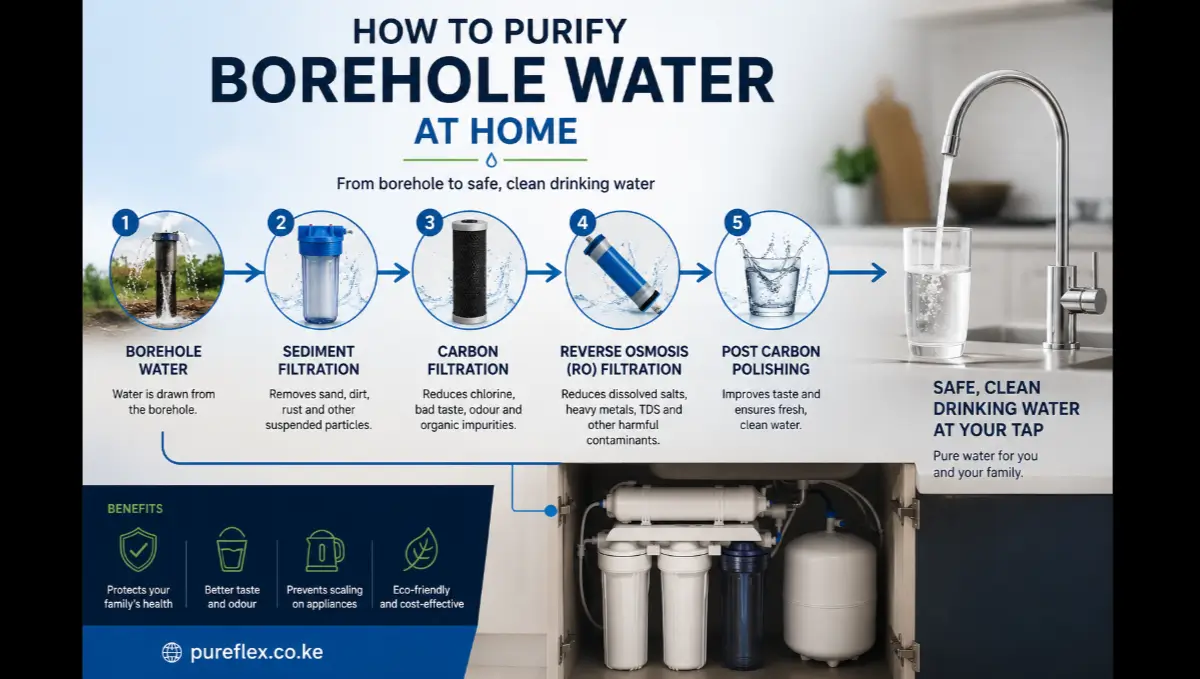
Borehole water can be an excellent source of water for a Kenyan home, but borehole water is not automatically safe for drinking just because it looks clear.
Groundwater can contain minerals, salts, iron, manganese, hardness-causing compounds and microbiological contaminants. The right treatment therefore depends on the actual quality of the water coming from the borehole.
For many homes, the most practical approach is to treat the drinking water at the point of use, particularly in the kitchen. An under-sink RO or UF system can provide treated water directly from a dedicated kitchen tap without requiring the entire household water supply to undergo drinking-water treatment.
Kenya’s Water Services Regulatory Board (WASREB) states that potable water should be free from disease-causing organisms and harmful chemicals, have low turbidity and colour, and not have unacceptable taste, odour or salinity.
Why Borehole Water May Need Treatment
Borehole water passes through geological formations before reaching the underground water source. During that process, it can pick up naturally occurring minerals and other substances from the surrounding rock and soil.
The result can vary considerably from one location to another.
A borehole in Ruiru, Kiambu, Nairobi, Machakos, Kajiado or another part of Kenya may have a very different water profile from a borehole elsewhere.
Common issues homeowners may encounter include:
- High total dissolved solids (TDS)
- Hard water
- Salty or unpleasant-tasting water
- Iron staining
- Manganese
- Sediment or turbidity
- Unpleasant odour
- Microbiological contamination
- Scaling on kettles, taps and appliances
- Water that looks clear but contains dissolved contaminants
This is why simply choosing a water filter based on the appearance of the water can be misleading.
Test Your Borehole Water Before Choosing a Purifier
The first step in learning how to purify borehole water at home is testing the water.
A basic water-quality assessment can help determine what treatment is actually required. In Kenya, KEBS lists testing parameters for drinking water that include substances such as pH, nitrates, nitrites, sulphates, chlorides, iron, zinc, calcium, potassium, sodium, lead, cadmium and arsenic, alongside microbiological testing parameters.
For a homeowner, useful measurements may include:
| Water-quality concern | Why it matters | Possible treatment approach |
|---|---|---|
| High TDS | Affects taste and indicates dissolved substances | RO |
| Hardness | Causes scale and affects appliances | RO or appropriate softening |
| Sediment | Makes water cloudy and can damage filters | Sediment filtration |
| Iron | Can cause staining and metallic taste | Appropriate iron treatment + filtration |
| Manganese | Can cause staining and taste issues | Appropriate treatment + filtration |
| Microbiological contamination | Can present a health risk | Appropriate disinfection/filtration |
| Chlorine or chemical taste | Affects taste and odour | Activated carbon |
| Low contaminant load with microbiological concern | May require targeted treatment | UF or other appropriate treatment |
The important point is that there is no single purifier that is automatically best for every borehole.
What Is the Best Way to Purify Borehole Water at Home?
For many homeowners, the best strategy is to separate general household water from drinking and cooking water.
Instead of installing an expensive treatment system for every outlet in the house, a point-of-use system can be installed in the kitchen.
For example:
Borehole → household water supply → kitchen point-of-use purifier → dedicated drinking-water tap
This approach is particularly useful where the primary concern is producing high-quality water for:
- Drinking
- Cooking
- Making tea and coffee
- Preparing baby food
- Washing fruits and vegetables
- Filling drinking bottles
For a kitchen-focused installation, homeowners can consider Pureflex’s range of kitchen water purification solutions in Kenya, including under-sink and countertop options.
Under-Sink RO for Borehole Water
An under-sink reverse osmosis (RO) system is one of the strongest options when borehole water contains significant dissolved contaminants or high TDS.
The system is installed beneath the kitchen sink, leaving the countertop relatively uncluttered. Treated water is delivered through a dedicated drinking-water faucet.
RO is particularly useful where homeowners are concerned about:
- High TDS
- Salty taste
- Excess dissolved minerals
- Hardness
- Unwanted taste
- Certain dissolved contaminants
For homeowners who want a discreet kitchen installation, an under-sink RO system can be an attractive alternative to keeping a large water dispenser or purifier on the countertop.
Read more about choosing an under-sink reverse osmosis system in Kenya, particularly if your borehole water is salty or has high TDS.
Under-Sink UF for Borehole Water
Ultrafiltration (UF) works differently from reverse osmosis.
A UF system uses a membrane with very small pores to remove many suspended particles and microorganisms while allowing many dissolved minerals to remain in the water.
This can make UF attractive when the borehole water has a relatively suitable mineral profile but requires additional filtration at the kitchen tap.
However, UF should not automatically be considered a substitute for RO when the primary problem is high TDS or dissolved salts.
If a water test shows high dissolved solids, an RO system may be more appropriate. If the water quality does not require substantial dissolved-solids removal, UF may be a suitable point-of-use option.
Countertop RO Systems for Borehole Water
Not every kitchen is suitable for an under-sink installation.
A countertop RO system can be useful where:
- There is limited cabinet space
- The homeowner is renting
- A permanent installation is not preferred
- The kitchen layout makes under-sink plumbing difficult
- The user wants a compact drinking-water solution
Countertop systems can provide treated water directly in the kitchen while avoiding extensive modifications to existing cabinetry.
Pureflex’s kitchen water purifier solutions include countertop options for homeowners who prefer this type of setup.
Cabinet RO Systems for the Home
A cabinet RO system is another option where the household needs a more substantial drinking-water purification setup.
Cabinet systems can be particularly useful when:
- Several people regularly consume purified water
- The household has greater drinking-water demand
- A larger-capacity system is preferred
- The kitchen or utility area has room for the installation
- The homeowner wants a dedicated purification unit
For a typical family home, the choice between an under-sink RO and a cabinet RO should depend on water quality, expected consumption, available space and installation requirements, rather than simply choosing the largest system.
You can view Pureflex water purification products to see the currently available options.
RO vs UF for Borehole Water: Which Should You Choose?
This is one of the most important questions homeowners should answer before buying a borehole-water purifier.
| Feature | Under-Sink RO | Under-Sink UF |
|---|---|---|
| Removes suspended particles | Yes, with pre-filtration | Yes |
| Reduces many dissolved substances | Yes | Limited |
| Reduces TDS | Yes | Generally no |
| Suitable for high-TDS water | Often preferred | Generally no |
| Retains more dissolved minerals | No | Yes |
| Kitchen installation | Yes | Yes |
| Best choice depends on | Water test + household needs | Water test + household needs |
The decision should therefore begin with water testing, not with the assumption that RO is always better.
For example, a household with relatively acceptable TDS but a filtration requirement may have different needs from a household whose borehole produces water with very high TDS and noticeable scaling.
Can You Purify Borehole Water Without an RO System?
Yes, depending on the water-quality problem.
Boiling, chlorination, activated carbon, sediment filtration, UF and other treatment methods can address particular water-quality concerns.
But each method has limitations.
A method that addresses microorganisms may not remove dissolved salts. Similarly, a sediment filter may remove visible particles without significantly changing dissolved mineral content.
This is why homeowners should avoid choosing a purification method solely because the water looks dirty, tastes bad or appears clear.
The appropriate treatment should correspond to the contaminants identified through testing.
What About Borehole Water That Looks Clear?
Clear water can still require treatment.
This is one of the biggest misconceptions about borehole water.
Turbidity is only one aspect of water quality. Water can appear completely clear while containing dissolved substances that cannot be seen with the naked eye.
Therefore:
Clear does not necessarily mean safe for drinking.
Testing gives homeowners a much better basis for selecting a purifier.
How to Purify Borehole Water for Drinking and Cooking
For a typical Kenyan home, a practical point-of-use setup could look like this:
Borehole → storage/household supply → pre-filtration where required → RO or UF → dedicated kitchen drinking tap
The exact configuration should depend on the water test.
If TDS is high
An RO system may be appropriate because reverse osmosis is designed to reduce many dissolved substances.
If the main concern is suspended particles
Appropriate sediment filtration may be required before the drinking-water system.
If microbiological quality is a concern
The treatment system should be selected based on the actual test results and the required level of microbiological control.
If the water causes scale
Testing can help determine whether hardness or dissolved solids are contributing to the problem and whether RO or another treatment approach is appropriate.
Why Point-of-Use Purification Makes Sense for Many Kenyan Homes
Treating every litre of borehole water to drinking-water quality can be unnecessary when the primary objective is safe water for consumption and cooking.
A kitchen point-of-use system has several practical advantages.
Less disruption to the household
An under-sink purifier treats water at the point where it is consumed rather than requiring major changes to every water outlet.
Cleaner kitchen setup
Under-sink systems keep the main purification equipment inside the cabinet, leaving the countertop free for normal kitchen use.
Targeted drinking-water treatment
The system can focus on water used for drinking and cooking while the rest of the household continues using the main water supply for bathing, cleaning and other purposes.
Convenient access
A dedicated drinking-water tap provides treated water directly at the kitchen sink.
How Often Should Borehole Water Filters Be Replaced?
Filter replacement depends on the quality and quantity of water being treated.
A household with heavily contaminated or sediment-laden borehole water may consume pre-filters faster than a household with relatively clean source water.
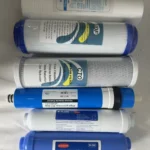
Common components in an RO system can include:
- Sediment/PP filter
- Activated carbon filter
- RO membrane
- Post-carbon filter
- Other treatment cartridges depending on the system
The correct replacement interval should follow the system manufacturer’s recommendations and actual water conditions.
For ongoing maintenance, homeowners can explore RO replacement filters and water purification spares or contact Pureflex for assistance in identifying the appropriate components.
Signs Your Borehole Water Purifier May Need Servicing
A purifier should not simply be installed and forgotten.
Pay attention to changes such as:
- Reduced water flow
- Unusual taste
- Unusual odour
- Increased scaling
- Water appearing cloudy
- Changes in system pressure
- A noticeable reduction in purified-water production
- Filters reaching their recommended replacement interval
Regular maintenance helps keep the system operating as intended.
How to Choose a Borehole Water Purifier for Your Kitchen
Before buying a system, consider these seven questions:
1. What does the borehole water test show?
This should be the starting point.
2. Is TDS high?
If so, RO may be more appropriate than UF.
3. Is the water primarily needed for drinking and cooking?
If yes, a point-of-use kitchen system may be sufficient.
4. How much cabinet space is available?
This can influence the choice between under-sink and countertop systems.
5. How many people use the kitchen?
Higher consumption may influence the appropriate system capacity.
6. Do you want the purifier hidden away?
If yes, an under-sink system can provide a cleaner installation.
7. Are replacement filters readily available?
This matters because purification is a continuing process, not a one-time purchase.
Best Borehole Water Purification Setup for a Kenyan Home
For homeowners specifically looking for a kitchen drinking-water solution, there are several sensible configurations.
Compact kitchen
Under-sink UF
Suitable where testing shows that UF meets the household’s treatment requirements.
High-TDS borehole water
Under-sink RO
A strong option where dissolved solids and related water-quality concerns make RO appropriate.
Limited cabinet space
Countertop RO
A practical alternative where an under-sink installation is inconvenient.
Higher household demand
Cabinet RO
Suitable where a larger or more substantial RO configuration is required.
The right system should always be matched to the source-water quality and household requirements.
Get the Right Borehole Water Purification System for Your Home
If you are in Nairobi, Kiambu, Ruiru, Juja, Thika, Syokimau, Kitengela, Kajiado or elsewhere in Kenya and use borehole water for drinking, the first question should not simply be, “Which water purifier should I buy?”
A better question is:
“What is actually in my borehole water, and which purification technology is appropriate for it?”
Once the water quality is understood, Pureflex can help you select a suitable under-sink RO, under-sink UF, countertop RO or cabinet RO system for your kitchen.
You can request a quote from Pureflex with details about your water source, location and purification requirements.
If you would rather discuss your requirements first, contact Pureflex for assistance.
For homeowners who want a discreet, convenient drinking-water solution, an under-sink system can be particularly attractive because the main equipment sits beneath the kitchen counter while purified water is available from a dedicated tap.
Conclusion
Learning how to purify borehole water at home starts with understanding the water itself.
Borehole water quality varies considerably across Kenya, so there is no universal purification system that is ideal for every household. Testing can identify important concerns such as TDS, hardness, iron, manganese, microbiological contamination and other parameters.
For kitchen drinking water, under-sink RO, under-sink UF, countertop RO and cabinet RO systems can provide different solutions depending on the results and the household’s needs.
For many homes, point-of-use purification is a practical way to obtain treated drinking and cooking water without having to install a drinking-water treatment system throughout the entire property.
The most important principle is simple:
Test the water first. Choose the purification technology second.
If you are ready to discuss your home’s borehole water requirements, talk to Pureflex or request a quotation.
Frequently Asked Questions
Is borehole water safe to drink in Kenya?
Not necessarily. Borehole water quality varies by location and source. Water should be tested before being treated as drinking water.
What is the best purifier for borehole water?
There is no single best system for every borehole. An under-sink RO system can be appropriate for water with high TDS or significant dissolved-solids concerns, while UF may be suitable for some water profiles where extensive dissolved-solids removal is not required.
Does RO remove TDS from borehole water?
Reverse osmosis is designed to reduce many dissolved substances and can substantially reduce TDS. Actual performance depends on the source water, membrane, system design and operating conditions.
Does UF remove TDS?
UF generally does not remove dissolved salts and minerals in the same way that RO does. If high TDS is the primary concern, water testing should be used to determine whether RO is more appropriate.
Can I install an RO system under my kitchen sink?
Yes. Under-sink RO systems are specifically designed for point-of-use installation beneath kitchen counters, with treated water delivered through a dedicated faucet.
Can I use borehole water with an under-sink UF system?
Potentially, but the decision should be based on the borehole-water test. UF is not a universal solution for every borehole-water problem.
Do I need to purify all the water in my house?
Not necessarily. If your primary requirement is treated water for drinking and cooking, a point-of-use system in the kitchen can be a practical approach. Whole-house treatment may be appropriate for different water-quality or household requirements.
How often should I replace RO filters?
Replacement frequency depends on the system, source-water quality and water consumption. Following the manufacturer’s maintenance schedule and monitoring changes in flow, taste and system performance is important.
Can borehole water be used for cooking?
It should meet appropriate drinking-water quality requirements before being used for cooking. If the water has not been tested or treated, homeowners should not assume that clear-looking borehole water is suitable.
How to Purify Borehole Water?
To purify borehole water, first test the water to identify issues such as high TDS, hardness, iron, manganese, sediment or microbiological contamination. The appropriate treatment may include sediment filtration, activated carbon, UF or reverse osmosis. For kitchen drinking water, an under-sink RO or UF system can provide point-of-use purification, depending on the water-quality results.
How to Purify Borehole Water at Home?
The most practical way to purify borehole water at home is to test the source water first and then select a treatment system based on the results. For drinking and cooking water, homeowners can consider under-sink RO, under-sink UF, countertop RO or cabinet RO systems. The right option depends on the contaminants present, TDS, household consumption and available kitchen space.
How to Purify Salty Borehole Water?
Salty borehole water generally requires a treatment method capable of reducing dissolved salts. Reverse osmosis (RO) is commonly used for this purpose because it can significantly reduce dissolved salts and other dissolved substances. The water should be tested first to determine the level of salinity and the appropriate RO system configuration.
How to Purify Salty Borehole Water at Home?
To purify salty borehole water at home, start with a water-quality test, particularly for TDS and dissolved salts. Where the results indicate that RO is appropriate, an under-sink RO system can provide purified water directly at the kitchen tap. A countertop or cabinet RO system may be preferable where under-sink space or household water demand makes another configuration more suitable.
How to Purify Borehole Water for Drinking?
To purify borehole water for drinking, test the water first and select treatment based on the contaminants identified. Depending on the results, treatment may involve sediment filtration, activated carbon, UF or RO. For a typical Kenyan kitchen, a properly selected under-sink RO or UF system can provide treated water directly from a dedicated drinking-water tap.
Where can I get a borehole water purifier in Kenya?
Pureflex provides home-focused purification options including under-sink RO, under-sink UF, countertop RO and cabinet RO systems, together with replacement filters and spares. You can contact Pureflex or request a quote based on your home’s water-quality and kitchen requirements.
Leave a Comment