
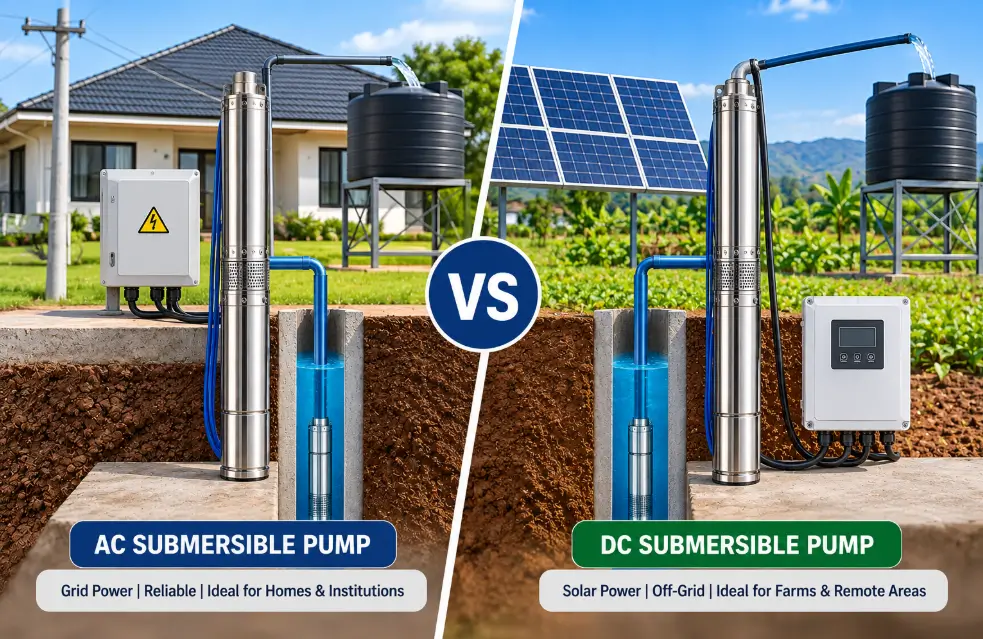
Choosing between a DC vs AC submersible pump can be confusing, especially when both options can pump water from boreholes and wells.
The main difference is the type of electrical power each pump uses. AC submersible pumps are generally suitable for properties with reliable mains electricity, while DC submersible pumps are especially useful for solar-powered and off-grid water systems.
However, the decision is not simply about choosing AC or DC.
Your borehole depth, required flow rate, total pumping head, available electricity, solar potential, installation budget and daily water demand all matter.
If you are trying to understand the difference between AC pump and DC pump, this guide compares both options and explains which may be more suitable for homes, farms, institutions and businesses in Kenya.
AC vs DC Submersible Pump at a Glance
| Feature | AC Submersible Pump | DC Submersible Pump |
|---|---|---|
| Power type | Alternating current | Direct current |
| Common power source | Kenya Power electricity or generator | Solar panels, batteries or another compatible DC source |
| Solar suitability | Usually requires an inverter or compatible controller | Naturally suited to many solar systems |
| Off-grid applications | Possible with the right power system | Particularly suitable |
| Grid-powered installations | Excellent option | May require additional DC equipment |
| Typical applications | Homes, schools, hospitals, businesses and boreholes | Solar boreholes, farms, irrigation, livestock and remote sites |
| Power availability | More consistent where grid electricity is reliable | Can vary depending on the DC source, especially solar |
| System design | Often straightforward where AC power is already available | Requires careful matching of the pump, panels and controller |
| Best choice | Sites with suitable AC electricity | Solar and off-grid applications |
This table provides a general comparison. Individual pump models can have very different performance characteristics, so always compare their flow rate, head, voltage and power requirements.
What Is the Difference Between AC Pump and DC Pump?
The fundamental difference between AC pump and DC pump is the type of electrical supply used to operate the motor.
An AC pump uses alternating current, while a DC pump uses direct current.
The practical difference becomes clearer when you consider the power available at your property.
AC pump
An AC pump may be suitable where the site has:
- Reliable Kenya Power electricity
- A suitable generator
- An appropriate AC electrical installation
- Existing AC pump controls and protection equipment
DC pump
A DC pump may be suitable where the site has:
- Solar panels
- A compatible battery system
- Another suitable DC power source
- No convenient connection to the electricity grid
This is why DC pumps are commonly considered for solar boreholes, irrigation systems and rural water projects in Kenya.
AC Pump vs DC Pump: Which Is Better?
There is no universal winner.
The better option depends on your power source, borehole conditions and water requirements.
Choose AC when:
- You already have reliable electricity from Kenya Power.
- The borehole requires a conventional electric pumping system.
- You need a pump for a home, school, hospital, business or institution.
- Your existing electrical installation is designed around AC equipment.
- You want to use a generator as a backup or primary power source.
Choose DC when:
- You want to use solar energy directly.
- The property is off-grid.
- Extending the electricity connection would be expensive or impractical.
- You are installing a solar borehole or irrigation system.
- The site is a remote farm, ranch or rural home.
- You want to reduce dependence on grid electricity.
The decision should therefore begin with the available power source, not simply the pump purchase price.
DC vs AC Submersible Pump for Solar Water Pumping
This is where the comparison becomes particularly important.
Solar panels produce DC electricity. A suitable DC solar pump can therefore be designed to operate from the DC output of a solar photovoltaic system.
With a conventional AC pump, solar electricity normally needs to pass through an inverter or compatible solar pump controller before it can operate the pump.
That does not mean AC pumps cannot be used with solar.
They can.
For example, Grundfos explains how solar inverter systems convert DC electricity from solar panels into AC power for conventional pumps.
The important distinction is:
DC pump + solar: The pump can be designed to operate from the DC side of the solar system.
AC pump + solar: Solar DC power is converted into AC through suitable equipment before reaching the pump.
Neither arrangement is automatically better. The overall system design, equipment quality and correct sizing determine the result.
Which Is More Efficient: AC or DC Pump?
It is tempting to say that DC pumps are always more efficient, but that is too broad.
Pump efficiency depends on the motor, pump hydraulics, operating point, controller, pipework and total system design.
In solar applications, DC brushless motors can be designed specifically for variable solar power conditions. LORENTZ describes its solar pumping systems as using DC brushless motors designed for solar applications.
However, the efficiency of the complete system matters more than the motor alone.
Consider the full pumping chain:
Solar panels → controller or inverter → motor → pump → pipes → storage tank
Energy losses can occur at several points.
Therefore, when comparing an AC pump vs DC pump for solar pumping, assess the complete system rather than assuming that one motor type will always use less energy.
AC vs DC Pump for Boreholes in Kenya
For borehole installations in Kenya, the choice between AC and DC should take into account the availability and reliability of electricity at the site.
AC borehole pump
An AC submersible pump may be suitable when the property already has reliable electricity from Kenya Power or a properly sized generator.
For example, a home in Nairobi, Kiambu, Nakuru, Mombasa or another area with a dependable electrical connection may find an AC borehole pump practical.
The same applies to schools, hospitals, apartments, hotels and businesses with an established electrical installation.
DC solar borehole pump
A DC solar submersible pump can be particularly useful for farms, rural homes, ranches and remote properties where grid electricity is unavailable or unreliable.
Solar panels can provide the energy required for pumping during daylight hours, while water can be stored in a tank for use in the evening or during periods of low sunlight.
AC Pump vs DC Pump for Irrigation
For agricultural irrigation, the choice depends heavily on the available energy source and the amount of water required.
A farm with reliable grid electricity may find an AC pump practical.
A remote farm without grid electricity may benefit from a DC solar pumping system.
However, irrigation requirements can be much higher than domestic water requirements. A pump that is suitable for a household may not provide enough water for drip irrigation, sprinklers or large-scale farming.
Before selecting a pump, establish:
- Required daily water volume
- Required flow rate
- Borehole or water-source depth
- Static and dynamic water levels
- Total pumping head
- Irrigation method
- Daily operating period
- Available solar energy
- Storage tank capacity
- Size of the irrigated area
A pump should deliver the required flow at the required head.
Choosing a pump simply because it has a higher wattage or horsepower can result in an unsuitable system.
AC vs DC Submersible Pump for Homes
For a residential borehole, either technology can work depending on the power available.
AC may be preferable when:
The home already has reliable electricity and the borehole pump can be connected to the electrical installation with the correct protection and controls.
DC may be preferable when:
The home has a solar installation or is located in an area where grid electricity is unavailable or unreliable.
A solar DC pump can fill an elevated water tank during the day, allowing stored water to be used for bathing, cleaning, toilets, laundry and other household needs.
For homes considering water treatment as well as pumping, PureFlex provides home water filtration solutions for Kenyan households.
AC Pump vs DC Pump Cost
The purchase price is important, but it should not be the only consideration.
When comparing AC pump vs DC pump, consider the cost of the complete system rather than the pump alone.
AC system costs may include:
- AC submersible pump
- Electrical cable
- Control panel
- Protection equipment
- Delivery pipe
- Installation
- Generator, where required
- Electricity consumption
DC solar system costs may include:
- DC submersible pump
- Solar panels
- Solar pump controller
- Solar mounting structure
- Pump cable
- Delivery pipe
- Protection equipment
- Installation
- Water storage tank
- Battery system, where required
A DC solar system can have a higher initial cost because the solar panels, mounting structure and controller form part of the installation.
However, the long-term operating cost depends on the energy source, system efficiency, maintenance and operating conditions.
For current options, compare PureFlex’s submersible water pump range with its guide to submersible water pump prices in Kenya.
AC vs DC Pump: Installation Considerations
The installation requirements differ because the electrical systems are different.
An AC installation needs:
- A suitable AC electrical supply
- Correctly sized wiring
- Appropriate circuit protection
- A suitable control panel
- Proper earthing
- Correct pump installation
A solar DC installation requires careful matching of the pump to the solar array and controller.
The solar system should be designed around:
- Pump voltage
- Pump current
- Solar panel voltage
- Solar panel output
- Controller specifications
- Cable size
- Borehole depth
- Water level
- Required water output
- Expected sunlight conditions at the site
For larger installations, professional system sizing is especially important.
AC vs DC Submersible Pump: Maintenance
Maintenance requirements depend on the specific pump and installation rather than AC or DC alone.
Both types can require attention to:
- Water quality
- Electrical connections
- Pump performance
- Cable condition
- Pipework
- Borehole conditions
- Dry-running protection
- Control equipment
- Storage tanks
- Non-return valves
Solar systems also require attention to the solar panels and associated electrical equipment.
Keeping solar panels reasonably clean can help maintain their ability to produce power. It is also important to check the mounting structure, cables, controller and protection equipment periodically.
For borehole systems in Kenya, regular inspection can help identify falling water levels, sand production, blocked pipes or reduced pump performance before they cause a major failure.
Can One Pump Use Both AC and DC?
Some specially designed pump systems can operate from both AC and DC power sources.
However, a conventional AC pump should not simply be connected to a DC source.
Likewise, a DC pump should not be connected directly to an AC supply unless the manufacturer’s specifications and required conversion equipment explicitly allow it.
Specialised AC/DC systems are available. For example, Grundfos describes SQFlex submersible pumps that can operate from AC or DC sources.
This type of system can be useful when solar power is the preferred energy source but another compatible power source is needed as a backup.
What About Hybrid AC/DC Solar Pumps?
A hybrid AC/DC pump provides another option between a conventional AC pump and a dedicated DC solar pump.
Depending on the specific product and system design, hybrid pumping can allow different power sources to be used.
For example, solar can be used as the primary source while AC electricity from Kenya Power or a generator provides an alternative when required.
This can be useful for installations where a reliable water supply is important even when solar conditions are less favourable.
PureFlex lists hybrid AC/DC Doyin pumps in several capacities, including 800W, 1,500W, 2,200W and 3,000W configurations.
You can compare the available Doyin solar pumping solutions when considering conventional AC, dedicated solar DC and hybrid systems.
DC vs AC Submersible Pump: Pros and Cons
AC Submersible Pump Advantages
- Suitable for reliable grid electricity
- Familiar technology for conventional electrical installations
- Available in many capacities and configurations
- Suitable for homes, schools, hospitals, hotels and businesses
- Can work with generators where appropriately designed
- May be practical where solar panels are not required
AC Submersible Pump Limitations
- Depends on an appropriate AC power source
- Power interruptions can affect pumping
- Solar operation may require an inverter or compatible controller
- Operating costs depend on electricity consumption and tariffs
- Generator operation can increase fuel and maintenance costs
DC Submersible Pump Advantages
- Well suited to solar pumping
- Useful for off-grid locations
- Can work directly with suitable DC power systems
- Suitable for rural irrigation and water-supply applications
- Can reduce dependence on Kenya Power electricity
- Useful for farms, ranches and remote homes
DC Submersible Pump Limitations
- Requires careful electrical matching
- Solar output varies during the day and across weather conditions
- Complete solar systems require additional components
- Pump performance must be matched to the available solar power
- Water storage may be needed to maintain supply when sunlight is limited
Which Pump Should You Choose?
Use this guide as a starting point:
| Your situation | Recommended direction |
|---|---|
| Reliable Kenya Power electricity | AC submersible pump |
| Remote property without grid power | DC solar submersible pump |
| Borehole with solar panels | DC solar pump or suitable solar pumping system |
| Farm with no grid connection | DC solar pump |
| Home with reliable mains electricity | AC submersible pump |
| Solar system with AC backup | Hybrid AC/DC solution may be worth considering |
| Large solar irrigation project | Compare complete AC, DC and hybrid system designs |
| Existing AC pump and solar upgrade | Consider a compatible solar inverter or drive |
| Rural water project with limited grid access | DC solar or hybrid pumping system |
These are general guidelines. The final choice should be based on the actual pump curve, borehole data, electrical specifications and water requirements.
DC vs AC Submersible Pump: The Bottom Line
So, DC vs AC submersible pump—which is better?
The answer depends on your power source and application.
An AC submersible pump is often a practical choice when reliable electricity from Kenya Power or a suitable generator is already available. It can be suitable for homes, schools, hospitals, apartments, hotels, businesses and other conventional borehole water systems.
A DC submersible pump can be particularly attractive for solar-powered and off-grid water systems. It can work well for farms, irrigation, livestock watering and remote boreholes where grid electricity is unavailable or unreliable.
For some installations, a hybrid AC/DC system may offer greater flexibility by allowing solar power and AC electricity to work as alternative energy sources.
The most important thing is to avoid choosing a pump based only on horsepower, wattage or purchase price. Start with the borehole depth, water level, required flow, total head and available energy source. Then select a pump and complete system that can reliably meet those requirements.
If you are still comparing options, explore PureFlex’s AC submersible pump range, DC submersible pump range and solar pumping solutions.
Frequently Asked Questions
What is the difference between an AC pump and a DC pump?
The primary difference is the type of electrical power they use. AC pumps operate using alternating current, while DC pumps operate using direct current. DC pumps are particularly suited to solar systems because solar panels produce DC electricity.
Is an AC or DC submersible pump better?
Neither is universally better. AC pumps can be suitable where reliable electricity from Kenya Power or a generator is available, while DC pumps are particularly useful for solar and off-grid applications.
Is a DC pump better for solar?
A suitable DC pump can be well suited to solar because photovoltaic panels produce DC electricity. However, the complete system must be correctly sized and matched to the borehole and daily water demand.
Can an AC pump run on solar?
Yes. An AC pump can be used in a solar water pumping system when a suitable solar inverter or compatible conversion equipment supplies the required AC power.
Can a DC pump run without solar?
Yes, if the pump is compatible with another suitable DC power source, such as a correctly specified battery system. The exact requirements depend on the pump.
Which is cheaper, AC or DC pumps?
There is no universal answer. Compare the cost of the complete system, including the pump, power source, controls, solar equipment where applicable, installation and ongoing energy costs.
Which pump is better for a borehole in Kenya?
It depends on the site’s power source and water requirements. An AC pump may suit a borehole with reliable Kenya Power electricity, while a DC solar pump can be suitable for an off-grid or solar-powered borehole.
Are hybrid AC/DC pumps available?
Yes. Hybrid AC/DC pumping systems are available and can provide flexibility where more than one compatible power source is required.
How do I choose between AC and DC for my borehole?
Start with the borehole depth, water level, required flow, total head, borehole diameter and available power source. Then compare suitable AC, DC or hybrid pumps based on their actual performance specifications.


Leave a Comment