
If you are comparing a 5 stage vs 7 stage reverse osmosis system, you may be wondering whether two extra filtration stages actually make a difference.
The short answer is: not necessarily.
A 7-stage reverse osmosis system is not automatically better than a 5-stage system simply because it has more stages. What matters is what each stage does, the quality of the RO membrane, the quality of your incoming water, and what you want the purified water to achieve.
For homeowners in Kenya dealing with tap water, borehole water, hard water, high TDS, salty water or unpleasant tastes and odours, understanding this difference can help you avoid paying more for filtration stages you may not actually need.
At PureFlex, we offer both 5-stage and 7-stage water purification options, giving you the flexibility to choose a system based on your water quality and purification requirements rather than simply choosing the system with the highest number of stages.
5 Stage vs 7 Stage Reverse Osmosis at a Glance
| Feature | 5-Stage RO System | 7-Stage RO System |
|---|---|---|
| Sediment filtration | Yes | Yes |
| Carbon filtration | Yes | Yes |
| RO membrane | Yes | Yes |
| Final polishing | Usually included | Usually included |
| Additional treatment | Depends on configuration | Often includes additional treatment |
| Purification capability | Excellent when properly configured | Excellent when properly configured |
| Complexity | Lower | Higher |
| Maintenance | Generally simpler | Generally more components to maintain |
| Best for | Straightforward drinking-water purification | Users wanting additional treatment or conditioning |
| Is it automatically better? | No | No |
What Does “Stage” Mean in an RO Water Purifier?
A stage is simply a separate treatment step through which the water passes.
A typical reverse osmosis system combines several types of filtration. Some stages remove sediment, others use activated carbon, while the RO membrane tackles dissolved contaminants that ordinary filters cannot effectively remove.
According to the U.S. Environmental Protection Agency, reverse osmosis uses pressure to force water through a semi-permeable membrane. The membrane allows treated water to pass while retaining many dissolved contaminants, producing a treated-water stream and a concentrated reject stream.
This is why the RO membrane is arguably the most important component in a household RO system.
Adding two extra stages after the membrane does not automatically mean the system removes twice as many contaminants.
How Does a 5-Stage Reverse Osmosis System Work?
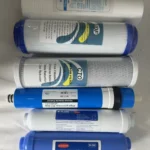
A conventional 5-stage RO system commonly combines:
Stage 1: Sediment Filter
The first filter removes suspended particles such as:
- Sand
- Dirt
- Rust
- Silt
- Other visible particles
This stage protects the finer filters and RO membrane from premature clogging.
This can be particularly important where water comes from a borehole or a supply with noticeable sediment.
If you are using borehole water in Kenya, it is also worth understanding the wider treatment requirements rather than assuming an RO system alone is always the complete solution. See our guide on how to purify borehole water at home.
Stage 2: Activated Carbon Filtration
Activated carbon helps reduce chlorine, unpleasant tastes, odours and certain organic contaminants.
Carbon pre-treatment is particularly important because the RO membrane needs appropriate protection from contaminants that could damage or foul it.
Stage 3: Carbon Filtration
A second carbon stage provides additional protection and polishing before water reaches the RO membrane.
The exact configuration varies between manufacturers, so consumers should check the actual specifications rather than assuming every 5-stage system uses identical cartridges.
Stage 4: Reverse Osmosis Membrane
This is the central purification stage.
Water is forced under pressure through the semi-permeable RO membrane. Many dissolved solids and other contaminants are rejected while purified water passes through.
RO can reduce a broad range of contaminants, including dissolved solids and various inorganic and organic contaminants.
This is also why RO is particularly useful for water with high TDS, excessive salts or certain dissolved contaminants.
If you want a deeper explanation, read our guide on how reverse osmosis purifies water.
Stage 5: Post-Carbon Filter
The final carbon filter is generally used to polish the treated water before it reaches the drinking-water tap.
It can improve taste and odour, making the finished water more pleasant to drink.
How Does a 7-Stage Reverse Osmosis System Work?
A 7-stage system normally starts with the same basic treatment philosophy but adds one or more treatment stages.
The additional stages can vary considerably from one manufacturer to another.
For example, a 7-stage system may incorporate:
- Additional carbon filtration
- Alkaline or remineralisation filtration
- UV treatment
- Additional polishing
- Other specialised treatment media
This is where consumers need to be careful.
There is no universal definition of what “7-stage” means.
Two systems advertised as 7-stage RO purifiers can contain completely different filtration technologies.
Therefore, when comparing a 5-stage and 7-stage RO system, don’t simply count the cartridges.
5 Stage vs 7 Stage Reverse Osmosis: What Is the Real Difference?
The biggest difference is usually the additional treatment provided after or around the core RO process.
The basic purification process can already be extremely effective with a properly designed 5-stage system.
A 7-stage system may add additional treatment intended to address taste, mineral content, microbial control or other specific preferences.
This means the better question isn’t:
“Is 7-stage better than 5-stage?”
Instead, ask:
“Which system is better suited to my water and what I want from my drinking water?”
That distinction can save you money and prevent you from buying a system simply because the number seven sounds better than five.
Does a 7-Stage RO System Purify Water Better Than a 5-Stage System?
Not automatically.
This is one of the most important things to understand when comparing 5-stage vs 7-stage reverse osmosis.
A well-designed 5-stage RO system can provide excellent purification because the RO membrane itself performs the primary dissolved-contaminant removal.
The EPA notes that RO can remove a wide range of contaminants and can be particularly useful for dissolved solids, salts and various inorganic and organic contaminants.
Meanwhile, additional stages may serve different purposes.
For example, a remineralisation filter does not necessarily make the RO membrane more effective at removing contaminants. Instead, it can change the characteristics of the treated water after RO.
Similarly, an additional carbon filter may primarily improve taste and odour.
Therefore:
More stages ≠ automatically cleaner water.
5 Stage vs 7 Stage RO: Which Is Better for Borehole Water in Kenya?
This is where the quality of your source water becomes extremely important.
Borehole water can vary dramatically from one location to another.
One borehole may have relatively low TDS and mainly require sediment and taste improvement. Another may have high hardness, iron, fluoride, salinity or other dissolved contaminants.
Consequently, there is no single RO configuration that is ideal for every borehole in Kenya.
Before purchasing a purifier, consider testing the water.
Our guide on how to test water quality at home explains some of the basic considerations, while a proper laboratory water analysis can provide much more useful information for designing a treatment system.
If your borehole water has high TDS, an RO system may be considerably more appropriate than a conventional carbon-only water filter.
You can also learn more about whether borehole water is safe for drinking.
What About High-TDS Water?
High TDS is one of the situations where reverse osmosis can be particularly useful.
TDS refers broadly to dissolved substances in water. Conventional sediment and carbon filters are not designed to remove dissolved minerals and salts in the same way that an RO membrane does.
The EPA identifies reverse osmosis as a treatment technology capable of removing dissolved solids and dissolved inorganic contaminants.
If your main problem is high TDS, don’t automatically assume that buying a 7-stage system will provide substantially better TDS reduction than a 5-stage system.
Instead, examine:
- The RO membrane specification
- The membrane capacity
- Feed-water pressure
- Incoming TDS
- Expected rejection rate
- The condition of the pre-filters
- The quality of the replacement filters
The membrane and overall system design matter far more than the number printed on the product description.
Does a 7-Stage RO System Add Minerals Back to Water?
Sometimes.
Some 7-stage systems include a remineralisation or alkaline stage after the RO membrane.
This is designed to add selected minerals back into the treated water or alter its mineral characteristics.
It is important to distinguish this from the purification process itself.
RO can remove minerals along with many unwanted dissolved substances. EPA guidance notes that RO can remove beneficial minerals such as calcium as well as contaminants.
A post-RO remineralisation stage therefore serves a different purpose from the RO membrane.
It is not accurate to say that adding a remineralisation stage makes the RO membrane itself more powerful.
5 Stage vs 7 Stage RO: Maintenance
Maintenance is another factor that is often overlooked.
Every filter cartridge eventually needs replacement.
A system with more treatment stages can potentially mean:
- More filter cartridges
- More replacement components
- More maintenance points
- More replacement costs over time
That doesn’t make a 7-stage system a bad choice.
It simply means that you should consider the total cost of ownership, not just the purchase price.
The EPA also stresses the importance of proper filter and membrane maintenance for point-of-use filtration systems.
For Kenyan households, this is particularly important because water conditions can vary considerably depending on whether the source is municipal water, a borehole, a well or another supply.
Does More Stages Mean More Water Waste?
Not necessarily.
Water waste is primarily influenced by the RO system’s design, membrane performance, operating pressure and recovery efficiency rather than simply whether a system has five or seven stages.
During RO treatment, some incoming water becomes reject water because contaminants retained by the membrane need to be discharged.
The EPA notes that conventional point-of-use RO systems can generate significant reject water, while more efficient WaterSense-labelled systems are designed to reduce water waste.
Therefore, when buying an RO system, ask about water recovery and reject-water ratio, rather than assuming that a 7-stage system is either more or less wasteful.
5 Stage vs 7 Stage Reverse Osmosis: Which One Should You Buy?
The best choice depends on your priorities.
Choose a 5-Stage RO System If:
A 5-stage system may be the better choice if you want:
- Effective drinking-water purification
- RO treatment without unnecessary complexity
- Lower initial cost
- Simpler maintenance
- Reduction of dissolved solids
- Better taste and odour
- A straightforward under-sink drinking-water solution
For many households, this is all they need.
At PureFlex, we offer a 5-stage reverse osmosis system for customers looking for a straightforward RO purification solution.
Choose a 7-Stage RO System If:
A 7-stage system may make more sense if you specifically want additional treatment beyond the core RO process.
For example, you may prefer a system with additional polishing, remineralisation, alkaline treatment or another specialised stage.
At PureFlex, we also offer a 7-stage under-sink water purifier for customers who want additional treatment stages.
The key is to examine what those seven stages actually are.
5 Stage vs 7 Stage RO for Kenyan Homes
For households in Nairobi and other parts of Kenya, the decision should begin with the water source rather than the number of stages.
Municipal Water
If you receive treated municipal water, your main concerns may be taste, odour, chlorine, dissolved solids and the condition of the water after distribution.
A properly configured 5-stage RO system may be sufficient for drinking water.
Borehole Water
Borehole water requires greater attention because its chemistry can vary significantly.
Depending on the location, you may encounter high TDS, hardness, iron, fluoride, salinity or other water-quality issues.
In this situation, water testing should guide the treatment design.
Salty or Brackish Water
If the water tastes noticeably salty or has elevated dissolved salts, RO can be particularly useful because the technology is designed to remove dissolved salts and other dissolved constituents.
Read our guide on how to purify salty water at home for more information.
5 Stage vs 7 Stage Reverse Osmosis: Cost Comparison
A 7-stage purifier will often cost more than a comparable 5-stage system because it contains additional treatment components.
However, purchase price should not be the only consideration.
Compare:
- Initial purchase price
- Replacement filter costs
- RO membrane replacement cost
- Maintenance frequency
- Water consumption
- Available spare parts
- Installation requirements
- Actual contaminant-removal capability
A cheaper system can become expensive if replacement filters are difficult to find or if the membrane requires frequent replacement.
Conversely, paying more for a 7-stage system may not provide meaningful additional value if the extra stages do not address a problem in your water.
For buyers comparing current RO options, you can also review our guide to reverse osmosis machine prices in Kenya.
Is a 7-Stage Water Purifier Worth the Extra Money?
It can be—but only when the additional stages provide something you actually need.
If the extra stages improve taste, add remineralisation, provide additional disinfection or address another specific requirement, the additional investment may be justified.
But if the only reason for choosing seven stages is that seven sounds better than five, you may be paying for features that don’t materially improve your drinking water.
The smarter approach is to compare the individual stages and their purpose.
5 Stage vs 7 Stage Reverse Osmosis: The Verdict
So, which is better: 5 stage or 7 stage reverse osmosis?
There is no universal winner.
A 5-stage RO system can be an excellent choice when you want effective reverse osmosis purification with a simpler configuration and potentially lower maintenance requirements.
A 7-stage RO system can be the better choice when its additional stages provide treatment or water conditioning that matches your specific needs.
The most important factor is therefore not the number of stages.
It is the quality and configuration of those stages.
For most buyers, the decision should follow this order:
Test your water → identify the problem → choose the appropriate RO membrane → compare filtration stages → consider maintenance and running costs → then compare prices.
That approach is far more reliable than choosing a purifier based solely on a “5-stage” or “7-stage” label.
If you are still unsure which system is appropriate for your home, start by understanding what reverse osmosis is and how it works, then compare your water-quality requirements with the available under-sink reverse osmosis systems.
For more information about drinking-water treatment in Kenya, you can also explore our water purification resources.
Frequently Asked Questions
Is 7-stage RO better than 5-stage RO?
Not automatically. The effectiveness of an RO system depends on the quality of its membrane, pre-filtration, operating conditions and the specific functions of its additional stages.
Does a 5-stage RO system remove TDS?
Yes. The RO membrane is designed to reduce many dissolved solids. The actual reduction depends on the membrane, feed-water quality, pressure and operating conditions.
Does a 7-stage RO system remove more contaminants?
Not necessarily. Additional stages may provide different forms of treatment rather than substantially increasing the contaminant rejection of the RO membrane.
Which RO system is better for borehole water in Kenya?
It depends on the borehole’s water chemistry. Water testing is recommended before selecting a treatment system because borehole water can vary significantly in TDS, hardness, iron, fluoride, salinity and other characteristics.
Is reverse osmosis suitable for salty water?
Yes. RO is widely used to reduce dissolved salts and can be used for brackish-water treatment and desalination.
Does RO remove minerals?
RO can reduce dissolved minerals along with other dissolved substances. Some systems subsequently use remineralisation stages to add selected minerals back to the treated water.
Does RO waste water?
Yes, conventional RO systems produce a reject-water stream. The amount varies by system design and operating conditions, so buyers should compare recovery efficiency rather than judging a system solely by its number of stages.
Final Recommendation
If you are choosing between 5 stage vs 7 stage reverse osmosis in Kenya, don’t buy based on the number of stages alone.
Choose a 5-stage system when you want reliable RO purification without unnecessary complexity.
Choose a 7-stage system when its additional filtration stages provide a specific benefit that matters to you.
And if you are treating borehole, salty or high-TDS water, test the water first. The results will tell you much more about the right purification system than the number of stages ever will.
At PureFlex, we help you choose water purification equipment based on your actual water-treatment needs—not simply the number of stages printed on the box.
Leave a Comment