
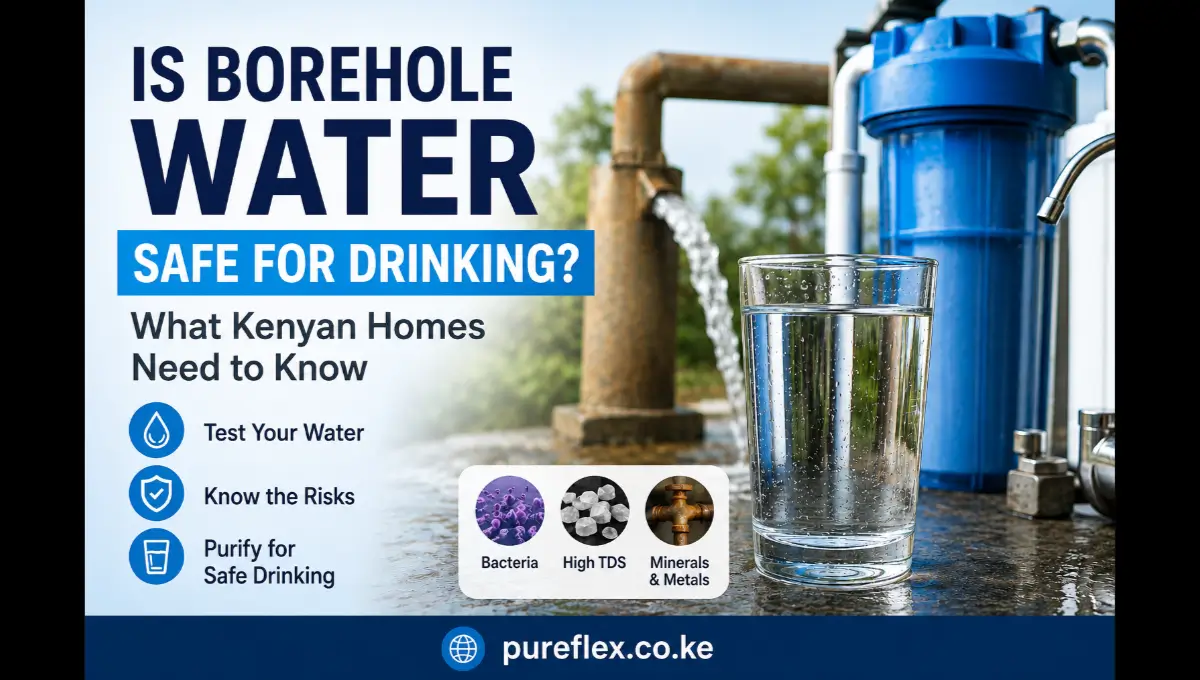
If your home in Kenya uses borehole water, you may have wondered: is borehole water safe for drinking?
The short answer is: it can be safe, but borehole water should not automatically be assumed to be safe for drinking simply because it comes from underground.
Groundwater can contain minerals, salts, metals, bacteria and other contaminants depending on the location of the borehole, the surrounding environment, the depth of the water source and the condition of the borehole itself. In some parts of Kenya, groundwater can also have elevated salinity or hardness.
For homeowners and tenants using borehole water in Nairobi, Kiambu, Thika, Machakos, Kajiado, Nakuru, Mombasa and other parts of Kenya, the safest approach is to test the water and use an appropriate purification system before drinking it.
Is Borehole Water Safe for Drinking?
Borehole water is not automatically safe for drinking.
A properly constructed and maintained borehole can provide good-quality groundwater, but the quality of that water depends on the characteristics of the aquifer and the conditions around the borehole.
Kenya’s water authorities recognise the importance of monitoring groundwater quality. The Ministry of Water, Sanitation and Irrigation includes groundwater quality assessment and monitoring among its water-resource management responsibilities.
This means that the fact that water looks clean, clear and fresh does not provide enough evidence that it is suitable for drinking.
Some contaminants cannot be seen, smelled or tasted.
That is why water testing should come before choosing a water purifier.
Why Borehole Water May Not Be Safe to Drink
Borehole water can be affected by several different types of contamination.
1. Bacteria and other microorganisms
Groundwater can become contaminated by microorganisms, particularly where there are sanitation problems, leaking septic systems, poorly protected boreholes or other sources of contamination close to the water source.
Microbiological contamination is particularly important because contaminated water can appear completely normal.
Kenya’s drinking-water guidance places importance on microbiological parameters, including E. coli, with the guideline indicating that E. coli should not be detected in drinking water.
For a household using borehole water, this is one of the reasons relying on appearance alone is not sufficient.
2. High levels of salts and dissolved minerals
Some boreholes produce water with relatively high levels of dissolved minerals.
This can be particularly noticeable in areas where groundwater is naturally mineralised or saline. Kenya’s national water-quality documentation notes that groundwater quality varies considerably and that some drier areas have groundwater that tends to be saline.
High dissolved solids can affect:
- Taste
- Odour
- Water hardness
- Cooking
- Household appliances
- Drinking-water quality
If your borehole water tastes salty, has a strong mineral taste or leaves significant deposits on kettles and plumbing fixtures, testing is advisable before using it as your primary drinking water.
For households dealing specifically with salty groundwater, see this guide on how to purify salty water at home.
3. Hard water
Borehole water can also contain elevated levels of calcium and magnesium.
Hard water is not necessarily the same thing as unsafe water, but it can create practical problems in a home.
You may notice:
- White deposits on taps
- Scaling inside kettles
- Reduced efficiency of water heaters
- Soap that does not lather easily
- Deposits around sinks and showers
The appropriate treatment depends on the actual water chemistry. A water test can determine whether hardness is a concern and what treatment is appropriate.
4. Iron and manganese
Some borehole water contains elevated iron or manganese.
This can cause:
- Yellow, brown or black staining
- Metallic taste
- Unpleasant appearance
- Deposits in plumbing
- Problems with laundry
A purifier should therefore be selected based on the contaminants actually present rather than simply choosing the most expensive filtration system.
5. Nitrates and other chemical contaminants
Depending on the surrounding environment, groundwater can be affected by agricultural activities, sanitation systems, industrial activities and other sources.
The location of a borehole therefore matters.
Kenya’s groundwater regulations include provisions intended to protect groundwater resources from activities that could negatively affect groundwater quality.
Can You Drink Borehole Water Without Filtering It?
It is better not to assume that untreated borehole water is suitable for drinking.
If the water has been professionally tested and meets applicable drinking-water requirements, it may be suitable for consumption. However, if the water has never been tested, there is no reliable way to know its quality merely by looking at it.
A clear glass of borehole water can still contain contaminants that cannot be detected visually.
For Kenyan households, a sensible approach is:
Test → identify contaminants → choose treatment → maintain the system → retest when necessary.
This is more reliable than buying a purifier based only on the source of the water.
What Should You Test in Borehole Water?
A comprehensive borehole water test should consider both microbiological and chemical characteristics.
Depending on the situation, relevant parameters may include:
- E. coli
- Total coliforms
- pH
- TDS
- Electrical conductivity
- Turbidity
- Hardness
- Iron
- Manganese
- Nitrates
- Chlorides
- Sulphates
- Fluoride
- Salinity
- Other parameters recommended by the testing laboratory
The exact tests required can depend on the location and intended use of the water.
Kenya’s Ministry of Health provides services that include food and water sampling for analysis, while the Ministry also maintains public-health laboratory services.
For regulatory information, homeowners can also consult the WASREB Drinking Water Quality Guidelines.
What Is the Best Way to Purify Borehole Water at Home?
There is no single purifier that is automatically best for every borehole.
The correct system depends on the water-quality results.
For example, a household may need different treatment where the main issue is bacteria compared with a household dealing with high TDS, salinity, hardness, iron or other dissolved contaminants.
However, reverse osmosis (RO) is an important option for households that need to reduce many dissolved contaminants from drinking water.
Reverse osmosis works by forcing water through a semi-permeable membrane that allows water molecules to pass while rejecting a significant portion of dissolved substances.
For a more detailed explanation, see how reverse osmosis purifies water and what is reverse osmosis.
Is Reverse Osmosis Good for Borehole Water?
It can be, particularly where borehole water contains elevated dissolved solids, salts or other contaminants that an RO membrane is designed to reduce.
However, an RO system should not be viewed as a substitute for proper water testing.
Borehole water with excessive sediment, iron, manganese or other characteristics may require appropriate pre-treatment before reaching the RO membrane.
This is why a professionally selected system can perform better than simply installing a generic RO purifier.
For households looking for a drinking-water solution installed at the kitchen sink, a home drinking water filtration system can provide a convenient point-of-use approach.
Another option is a kitchen water purifier designed specifically for drinking and cooking water.
What About a 5-Stage RO System?
A 5-stage reverse osmosis system is a popular type of household drinking-water purifier.
A typical system may combine several stages of filtration with an RO membrane and post-filtration to improve the quality and taste of the treated water.
However, the number of stages alone does not determine whether a system is appropriate for your borehole.
For example, a five-stage system may be suitable for one household but require additional pre-treatment in another household where the source water has specific problems.
Homeowners interested in this option can view the 5-stage reverse osmosis system.
What Is the Best Borehole Water Purifier for a Home in Kenya?
The best borehole water purifier is the one matched to the actual quality of your borehole water.
For many homes, the ideal setup is not necessarily a large treatment plant for the entire house.
Instead, a point-of-use drinking-water purifier can be installed under the kitchen sink to provide treated water for:
- Drinking
- Cooking
- Making tea and coffee
- Washing fruits and vegetables
- Preparing food
An under-sink RO system can be particularly convenient because it treats the water at the point where drinking water is needed without requiring every outlet in the house to pass through the RO membrane.
PureFlex has a guide comparing options for the [best under-sink reverse osmosis system in Kenya] best under-sink reverse osmosis system in Kenya.
Do You Need to Purify Borehole Water if It Looks Clean?
Yes, testing is still recommended.
Appearance is not a reliable indicator of drinking-water safety.
Water can be:
- Crystal clear but microbiologically contaminated
- Clear but high in dissolved salts
- Clear but excessively hard
- Clear but contain elevated concentrations of certain minerals
Similarly, unpleasant taste or visible staining can indicate a water-quality problem, but the absence of these signs does not prove that the water is safe.
The safest decision is therefore based on water analysis rather than appearance.
What If You Are Renting a House With Borehole Water?
Tenants face a slightly different situation.
If you have moved into an apartment, maisonette or rental house supplied by a borehole, it may not be obvious when the borehole was drilled, whether it has been maintained properly or when the water was last tested.
Ask the landlord, property manager or management company:
- Is the property supplied by a borehole?
- When was the water last tested?
- Is there a recent water-quality report?
- What treatment system is installed?
- When were the filters last replaced?
- Is the water used for drinking and cooking?
If there is no recent water-quality information, consider having the drinking water tested.
Tenants do not necessarily need to install a whole-house treatment system. A point-of-use purifier under the kitchen sink may be a practical option where the primary concern is drinking and cooking water.
How Often Should Borehole Water Be Tested?
The appropriate testing frequency depends on the source, local conditions, treatment system and any changes affecting the borehole.
Testing becomes especially important when:
- A new borehole has been installed
- There has been flooding
- A nearby septic system has failed
- The borehole has undergone repairs
- The water suddenly changes colour or taste
- There is a noticeable change in TDS or salinity
- A household member becomes concerned about water quality
- A filtration system has been changed
- There has been a significant change in the surrounding land use
Regular monitoring is consistent with Kenya’s broader water-safety approach, which emphasises identifying risks, monitoring water quality and putting appropriate control measures in place.
Borehole Water vs Tap Water: Which Is Safer?
Neither source should automatically be considered safe simply because of where it comes from.
Municipal water is generally subject to treatment and water-quality monitoring by the relevant water service provider, while private borehole owners are responsible for understanding and managing the quality of their own source.
WASREB states that water quality is an important indicator of water-service quality and has a mandate to establish and monitor standards for water services in Kenya.
With private borehole water, the homeowner has an additional responsibility: know what is in the water and treat it appropriately.
How to Know Which Purifier Your Borehole Needs
Before purchasing a purifier, start with a water-quality test.
Once the results are available, the treatment approach can be selected according to the problem.
For example:
| Borehole water concern | Possible treatment approach |
|---|---|
| Sediment or suspended particles | Sediment filtration |
| Unpleasant taste or odour | Activated carbon filtration |
| Bacteria | Appropriate disinfection/filtration |
| Hardness | Water softening where appropriate |
| Iron or manganese | Appropriate iron/manganese treatment |
| High TDS | Reverse osmosis may be appropriate |
| Salinity | Reverse osmosis or specialised desalination |
| Multiple dissolved contaminants | Treatment designed around laboratory results |
This is why buying a purifier first and testing the water later is not always the best approach.
Can PureFlex Help With Borehole Water Purification in Kenya?
Yes. PureFlex Water Solutions focuses on household water purification solutions for homes in Kenya, including reverse osmosis and drinking-water filtration systems.
Homeowners can learn more about PureFlex Water Solutions or explore available PureFlex water purification products.
If you already have a borehole water test, the results can help determine which purification approach is appropriate for your home.
For households that are unsure where to start, request a water purification quote or contact PureFlex Water Solutions for guidance.
Final Answer: Is Borehole Water Safe for Drinking?
Borehole water can be safe for drinking, but it should not be assumed to be safe without testing.
The quality of borehole water in Kenya varies from one location to another. Some households may have relatively clean groundwater, while others may experience high hardness, salinity, dissolved minerals, iron, manganese or microbiological contamination.
The most reliable approach is:
1. Test the borehole water.
2. Identify the contaminants or water-quality problems.
3. Choose a purification system designed for those conditions.
4. Maintain the purifier and replace filters as recommended.
5. Retest the water when circumstances change or when appropriate.
If your borehole water has never been tested, that should be the first step before deciding which purifier to buy.
For homeowners and tenants who want to understand the treatment process in greater detail, this guide explains how to purify borehole water at home.
And if the main concern is salty or highly mineralized borehole water, PureFlex also explains why drinking salt water can be harmful and discusses salt-water purifier machine options and price in Kenya.
Leave a Comment