
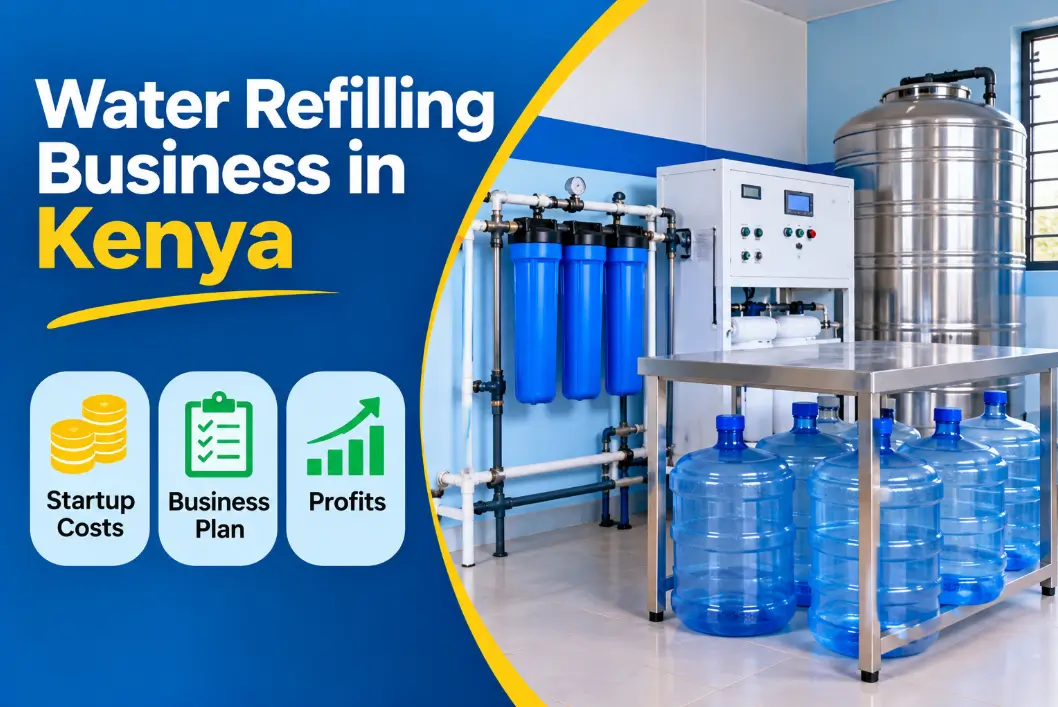
Starting a water refilling business in Kenya does not always require hundreds of thousands of shillings. A small neighbourhood shop can begin with a basic water purification system, a storage tank, a packing table and a suitable business premises.
The amount you need depends mainly on your water source, the purification system, the size of your shop and the number of customers you expect to serve.
For example, an entrepreneur using treated municipal water may only need a simple purification system. Someone using salty borehole water will need more advanced treatment, such as reverse osmosis.
This guide explains the water refilling business in Kenya, including realistic startup costs, business planning, equipment choices and the capital required for different types of operations.
1. Is a Water Refilling Business Profitable in Kenya?
Yes. A water refilling business can generate income by supplying purified drinking water to households, offices, shops and other customers.
The business works particularly well in residential neighbourhoods where people regularly buy drinking water but do not have convenient access to affordable refill stations.
However, profitability depends on more than the selling price. You must consider:
- The number of customers who buy water every day.
- The cost of municipal water or other water sources.
- Electricity consumption.
- Rent and staff expenses.
- Filter replacement and equipment maintenance.
- Competition and customer retention.
A small shop does not need to serve thousands of customers from the beginning. It can start with a manageable production capacity and expand as demand increases.
2. How Much Capital Do You Need to Start a Water Refilling Business in Kenya?
A basic neighbourhood refill shop can start with approximately KSh 100,000–125,000, depending on the equipment and premises.
A larger RO-based station requires more capital. A commercial plant with bottling equipment may require KSh 1 million or more.
The important thing is to avoid buying equipment that is larger or more expensive than your market requires.
Example A: Basic neighbourhood water refill shop
This model suits an entrepreneur who wants to serve nearby households using treated municipal water.
The business can start with a basic purification unit, one storage tank and a simple packing area.
| Item | Estimated cost (KSh) |
|---|---|
| Basic municipal water purifier | 40,000 |
| Water storage tank | 30,000 |
| Packing table | 20,000 |
| First month’s rent | 10,000 |
| Basic plumbing, taps and fittings | 17,000 |
| Initial filters and cleaning materials | 5,000 |
| Initial water testing allowance | 5,000 |
| Basic signage and opening materials | 3,000 |
| Provisional permit and compliance allowance | 20,000 |
| Estimated starting budget | 150,000 |
This is a lean startup example, not a fixed supplier quotation. The permit allowance must be confirmed with the relevant county and health authorities. The entrepreneur should also confirm that the selected purifier is suitable for the water quality and expected daily sales.
The business can begin with a simple refill arrangement. It does not need an automatic filling line, stainless steel tanks or a large commercial RO plant.
Example B: Small RO water refilling shop
This model suits an entrepreneur whose source water requires reverse osmosis treatment.
RO is particularly useful where water contains high levels of dissolved salts or other contaminants that ordinary filtration cannot adequately remove.
The cost will depend on the RO system’s capacity, pretreatment requirements and the storage and dispensing equipment included.
A small RO-based shop may require approximately KSh 300,000–450,000 or more. This is a planning range, not a guaranteed market price. Some systems may cost less or more depending on their specifications.
Example C: Medium commercial refill station
A medium station targets higher daily demand. It may serve households, offices, shops and customers who purchase larger quantities.
It may require:
- A higher-capacity commercial purification system.
- Separate raw-water and treated-water storage.
- Multiple filling points.
- Better drainage and plumbing.
- Dedicated bottle washing and handling facilities.
- More working capital.
A reasonable planning range is approximately KSh 350,000–700,000, depending on the equipment and premises.
Example D: Water refilling and small bottling plant
A bottling operation is different from a simple refill shop. It requires additional equipment and stricter attention to hygiene, packaging and applicable product standards.
The setup may include:
- Commercial RO or other suitable treatment equipment.
- Bottle rinsing equipment.
- Bottle filling equipment.
- Capping and sealing equipment.
- Labelling equipment.
- Packaging materials.
- Larger storage facilities.
A setup of this nature can require KSh 1 million or more. The final cost depends on production capacity and the level of automation.
Startup capital comparison
| Business model | Indicative starting capital |
|---|---|
| Basic neighbourhood refill shop | KSh 150,000–225,000 |
| Small RO-based refill shop | KSh 300,000–450,000+ |
| Medium commercial refill station | KSh 350,000–700,000+ |
| Small bottling operation | KSh 1,000,000+ |
3. How Much Does Shop Rent Cost in Different Kenyan Counties?
Rent depends on the neighbourhood, shop size, visibility and proximity to customers. A shop in a busy commercial centre will usually cost more than a small premises inside a residential estate.
For a basic refill shop, the entrepreneur should consider affordable neighbourhood premises rather than expensive town-centre locations.
The following figures are illustrative monthly rent allowances for small shops. They are not official county averages.
| Location | Indicative monthly rent |
|---|---|
| Nairobi | KSh 10,000–45,000 |
| Mombasa | KSh 8,000–30,000 |
| Nakuru | KSh 7,000–28,000 |
| Kisumu | KSh 7,000–28,000 |
| Other growing towns | KSh 5,000–25,000 |
These figures are planning assumptions. Actual rent can fall outside these ranges.
4. Equipment Needed for a Small Water Refilling Business
The equipment you need depends on the water source and the type of business you intend to operate.
A simple municipal-water refill shop does not need the same equipment as a borehole-water RO plant.
Basic equipment for a neighbourhood refill shop
| Equipment | Purpose |
|---|---|
| Municipal water purifier | Improves water quality based on the treatment design |
| Storage tank | Stores treated water before dispensing |
| Packing table | Provides a clean working surface |
| Filling taps and fittings | Allow customers to refill containers |
| Plumbing connections | Connect the water source, purifier and tank |
| Cleaning materials | Support routine hygiene |
Additional equipment for an RO station
Where water analysis indicates that reverse osmosis is necessary, the business may require:
- Commercial RO system.
- Sediment prefilters.
- Activated carbon filtration.
- High-pressure pump, where required by the system design.
- RO membrane and pressure vessel.
- Treated-water storage.
- Suitable dispensing equipment.
You can learn more about how reverse osmosis purifies water before selecting a system.
The price of reverse osmosis machines in Kenya varies according to capacity, configuration and included components.
5. Choose Your Purification System Based on the Water Source
This is one of the most important decisions when planning a water refilling business.
Do not purchase a purification machine simply because it is advertised as suitable for a refill station. First, establish the quality of the source water.
Municipal water
Municipal water is generally treated before distribution. However, its quality can vary depending on the supply network, storage tanks and local conditions.
A suitable filtration and disinfection arrangement may be sufficient for some sources. The exact treatment must follow water testing.
Borehole water
Borehole water can contain dissolved minerals, iron, manganese, fluoride, salinity and other contaminants.
A water analysis helps determine whether the business needs sediment filtration, activated carbon, iron removal, softening, reverse osmosis or additional treatment.
For example, a borehole with high salinity may require RO treatment. A basic sediment filter alone will not remove dissolved salts.
Water from storage tanks
Water stored in underground or rooftop tanks may collect sediments and other contaminants.
The business should inspect and clean its storage tanks regularly. It should also assess whether additional filtration or disinfection is necessary.
For guidance, read how to test water quality at home.
6. How to Prepare a Water Refilling Business Plan
A business plan helps you understand your target customers, investment requirements and expected income.
It does not need to be complicated. A small refill shop can begin with a simple plan covering the following areas.
Step 1: Identify your target customers
Your customers may include:
- Households.
- Small offices.
- Retail shops.
- Restaurants.
- Salons and barbershops.
- Schools and other institutions.
Start by identifying how many potential customers live or operate near your proposed premises.
Step 2: Study the competition
Visit nearby refill stations and compare their prices, operating hours, cleanliness and customer service.
Find out what customers like and what they would like improved.
Step 3: Select your equipment
Use the source-water test results to select the correct treatment system.
Do not spend money on RO if the water does not require it. Equally, do not install a basic purifier where the water needs more advanced treatment.
Step 4: Prepare your budget
Include equipment, rent, plumbing, storage, permits, testing and initial operating expenses.
Start with equipment that meets your expected demand. You can add more storage or production capacity as sales increase.
Step 5: Set your selling prices
Compare prices charged by nearby refill shops.
Your selling price should cover water, electricity, rent, labour, maintenance, packaging and other operating costs.
Step 6: Plan your daily operations
Set procedures for cleaning containers, handling customer bottles, dispensing water, cleaning equipment and recording sales.
Good hygiene and consistent water quality help build customer confidence.
7. How Much Can a Small Water Refilling Shop Make?
Income depends on daily sales volume and the price charged per litre.
Consider this simple example.
A shop sells 300 litres per day at KSh 5 per litre.
| Item | Amount |
|---|---|
| Daily sales volume | 300 litres |
| Selling price per litre | KSh 5 |
| Daily revenue | KSh 1,500 |
| Monthly revenue (30 days) | KSh 45,000 |
This is revenue, not profit.
The owner must deduct rent, electricity, water, filter replacement, cleaning materials, labour and other expenses.
A shop with low rent and owner-operated staffing may have lower monthly expenses than a larger station employing several people.
The most important target is to build a consistent customer base while controlling operating costs.
8. How to Reduce the Cost of Starting a Water Refilling Business
A limited budget does not mean that you cannot enter the water business. However, you need to prioritise the right investments.
Consider these practical measures:
- Start with municipal water where suitable. It may require less treatment than some borehole sources.
- Choose a small neighbourhood shop. Avoid expensive commercial premises when starting.
- Buy equipment based on water analysis. Do not pay for treatment stages that the water does not need.
- Start with one storage tank. Add more storage when sales increase.
- Use a simple filling arrangement. Automatic filling equipment is not essential for every small refill shop.
- Operate the business yourself initially. This can reduce salary expenses.
- Expand gradually. Reinvest profits into additional equipment and storage.
The aim is to establish a safe, reliable and affordable operation before investing in a larger plant.
9. Licences and Compliance Requirements
Water refilling businesses must meet the applicable business, public health and water-quality requirements.
The exact requirements depend on the business model, the products sold and the county in which the business operates.
Before opening, confirm the applicable requirements with the relevant county government and public health office.
You may need to consider:
- Business registration through the Business Registration Service.
- The relevant county business permit.
- Public health and food hygiene requirements.
- Water quality testing.
- Applicable KEBS requirements for the specific water product and packaging model.
The Ministry of Health food hygiene licensing checklist provides guidance on food premises hygiene requirements.
Do not assume that a refill-only shop and a bottled-water production plant have identical compliance requirements. Confirm the rules that apply to your particular operation before investing.
10. How Pureflex Supports Water Refilling Business Startups
Starting a refill business involves more than purchasing a purification machine. The equipment must match the source water, expected daily production and available premises.
Pureflex Water Solutions supports entrepreneurs with:
- Water purification equipment supply.
- Water treatment system selection.
- Water quality assessment and treatment recommendations.
- Equipment installation and plumbing.
- Refill station setup.
- Shop layout and branding.
- Technical guidance and maintenance support.
Whether the plan involves a simple municipal-water purifier or a commercial RO station, the system can be selected according to the available capital and expected demand.
A small business should not be forced into an expensive setup when a simpler treatment arrangement can meet its needs.
Frequently Asked Questions
How much money do I need to start a water refilling business in Kenya?
A basic neighbourhood refill shop may start with approximately KSh 130,000–225,000. A small RO-based station may require KSh 300,000–450,000 or more. Larger commercial and bottling operations require higher investment.
Can I start a water refilling business with KSh 150,000?
Yes, it may be possible with a very lean setup, affordable premises and a suitable low-cost purifier. However, you must account for water testing, applicable permits, plumbing and initial operating expenses.
Can I use municipal water for a refill business?
Yes, provided the source water is suitable and the treatment system produces water that meets the applicable drinking-water requirements. Test the water before selecting the purification equipment.
Do I need an RO machine for a water refilling business?
No. Not every water source requires reverse osmosis. Municipal water may need a simpler treatment arrangement, while salty or high-TDS borehole water may require RO.
Can I start a water refilling business from a small shop?
Yes. A small, clean and well-organised shop can serve a neighbourhood market. The important considerations are suitable water treatment, hygiene, drainage, storage and customer access.
Is KSh 1 million enough to start a water bottling business?
It may be enough for a small operation, depending on the production capacity and equipment. However, a bottling setup needs more than a water purifier. You must budget for bottle rinsing, filling, capping, labelling, packaging, quality control and applicable compliance requirements.
Conclusion
The cost of starting a water refilling business in Kenya depends on the type of operation. A simple neighbourhood refill shop does not need the same investment as a commercial RO plant or bottling factory.
An entrepreneur can begin with a basic municipal-water purification setup and expand as demand grows. The most important decisions are choosing the right treatment system, controlling rent and operating expenses, maintaining hygiene and meeting applicable water-quality requirements.
With proper planning, a small refill shop can become the foundation for a larger water purification business.
Leave a Comment