
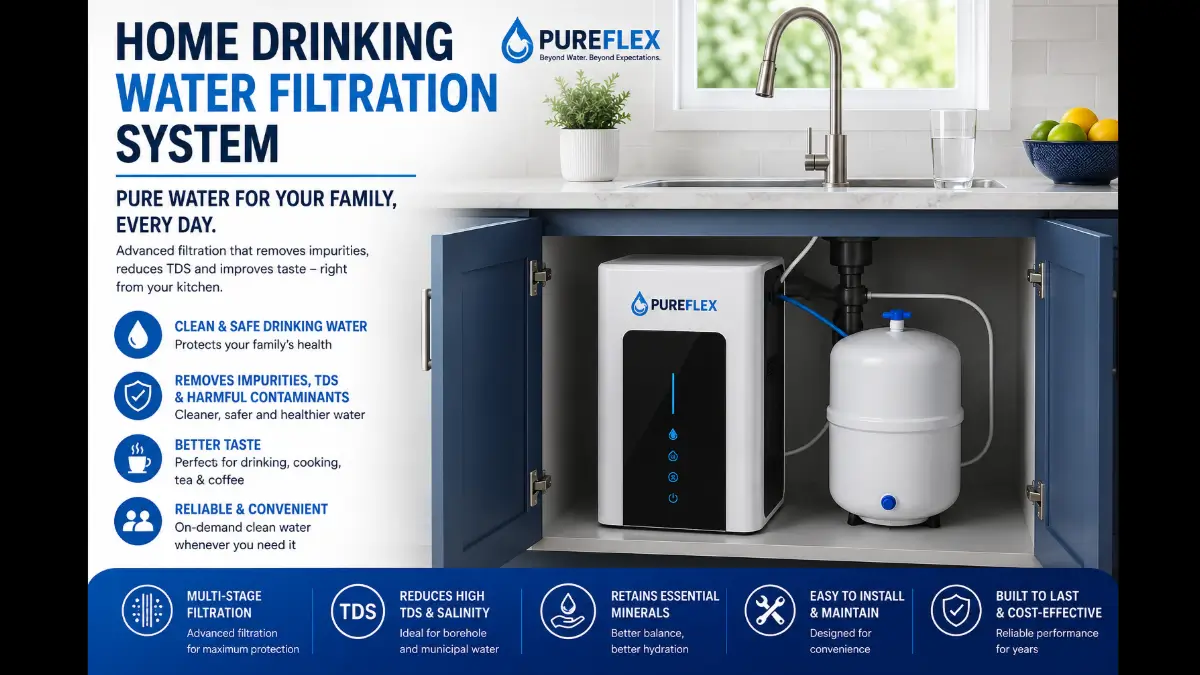
A home drinking water filtration system can give your family convenient access to treated water without requiring every litre entering the house to be purified.
For many Kenyan households, that means installing a filtration system at the kitchen point of use, where water is needed most for drinking, cooking, tea, coffee and filling reusable bottles.
The right system depends on your water source and its quality. A home in Ruiru using borehole water may have different requirements from an apartment in Westlands using municipal water, or a coastal home in Mombasa dealing with higher mineral content.
Kenya’s Water Services Regulatory Board (WASREB) notes that potable water should meet requirements relating to microbiological safety, chemicals, turbidity, salinity, taste and odour.
What Is a Home Drinking Water Filtration System?
A home drinking water filtration system is designed to treat water intended for consumption at a convenient point in the home, usually the kitchen.
Instead of treating water used for toilets, cleaning, gardening and other household purposes to drinking-water standards, a point-of-use system concentrates treatment where it matters most.
A typical setup is:
Source water → filtration → purification → dedicated drinking-water tap
For Kenyan kitchens, the most relevant options include:
- Under-sink RO systems
- Under-sink UF systems
- Countertop RO systems
- Cabinet RO systems
Pureflex provides kitchen water purification solutions for Kenyan homes, with options designed around different water-quality and kitchen requirements.
Why Do Kenyan Homes Need Drinking Water Filtration?
Water quality can vary considerably according to the source, location and storage conditions.
A household in Nairobi receiving municipal water may have different concerns from a home using borehole water in Kiambu, Kajiado or Machakos.
Homeowners may notice:
- High TDS
- Salty or mineral taste
- Hard water
- Sediment
- Unpleasant taste or odour
- Scale around taps and kettles
- Concerns about water stored in tanks
- Uncertainty about borehole-water quality
Importantly, water that looks clear is not necessarily water that meets drinking-water requirements.
This is why water testing is useful before selecting a purification system.
What Is the Best Home Drinking Water Filtration System in Kenya?
There is no single system that is best for every home.
The right choice depends on:
- Your water source
- Water-quality results
- TDS and dissolved mineral content
- Household consumption
- Available kitchen space
- Installation preferences
- Long-term filter and maintenance requirements
For many Kenyan homes, the decision comes down to choosing between RO, UF and different installation formats.
Under-Sink RO Systems
An under-sink reverse osmosis system is installed beneath the kitchen counter and supplies treated water through a dedicated faucet.
It can be particularly useful where testing identifies:
- High TDS
- Salinity
- Significant dissolved mineral content
- Hardness-related concerns
- Unwanted taste associated with dissolved substances
Point-of-use RO is a well-established approach to treating water at a single fixture. The U.S. Environmental Protection Agency describes point-of-use RO systems as treatment systems connected to a single fixture, such as a kitchen sink.
For homeowners considering this configuration, Pureflex’s guide to the best under-sink reverse osmosis systems in Kenya provides more detail on what to consider.
Under-Sink UF Systems
Ultrafiltration is another option for point-of-use drinking-water treatment.
UF uses a membrane with very small pores and can provide fine filtration, but it does not perform the same dissolved-solids reduction as RO.
That distinction matters.
If your primary concern is high TDS or salty borehole water, RO may be more appropriate. Where substantial dissolved-solids reduction is not required, UF may be a suitable option depending on the water-quality results.
The best choice should therefore be based on the water rather than simply choosing the technology with the most filtration stages.
Countertop RO Systems
A countertop RO system provides another option for homes where an under-sink installation is inconvenient.
It may suit:
- Apartments
- Rental homes
- Smaller kitchens
- Kitchens with limited cabinet space
- Homeowners who prefer a visible, accessible system
Countertop systems can provide purified drinking water without requiring the main equipment to be installed inside the kitchen cabinet.
If you are comparing different kitchen configurations, see Pureflex’s kitchen water purifier solutions.
Cabinet RO Systems
Cabinet RO systems can make sense where a household requires a larger or more substantial purification setup.
They may be suitable for:
- Larger families
- Higher drinking-water demand
- Homes with sufficient installation space
- Dedicated kitchen or utility areas
The important consideration is not simply capacity. The system should be appropriately matched to the household’s water demand and source-water quality.
RO vs UF: Which Is Better for Drinking Water?
RO and UF serve different purposes.
| Water concern | RO | UF |
|---|---|---|
| Sediment | Yes, with pre-filtration | Yes |
| Fine filtration | Yes | Yes |
| High TDS | Suitable | Generally limited |
| Dissolved salts | Reduces many | Generally limited |
| Salty borehole water | Often preferred | Generally not the first choice |
| Point-of-use kitchen use | Yes | Yes |
| Retains more dissolved minerals | Less | More |
If you want to understand exactly how RO achieves dissolved-solids reduction, read how reverse osmosis helps to purify water.
What If Your Home Uses Borehole Water?
Borehole water deserves particular attention because groundwater quality can vary considerably between properties.
For example, a borehole in Ruiru or Juja may have a different water profile from one in Kitengela, Ngong or Athi River.
The same applies across counties.
Households in Ruiru, Juja and Thika may encounter different water conditions from properties elsewhere in the county.
In Kajiado County, homes around Kitengela and Ngong may have different borehole-water characteristics.
In Machakos County, Nakuru County, Mombasa County and Kilifi County, source-water conditions can also vary between locations.
If your borehole water is salty, highly mineralized, hard or causing scale, testing is an important first step.
Pureflex’s guide on how to purify borehole water at home explains the process in greater detail.
How Does a Home Drinking Water Filtration System Work?
Different systems use different combinations of filtration technologies.
A typical RO system may follow this sequence:
Source water → sediment filtration → carbon filtration → RO membrane → post-filtration → drinking-water tap
Each stage has a different role.
Sediment filtration helps remove suspended particles. Carbon filtration can improve taste and odour and reduce certain substances. The RO membrane provides the key dissolved-solids separation.
The important question is therefore not:
“How many stages does the purifier have?”
It is:
“What does each stage remove, and does my water actually require it?”
Do You Need to Filter All the Water in Your House?
Not necessarily.
If your main objective is high-quality water for drinking and cooking, point-of-use treatment can be a practical approach.
There may be little reason to treat water used for:
- Toilet flushing
- Floor cleaning
- Washing vehicles
- Gardening
- Other general household activities
to the same level as drinking water.
A kitchen filtration system allows the household to concentrate purification where treated water is most important.
How Much Does a Home Drinking Water Filtration System Cost in Kenya?
There is no single price because systems differ considerably in design and specification.
The final cost can depend on:
- RO or UF technology
- System capacity
- Membrane specification
- Number and type of filtration stages
- Storage capacity
- Installation requirements
- Replacement-filter requirements
The cheapest purifier may not be the cheapest system to own.
When comparing systems, consider the availability and cost of replacement filters, servicing requirements and expected operating life.
You can view Pureflex’s available water purification products to explore the current range.
Home Drinking Water Filtration Systems for Different Kenyan Homes
Nairobi homes and apartments
For households using municipal or stored water, an under-sink or countertop system can provide convenient point-of-use drinking-water treatment.
Ruiru, Juja and Thika
For homes using borehole water, water testing can help determine whether RO, UF or another filtration configuration is appropriate.
Kitengela, Ngong and Kajiado
Where borehole water has high TDS, hardness or a salty taste, RO may be worth considering after testing.
Machakos
Water-quality conditions can differ from one property to another, so a system should be selected according to the actual source water.
Nakuru
Homes using borehole or other local water sources can benefit from testing before choosing a drinking-water purification system.
Mombasa and Kilifi
Coastal water conditions can make salinity and dissolved mineral content an important consideration for some households. Testing can help determine whether RO is appropriate.
What Should You Check Before Buying?
Before buying a home drinking water filtration system, ask:
What is my water source?
Is it borehole, municipal, stored or another source?
What does the water test show?
A water test can reveal problems that cannot be identified by appearance or taste alone.
Is TDS high?
If high TDS is the concern, RO may be more appropriate than basic filtration or UF.
How much kitchen space do I have?
This can influence whether an under-sink, countertop or cabinet system makes the most sense.
Can I obtain replacement filters?
A water purifier is not a one-time purchase. Filters and other consumable components eventually require replacement.
How much drinking water does my household use?
System capacity should reflect actual consumption rather than simply choosing the largest available unit.
Why Point-of-Use Filtration Makes Sense
Point-of-use filtration can be particularly practical when the objective is drinking and cooking water.
Instead of installing a treatment system for every outlet, the household can focus on the kitchen.
This can provide:
- Convenient access to treated water
- A dedicated drinking-water tap
- Less equipment around the kitchen
- Targeted treatment
- Easier filter maintenance
- A practical solution for apartments and family homes
For homeowners who want the main equipment hidden away, an under-sink system can keep the countertop uncluttered.
Why Choose Pureflex for Home Drinking Water Filtration?
Pureflex focuses on drinking-water purification solutions for Kenyan homes and kitchens.
The objective should not be to give every household the same purifier.
The right solution should consider:
- Water source
- Water-quality concerns
- Household size
- Drinking-water consumption
- Kitchen space
- Installation requirements
- Long-term filter availability
Whether you are looking for an under-sink RO system in Nairobi, a countertop solution in Syokimau, or a drinking-water system for borehole water in Kajiado, the starting point should be your actual water requirements.
You can contact Pureflex to discuss your water source and preferred kitchen setup.
Get the Right Home Drinking Water Filtration System
The best home drinking water filtration system is not necessarily the one with the most stages, the biggest storage tank or the lowest purchase price.
It is the system that addresses your water-quality requirements and fits the way your household uses water.
For Kenyan homes, particularly those using borehole water, testing provides a much better starting point than guessing.
Once the water is understood, you can choose between an under-sink RO, under-sink UF, countertop RO or cabinet RO configuration based on what your home actually needs.
If you are ready to explore your options, contact Pureflex for guidance on a suitable home drinking-water solution.
Conclusion
A home drinking water filtration system gives households a convenient way to treat water where it is actually consumed.
For Kenyan homes, the right system depends on the source and quality of the water. RO can be particularly useful where high TDS, dissolved salts or other dissolved substances are a concern, while UF may be suitable for water that does not require substantial dissolved-solids reduction.
Point-of-use treatment also means homeowners can focus on drinking and cooking water without necessarily treating the entire household supply.
The best approach is straightforward:
Test the water. Understand the problem. Choose the right filtration technology.
For homes in Nairobi, Kiambu, Kajiado, Machakos, Nakuru, Mombasa, Kilifi and beyond, Pureflex provides practical kitchen water purification options designed around different household needs.
Frequently Asked Questions
What is the best home drinking water filtration system in Kenya?
There is no single best system for every household. RO can be appropriate for high-TDS or salty borehole water, while UF or another filtration configuration may suit different water-quality conditions.
What are home drinking water filtration systems used for?
They are primarily used to treat water for drinking, cooking, preparing beverages and filling reusable bottles at a convenient point of use, usually in the kitchen.
Is an under-sink water purifier better than a countertop system?
It depends on your kitchen and lifestyle. Under-sink systems provide a discreet permanent installation, while countertop systems can be convenient for renters, apartments and kitchens with limited cabinet space.
Is RO good for borehole water?
RO can be appropriate where testing identifies high TDS, dissolved salts or other water-quality concerns that require substantial dissolved-solids reduction.
Does a water filter remove TDS?
Not all filters do. Sediment and carbon filters do not provide the same dissolved-solids reduction as RO. If high TDS is the primary concern, RO may be more appropriate.
How often should drinking-water filters be replaced?
Replacement frequency depends on the system, source-water quality and household consumption. Follow the manufacturer’s recommendations and monitor changes in water flow, taste and system performance.
Can I install a drinking-water filtration system in an apartment?
Yes. Countertop and under-sink systems can both be suitable for apartments, depending on available space and installation arrangements.
Do I need a drinking-water filtration system if I use municipal water?
Not necessarily. However, point-of-use filtration can be useful if you have concerns about taste, odour, sediment, storage tanks or household plumbing.
Can I use a home drinking water filtration system for borehole water?
Yes, but the appropriate system depends on the borehole-water quality. Testing can help determine whether RO, UF or another treatment approach is suitable.
How do I choose between RO and UF?
Start with the water-quality results. RO is generally more suitable where substantial dissolved-solids reduction is required, while UF may be appropriate where that level of reduction is unnecessary.
Where can I buy a home drinking water filtration system in Kenya?
Pureflex provides drinking-water purification solutions for Kenyan homes, including under-sink and countertop systems. You can view available water purification products or contact Pureflex.
Can Pureflex recommend a system based on my water?
Yes. Information about your water source, location, water-test results, household size and preferred installation can help determine a suitable configuration. You can contact Pureflex to discuss your requirements.
Leave a Comment