
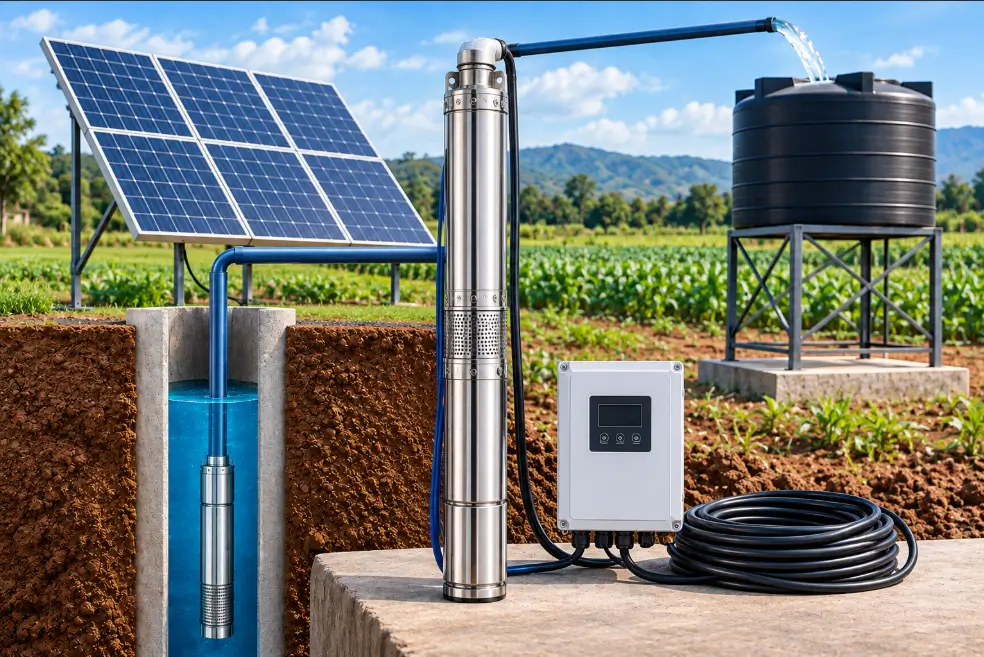
A DC submersible pump can be an excellent option when you need to pump water from a borehole or well using direct-current electricity, particularly in solar water pumping systems.
Unlike conventional AC pumps that normally depend on mains electricity, a DC pump can be designed to work directly with a suitable DC power source such as solar panels or batteries. This makes solar DC submersible pumps particularly useful for farms, homes, livestock watering systems and off-grid locations where reliable grid electricity may not be available.
However, choosing the right pump involves more than looking at the DC submersible pump price.
Flow rate, pumping depth, total head, borehole diameter, solar power availability and daily water requirements all affect which pump is suitable.
If you are comparing pump technologies, you can also read our guide to the AC submersible pump to understand how conventional AC pumping systems differ.
What Is a DC Submersible Pump?
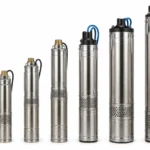
A DC submersible pump is a water pump powered by direct current electricity and designed to operate while submerged in water.
The pump is typically installed below the water level inside a borehole, well or other suitable water source. Its motor drives the pumping mechanism, moving water through a delivery pipe to a storage tank, irrigation system or point of use.
DC submersible pumps are particularly associated with solar pumping because photovoltaic panels naturally produce DC electricity.
Modern solar pumping systems can therefore be designed to use the electricity generated by solar panels to operate a suitable DC pump.
Solar-powered submersible pumping is already used for applications ranging from domestic water supply to agricultural irrigation. Grundfos, for example, describes its SQFlex range as solar submersible pumping equipment for applications including irrigation and off-grid water supply.
How Does a DC Submersible Pump Work?
The basic process is straightforward:
Solar panels or another DC power source → DC electrical supply → pump motor → pump hydraulics → water delivery pipe → storage tank or water system
When the DC motor receives suitable electrical power, it rotates the pump mechanism. The resulting hydraulic pressure moves water from the source through the rising pipe.
In a solar installation, the available pumping output can vary with the amount of solar energy available. Factors such as sunlight intensity, panel capacity, system design and pump specifications can therefore affect the amount of water delivered during the day.
Some modern solar pumping systems incorporate electronic controls and maximum power point tracking (MPPT) to make better use of available photovoltaic power. LORENTZ, for example, describes solar submersible systems using MPPT technology and high-efficiency brushless DC motors.
What Is a Solar DC Submersible Pump?
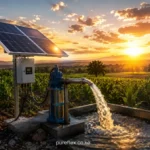
A solar DC submersible pump is essentially a DC-powered submersible pumping system designed to use energy from solar panels.
This combination is particularly useful where a property needs water but has limited access to grid electricity.
A typical system may include:
- Solar panels
- DC submersible pump
- Pump cable
- Solar pump controller, where required
- Borehole or well
- Delivery pipe
- Storage tank
- Mounting structure for the solar panels
- Appropriate electrical protection
The exact components depend on the pump and system design.
Not every DC pump can simply be connected directly to any solar panel. The voltage, current, operating range and controller requirements must be compatible with the pump.
Why Use a DC Submersible Pump for Solar Water Pumping?
One of the main attractions of a DC solar pumping system is that it can provide water without requiring a conventional grid electricity connection.
1. Suitable for off-grid locations
A solar DC submersible pump can be useful for farms, rural homes, livestock projects and other locations where grid electricity is unavailable or inconvenient.
2. Uses solar energy
Solar panels provide the energy required to operate the pumping system during suitable daylight conditions.
This can reduce dependence on grid electricity or fuel-powered pumping equipment.
3. Useful for remote water sources
Solar pumping can be particularly practical where the borehole or water source is located far from existing electrical infrastructure.
4. Suitable for irrigation
Farmers can use appropriately sized solar pumping systems to move groundwater for irrigation.
The required pump capacity depends heavily on the crop, irrigation method, available water, pumping depth and required daily volume.
5. Useful for livestock watering
Solar water pumping can also provide water for livestock in locations where extending grid electricity would be impractical.
LORENTZ, for example, lists livestock watering, irrigation and water supply among applications for its solar pumping systems.
DC Submersible Pump Price in Kenya: What Determines the Cost?
If you are searching for DC submersible pump price in Kenya, you will notice that prices can vary significantly between models.
That is because a small pump for a shallow application and a high-capacity solar borehole pump are completely different systems.
Several factors influence the final price.
| Factor | Effect on pump cost |
|---|---|
| Motor power | Larger motors generally require more substantial equipment |
| Flow rate | Higher water output can increase pump size and cost |
| Pump head | Higher-head applications may require different hydraulic designs |
| Pump diameter | Borehole dimensions can determine the suitable pump size |
| Pump construction | Stainless-steel and other durable materials can affect cost |
| Motor technology | High-efficiency motor designs may influence the purchase price |
| Controller | Some systems require dedicated electronic controls |
| Solar compatibility | Solar-ready equipment may have specific electrical requirements |
| Cable length | Deeper installations may require more cable |
| Solar panels | The complete solar pumping system costs more than the pump alone |
| Installation | Borehole, electrical and plumbing work add to the project cost |
For this reason, it is better to compare the complete pumping solution rather than asking only for the cheapest DC pump.
DC Submersible Pump Price vs Complete Solar Pump System Price
This is an important distinction when comparing prices.
The price of a DC submersible pump refers to the pump itself.
A complete solar water pumping system can include the pump plus solar panels, controller, cables, mounting structures, pipes, protection equipment and installation.
Therefore, the cost of a complete solar installation can be considerably higher than the price of the pump alone.
When requesting a quotation, explain that you want either:
Pump only
or
A complete solar pumping system.
This makes it easier to compare quotations accurately.
How to Choose the Right DC Submersible Pump
Choosing a DC submersible pump should begin with your water requirements rather than the advertised motor power.
1. Determine your required water volume
How much water do you need each day?
A household, livestock project and commercial farm can have very different water requirements.
For irrigation, calculate the required flow according to the irrigation system and the area being watered.
2. Determine the borehole depth
Find out the borehole depth and, more importantly, the relevant water levels.
The static water level and pumping water level can provide more useful information for pump sizing than total drilled depth alone.
3. Calculate the total head
The pump must overcome the vertical lifting requirement as well as pressure and friction losses within the system.
Total head can include:
- Water level
- Pumping depth
- Elevation of the storage tank
- Required pressure
- Pipe friction
- Fittings and other losses
A pump should therefore be selected according to its performance at the required operating head.
4. Check the borehole diameter
The pump must physically fit inside the borehole.
This is especially important when selecting larger-capacity equipment.
5. Check the DC voltage requirements
Different DC pumps can have different voltage requirements.
Before connecting a pump to solar panels, verify the pump’s electrical specifications and ensure that the solar system provides compatible voltage and current.
6. Consider daily solar availability
Solar pumping output can change throughout the day.
If your system relies entirely on direct solar power, pump sizing should account for the available solar resource and the amount of water required each day.
7. Decide whether you need water storage
For many solar pumping installations, storing water in a tank can be more practical than trying to pump water only when it is immediately needed.
The pump can operate during suitable solar conditions while the stored water can be used later.
This approach can be particularly useful for domestic and livestock water supply.
DC Submersible Pump for Boreholes
A DC submersible pump can be used for borehole water supply when its specifications match the borehole and water requirements.
For a typical borehole installation, you should establish:
- Borehole diameter
- Total borehole depth
- Static water level
- Dynamic water level
- Required daily water volume
- Required flow rate
- Storage tank height
- Pipe size and length
- Available solar power
- Pump operating voltage
This information gives a pump supplier or installer a much better basis for recommending suitable equipment.
PureFlex currently lists a range of submersible and solar pumping products, including the 3SDS4 Doyin solar submersible pump. The site’s current product listings also include several solar submersible and hybrid AC/DC models.
DC Solar Pump for Irrigation
Solar-powered DC pumping can be particularly attractive for agricultural applications.
Instead of relying entirely on grid electricity or fuel, a correctly designed solar pumping system can use sunlight to move water from a borehole or other source to an irrigation system or storage tank.
The required pump, however, depends on the irrigation design.
A drip irrigation system, sprinkler system and large-scale water transfer project can have very different flow and pressure requirements.
For this reason, farmers should avoid selecting a pump simply because it has a higher wattage.
The important question is:
How much water can the pump deliver at the required head?
DC Submersible Pump vs Solar DC Submersible Pump
These terms are closely related but are not always interchangeable.
A DC submersible pump describes a submersible pump that operates using direct-current power.
A solar DC submersible pump specifically refers to a DC submersible pump used as part of a solar-powered system.
A DC pump could potentially operate from a battery or another compatible DC power source, while a solar DC pump is intended to work with photovoltaic power as part of the system design.
This distinction is useful when comparing products because the pump alone may not tell you everything about the complete solar installation.
DC Submersible Pump vs AC Submersible Pump
The biggest difference between AC pump and DC pump is the type of electrical power used.
| Feature | DC Submersible Pump | AC Submersible Pump |
|---|---|---|
| Power type | Direct current | Alternating current |
| Common application | Solar and off-grid pumping | Grid-powered water systems |
| Solar integration | Particularly suitable | Usually requires suitable conversion equipment |
| Grid electricity | Not necessarily required | Normally requires AC supply |
| Off-grid suitability | High when properly designed | Depends on available power system |
| Battery compatibility | Can be suitable with compatible systems | Requires appropriate inverter/conversion |
| Typical application | Solar boreholes, irrigation, livestock | Homes, institutions, commercial systems |
Neither technology is automatically better for every installation.
The right choice depends on the available power source, pumping requirements, budget and operating conditions.
If your site already has reliable electricity, an AC pump may make sense. If you are planning an off-grid solar installation, a suitable DC solar pump may be worth considering.
You can read our dedicated AC submersible pump guide for more information.
Are DC Solar Pumps Worth It?
For suitable applications, a solar DC pumping system can offer an attractive alternative to conventional electrically or fuel-powered pumping.
Grundfos notes that solar-powered pumping solutions are increasingly used in developing countries and highlights their potential for off-grid water supply.
However, the economics depend on the complete installation.
You should consider:
- Pump cost
- Solar panel cost
- Controller cost
- Borehole depth
- Cable and pipe requirements
- Installation
- Maintenance
- Expected water demand
- Available solar resource
- Alternative electricity or fuel costs
A higher initial investment can make sense if the system meets the site’s water requirements reliably over its expected operating life.
Common Mistakes When Buying a DC Submersible Pump
Buying according to watts alone
Pump wattage does not tell you how much water the pump will deliver at your required head.
Ignoring borehole diameter
Always confirm the pump diameter before purchasing.
Assuming every DC pump is solar compatible
The electrical characteristics of the pump and solar system must be compatible.
Comparing pump-only prices with complete system prices
A pump quotation and a complete solar installation quotation are not equivalent.
Choosing a pump without knowing the water level
The pumping water level is essential for determining the required head.
Oversizing the system
A larger pump is not automatically a better pump. Oversizing can increase the cost of the pump, solar array and associated equipment without providing a useful benefit.
Frequently Asked Questions
What is a DC submersible pump?
A DC submersible pump is an electrically powered pump designed to operate underwater using direct-current electricity. It is commonly used in solar and off-grid water pumping applications.
What is a solar DC submersible pump?
A solar DC submersible pump is a DC-powered submersible pump used with photovoltaic solar power to pump water from sources such as boreholes and wells.
How much is a DC submersible pump in Kenya?
The DC submersible pump price depends on pump capacity, head, flow rate, construction, diameter and other specifications. A complete solar system will cost more because it can also include solar panels, controllers, cables, mounting equipment and installation.
Can a DC submersible pump work directly with solar panels?
Some pumps are specifically designed for solar operation, while others require a compatible controller or other equipment. Always match the pump’s electrical requirements with the solar system before installation.
Can a DC submersible pump be used for a borehole?
Yes. A suitably sized DC submersible pump can be used for borehole water supply, provided its diameter, head, flow rate and electrical requirements match the installation.
Are DC pumps suitable for irrigation?
Yes. DC solar pumping systems can be used for irrigation, provided the pump delivers the required flow and pressure for the irrigation system.
Do DC solar pumps need batteries?
Not necessarily. Some solar pumping systems are designed to pump directly from available solar power and use water storage rather than batteries. The appropriate configuration depends on the application.
What affects DC submersible pump performance?
Performance depends on factors such as pump design, motor power, water level, total head, pipework, available electrical power and the required flow rate.
Where to Buy a DC Submersible Pump in Kenya
When choosing a DC or solar submersible pump, look beyond the initial DC submersible pump price.
A reliable supplier should help you match the pump to the actual water system, including the borehole, required flow, head and available power source.
PureFlex Water Solutions offers submersible water pumping products alongside solar and hybrid pumping solutions. You can browse the submersible water pump range, view available products or explore solar pumping solutions.
Choose the Right DC Submersible Pump for Your Application
A DC submersible pump can be a practical choice for boreholes, irrigation, livestock watering and off-grid water supply, particularly when combined with a properly designed solar system.
The most important consideration is not simply the cheapest DC submersible pump price.
Instead, compare the pump’s flow rate, head, diameter, power requirements and compatibility with your solar system. For solar installations, also consider the size of the PV array, controller requirements and whether water storage will be used.
With the right combination of pump, solar power and water storage, a DC pumping system can provide a dependable water supply even where conventional grid electricity is unavailable.
For more options, explore the PureFlex submersible pump range and compare it with the AC submersible pump before deciding which technology best suits your application.

Leave a Comment