
River water may look clean enough to drink, especially when it comes from a fast-flowing river or a relatively clear section of the river. However, clear appearance does not mean the water is safe for drinking.
River water can contain bacteria, parasites, viruses, sediment, organic matter, agricultural runoff and other contaminants. In Kenya, surface water sources generally require appropriate treatment before they can be considered suitable for drinking. Kenya’s drinking-water guidance notes that surface water rarely meets potable-water requirements without adequate treatment.
The good news is that river water does not necessarily require reverse osmosis. Because river water is generally a freshwater source rather than a salty or highly mineralised source, ultrafiltration (UF) can be an appropriate purification technology when the source-water quality is suitable and the system is correctly designed.
This guide explains how to purify river water for drinking, the treatment stages involved, and when a UF purifier may be a better choice than an RO system.
Can You Drink River Water After Filtering It?
Not without proper treatment.
Untreated river water should not be assumed to be safe simply because it is clear, flowing or collected away from obvious sources of pollution. Surface water can become contaminated by human and animal waste, agricultural activities, soil runoff and other sources.
The Kenya Water Services Regulatory Board (WASREB) states that potable water should be free from disease-causing organisms and harmful chemicals, among other requirements. Its drinking-water guidelines also recognise that surface water sources commonly require treatment before being used as drinking water.
The treatment required depends on the quality of the particular river. For that reason, water testing is an important first step, especially when river water will be used regularly by a household, school, institution, farm, restaurant or commercial operation.
How to Purify River Water for Drinking
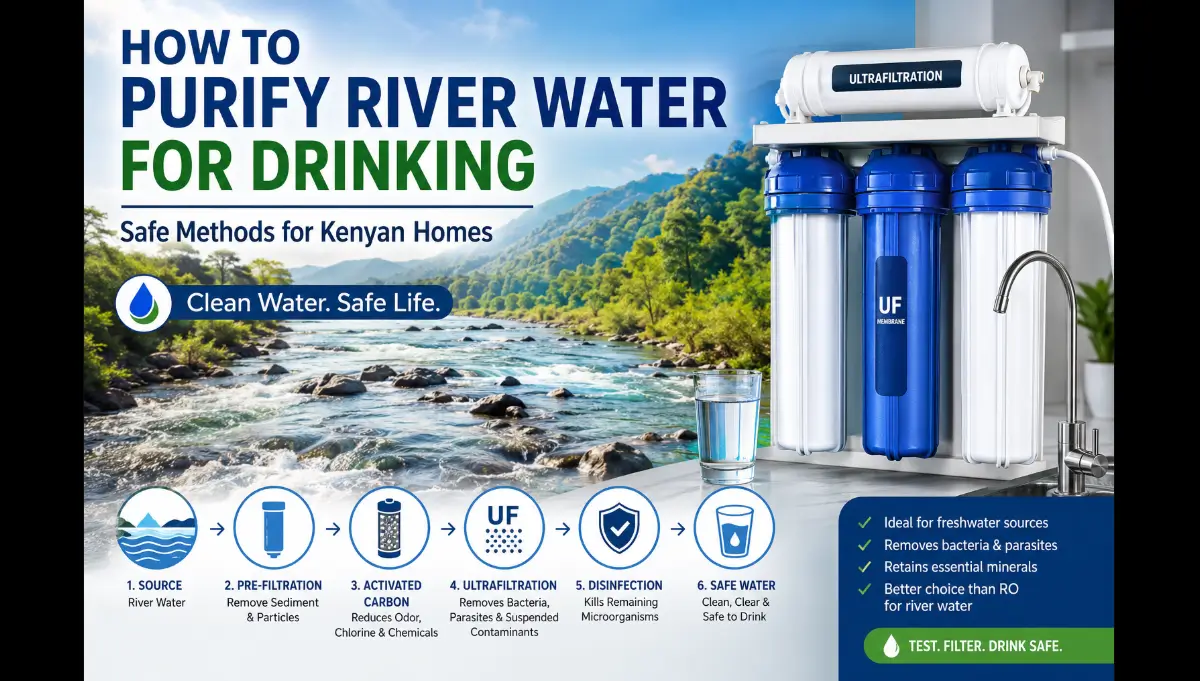
A practical river-water purification system normally combines several treatment stages rather than relying on one filter.
A typical setup can include:
River water → sediment/pre-filtration → activated carbon → ultrafiltration → disinfection → safe storage
The exact configuration should depend on the source-water quality.
1. Test the River Water First
Before choosing a purification system, determine what is actually present in the water.
Important parameters may include:
- Turbidity
- Total dissolved solids (TDS)
- pH
- Electrical conductivity
- E. coli and other microbiological indicators
- Iron and manganese where relevant
- Nitrates
- Fluoride where relevant
- Other contaminants associated with activities around the river
Testing is particularly important if the river is downstream of farms, settlements, industrial activities, wastewater discharge or areas with significant human or livestock activity.
A water-treatment system should be selected based on the contaminants that need to be removed, not simply on how cloudy or clear the water looks.
2. Remove Sand, Mud and Suspended Particles
River water can contain considerable amounts of suspended material, particularly after rainfall.
A sediment filter or other appropriate pre-treatment can remove larger particles such as:
- Sand
- Silt
- Mud
- Rust-like particles
- Other suspended solids
Pre-filtration is important because excessive sediment can quickly foul the finer membranes used later in the treatment process.
For heavily turbid river water, additional pre-treatment such as settling or other suitable filtration may be necessary before water reaches a UF membrane.
3. Use Activated Carbon Where Appropriate
Activated carbon can form another useful stage in a river-water treatment system.
It can help reduce substances responsible for unpleasant taste and odour and can remove or reduce certain organic contaminants depending on the carbon type, water chemistry and system design.
However, activated carbon should not be treated as a universal purification method. It does not replace microbiological treatment, and its effectiveness depends on the specific contaminants present.
4. Use Ultrafiltration to Remove Microbial and Suspended Contaminants
This is where ultrafiltration (UF) can be particularly useful for suitable freshwater sources.
UF uses a very fine membrane to separate contaminants from water. The CDC notes that ultrafiltration membranes typically have pore sizes around 0.01 micron, although actual pore sizes vary by product. UF can remove parasites and bacteria and is also somewhat effective against viruses, although it should not be assumed to remove every virus.
For this reason, a properly selected UF purifier can be an attractive option for river water that does not have the high dissolved-salt or mineral load that would make reverse osmosis more appropriate.
Why UF Can Be Suitable for River Water
One of the main advantages of UF is that it focuses on contaminants such as suspended particles and microorganisms without functioning like an RO membrane that removes a much wider range of dissolved substances.
For households looking for a way to purify river water for drinking, UF can therefore provide an efficient treatment stage when the source-water chemistry is appropriate.
PureFlex Water Solutions offers UF water purification systems for relatively clean freshwater sources, including applications where the objective is to remove bacteria and suspended solids while retaining minerals. The appropriate system should still be determined from the actual quality of the river water.
[UF Water Purifier for River Water]
5. Add Appropriate Disinfection
Depending on the source and treatment system, an additional disinfection stage may be appropriate.
Disinfection provides an additional barrier against microorganisms and can be especially important when water will be stored after treatment.
The treatment train should be designed as a complete system rather than assuming that one filtration technology can address every possible contamination risk.
The WHO recommends a risk-based approach to drinking-water safety that considers hazards from the source through to the consumer.
6. Store the Purified Water Safely
Purification does not guarantee that water will remain safe if it is subsequently stored in a contaminated container.
Use a clean, covered storage tank or container and prevent treated water from coming into contact with untreated river water.
This is particularly important for systems where purified water is produced in batches and stored for later consumption.
What Is the Best Way to Purify River Water?
There is no single treatment method that is best for every river.
The right approach depends on the quality of the source water.
| River-water condition | Potential treatment approach |
|---|---|
| Relatively clear freshwater with microbial contamination | Pre-filtration + UF + appropriate disinfection |
| Water with significant sediment | Sedimentation/pre-treatment + filtration + UF |
| Water with unpleasant taste or odour | Sediment filtration + activated carbon + appropriate membrane treatment |
| High TDS or dissolved minerals | Consider RO after appropriate pre-treatment |
| Suspected chemical contamination | Water testing followed by contaminant-specific treatment |
| Heavily polluted surface water | Comprehensive treatment designed from water-test results |
This distinction matters because UF and RO do different jobs.
If the main concern is bacteria, parasites and suspended particles in freshwater, UF may be a more appropriate technology.
If the water contains high levels of dissolved salts, excessive TDS or certain dissolved chemical contaminants, reverse osmosis may be more suitable.
For more information, see PureFlex’s guide on how reverse osmosis purifies water and what reverse osmosis is.
River Water vs Borehole Water: Does the Treatment Differ?
Yes.
River water and borehole water can have very different contamination profiles.
River water is a surface-water source, so microbial contamination, turbidity and suspended solids are often major considerations.
Borehole water, on the other hand, may have problems such as high TDS, hardness, iron, fluoride or salinity depending on the location and geology.
If the water source is a borehole, see the guide on how to purify borehole water at home and whether borehole water is safe for drinking.
Do You Need Reverse Osmosis to Purify River Water?
Not necessarily.
This is one of the most important points when choosing a river-water purifier.
Reverse osmosis is highly effective at reducing many dissolved substances, including salts and several inorganic contaminants. However, using RO when the primary challenge is microbial contamination and suspended particles may provide more treatment than necessary.
A suitable UF system can be a more targeted solution for some freshwater applications.
However, UF should not automatically be considered sufficient for every river. The CDC notes that UF removes bacteria and parasites but is only somewhat effective against viruses and does not remove chemicals.
Therefore, if testing identifies chemical contamination or high dissolved solids, another treatment technology may be required.
For households dealing with high-TDS or salty water, PureFlex also provides information about undersink reverse osmosis systems in Kenya.
Can UF Remove Salt from River Water?
UF is not designed to desalinate water.
This is another reason to test river water before selecting a purifier.
If the water has a high concentration of dissolved salts, UF will not provide the same level of dissolved-solids reduction as reverse osmosis. RO is designed to remove a much broader range of dissolved substances.
For information about treating salty water, see how to purify salty water at home.
For river water that is genuinely freshwater and does not have a significant dissolved-salt problem, UF can be considered as part of an appropriately designed purification system.
How to Choose a River Water Purifier in Kenya
When choosing a system for river water, do not select a purifier based only on price or the number of filtration stages.
Consider:
Source-water quality
A system designed for relatively clean freshwater may not be suitable for heavily polluted river water.
Turbidity
Highly muddy water may require substantial pre-treatment before reaching a UF membrane.
Microbiological contamination
Test for indicators such as E. coli and other relevant microbiological contaminants.
TDS and dissolved contaminants
A low TDS level may make UF a practical option, while high TDS or specific chemical contaminants may require RO or another treatment technology.
Daily water demand
A household may need a very different flow rate from a school, restaurant, farm or commercial premises.
Maintenance requirements
Filters and membranes require regular maintenance and replacement. A system that is difficult to maintain may perform poorly over time.
Water testing and professional assessment
Where the source is uncertain, testing provides a much stronger basis for choosing the right purification technology.
A Practical River Water Purification System for a Kenyan Home
For a household using a reasonably clean freshwater river as its source, a treatment setup could look like this:
River source → sediment pre-filter → activated carbon → UF membrane → appropriate disinfection → clean storage → drinking tap
This configuration can provide multiple treatment barriers while avoiding unnecessary RO treatment where dissolved salts are not the main problem.
However, heavily contaminated river water may require additional stages.
PureFlex Water Solutions can help households and businesses evaluate their water-treatment requirements and select an appropriate purification solution in Kenya. Contact PureFlex Water Solutions for guidance based on the water source and intended application.
Why River Water Should Not Be Judged by Appearance
One of the biggest mistakes people make with surface water is assuming that clear water is safe water.
A river can appear clean while containing microorganisms or dissolved contaminants that cannot be detected by sight, smell or taste.
The WHO’s drinking-water guidelines emphasise risk management and water safety from the source through to the consumer rather than relying solely on the appearance of finished water.
That is why a proper river-water purification system should be selected according to the actual risks associated with the source.
UF vs RO for River Water
| Feature | UF water purifier | RO water purifier |
|---|---|---|
| Suspended particles | Yes | Yes |
| Bacteria | Yes, depending on membrane/system | Yes |
| Parasites | Yes | Yes |
| Viruses | Some reduction; system-dependent | Generally stronger barrier |
| Dissolved salts | No | Yes |
| High TDS | No | Yes |
| Retains minerals | Generally yes | Generally reduces many dissolved minerals |
| Suitable for freshwater microbial treatment | Often suitable | Can be suitable |
| Suitable for desalination | No | Yes |
The key takeaway is simple: choose the treatment technology according to the contaminants in the water.
If the river is a freshwater source and testing shows that the principal concerns are suspended particles and microorganisms, UF can be a practical purification technology. If dissolved salts, high TDS or particular chemical contaminants are present, RO or additional treatment may be necessary.
How Much Does It Cost to Purify River Water in Kenya?
The cost depends on the treatment capacity and the quality of the source water.
A small household system will normally cost considerably less than a river-water treatment system designed for a school, hotel, restaurant, farm or commercial operation.
The final cost can also be affected by:
- Water testing
- Pre-treatment requirements
- UF membrane capacity
- Storage requirements
- Pumping requirements
- Installation
- Additional disinfection
- Replacement filters
- Water-quality monitoring
Rather than choosing a system solely from a price list, it is better to determine the treatment requirements first.
You can browse available water purification products from PureFlex for assistance selecting a system.
What About River Water That Is Very Dirty?
Very dirty river water should not simply be connected directly to a household UF purifier.
Heavy sediment loads can rapidly foul filters and membranes, while chemical contamination may require treatment methods that UF cannot provide.
In such cases, the system may need additional stages such as:
Raw river water → settling/coagulation where appropriate → sediment filtration → activated carbon → UF → disinfection → storage
The precise treatment process should be determined from water-quality testing.
WASREB’s drinking-water guidance specifically recognises that different levels of raw-water contamination require different levels of treatment.
Frequently Asked Questions
Is it safe to drink river water after filtering it?
Only when the treatment system is appropriate for the contaminants present and the treated water meets applicable drinking-water requirements. Simple filtration should not automatically be assumed to make river water safe.
What is the best filter for river water?
There is no universal best filter. For suitable freshwater sources, UF can be an effective component because it can remove bacteria, parasites and suspended contaminants. However, UF does not remove dissolved salts and is not designed to remove all chemical contaminants.
Can ultrafiltration purify river water?
Yes, UF can be used as part of a river-water purification system when the source-water quality and system design are appropriate. Pre-treatment may be necessary where river water contains substantial sediment or turbidity.
Does UF remove bacteria from river water?
Ultrafiltration can remove bacteria when the membrane and system are appropriately designed and maintained. The CDC identifies ultrafiltration as a treatment technology capable of removing bacteria.
Does UF remove viruses from river water?
UF can reduce some viruses, but it should not be assumed to remove all viruses. Additional treatment may be necessary depending on the source-water risk and the specific UF system.
Does UF remove salt from river water?
No. UF does not desalinate water. If river water has high dissolved salts or TDS, reverse osmosis may be more appropriate.
Can I use a home UF purifier for river water?
A household UF purifier may be suitable for an appropriate freshwater source, but the water should be assessed first. Heavily polluted or highly turbid river water may require substantial pre-treatment.
Do I need to boil river water after filtration?
Whether additional disinfection is required depends on the complete treatment system and the quality of the source water. A properly designed treatment system should provide an appropriate microbiological barrier rather than relying on assumptions based on water appearance.
What is the difference between UF and RO for river water?
UF primarily targets suspended particles and microorganisms while generally retaining dissolved minerals. RO provides a much stronger barrier for dissolved salts and many other dissolved contaminants. The appropriate choice depends on the water-quality test.
Where can I get a river-water purifier in Kenya?
PureFlex Water Solutions supplies water purification systems for homes and businesses in Kenya. For a river-water application, the appropriate system should be selected according to the source-water quality and required capacity. Visit PureFlex Water Solutions for assistance.
Final Takeaway
If the goal is to purify river water for drinking, the solution is not simply to run the water through any available filter.
Start by testing the source. Remove excessive sediment, use appropriate pre-treatment, select a membrane technology suited to the contaminants present, add disinfection where necessary, and store the treated water safely.
For freshwater river sources where microbial contamination and suspended solids are the primary concerns, a properly designed ultrafiltration (UF) system can be a practical alternative to reverse osmosis. Unlike RO, UF is not intended to remove dissolved salts, so it is particularly important to understand the source-water chemistry before choosing the system.
For households and businesses in Kenya looking for a suitable water purification solution, PureFlex Water Solutions provides filtration and purification systems designed around different Kenyan water-quality challenges.
Leave a Comment