
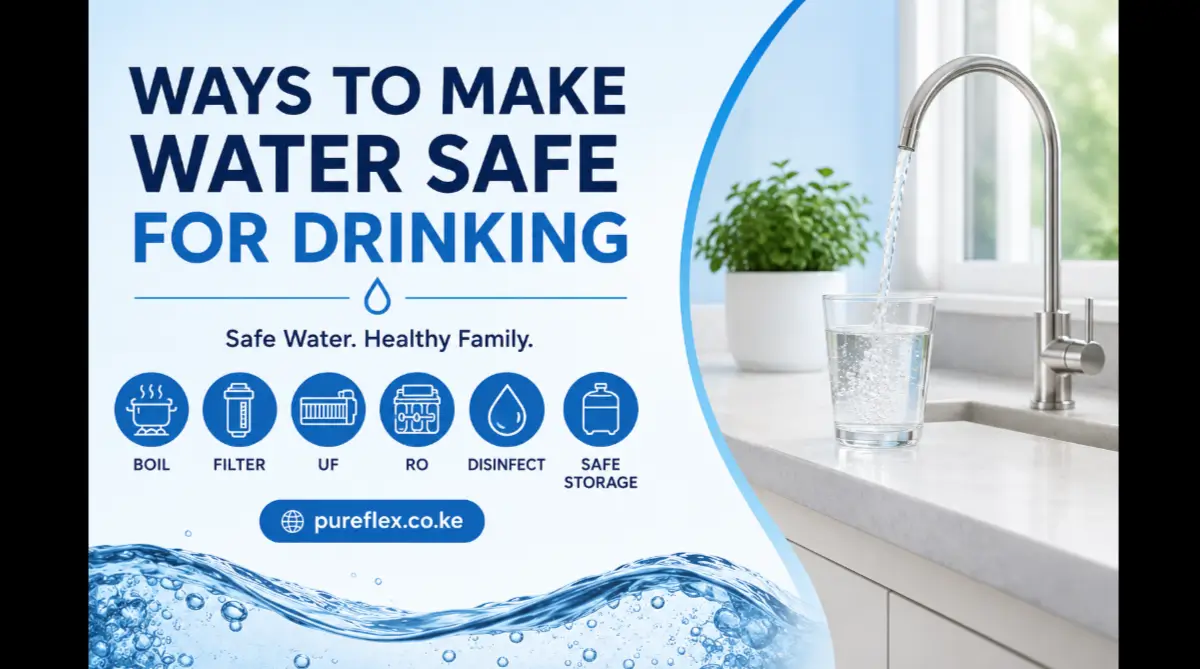
Clean-looking water is not necessarily safe to drink.
Water can contain bacteria, viruses, parasites, dissolved salts, heavy metals and other contaminants that may not be visible, taste unusual or produce a noticeable smell.
This is particularly important in Kenya, where households may rely on treated tap water, borehole water, rainwater, water vendors or other sources.
Kenya’s Water Services Regulatory Board (WASREB) states that potable water should be free from disease-causing organisms, harmful chemicals, excessive turbidity and salinity, among other requirements.
So, what are the best ways to make water safe for drinking at home?
1. Boil the Water
Boiling is one of the simplest ways to make water safer for drinking.
Bringing water to a rolling boil can inactivate disease-causing bacteria, viruses and protozoa. The World Health Organization recommends boiling as an effective household water treatment method.
After boiling:
- Allow the water to cool.
- Store it in a clean, covered container.
- Avoid touching the water with dirty hands or utensils.
- Use it within a reasonable period.
Boiling is useful when you need an immediate solution, but it can become inconvenient for households that need large quantities of drinking water every day.
2. Filter the Water
Filtration is another common way to improve drinking water quality.
A suitable water filter can reduce suspended particles, sediments and some microorganisms, depending on the technology used.
However, not every water filter removes every type of contaminant.
For example, a basic sediment filter may remove visible particles but will not necessarily deal with dissolved salts or other contaminants. The CDC also notes that many filters do not remove bacteria or viruses, meaning the filter must be selected according to the water quality problem.
This is why knowing your water source and, where possible, testing the water before choosing a purification system is important.
3. Use an Ultrafiltration (UF) System
UF is a practical option for households that want continuous filtration without boiling water every day.
Ultrafiltration uses a very fine membrane to separate many suspended particles and microorganisms from water while allowing water to pass through.
UF can be particularly useful where the main concern is microbial contamination and suspended particles rather than high levels of dissolved salts.
For households in Kenya using relatively low-TDS water, a properly selected UF system can be a convenient point-of-use solution.
However, UF does not solve every water-quality problem. If your water contains high levels of dissolved salts or has a high TDS level, reverse osmosis may be more appropriate.
4. Install a Reverse Osmosis (RO) System
For many Kenyan homes, reverse osmosis is one of the most comprehensive options for treating drinking water at the point of use.
An RO system forces water through a semi-permeable membrane under pressure. This helps reduce dissolved salts, TDS and many other dissolved contaminants.
This makes RO particularly useful for households dealing with:
- High-TDS water
- Salty or brackish water
- Some borehole water
- Unpleasant taste caused by dissolved substances
- Water containing excessive dissolved minerals
For a simple explanation of the technology, see how reverse osmosis works.
You can also learn the basics in this guide on what reverse osmosis is.
5. Use a Multi-Stage Drinking Water Purifier
A multi-stage system combines different filtration technologies to address different water-quality issues.
For example, a typical household RO system may use stages designed to reduce sediment, chlorine, organic compounds and dissolved contaminants before the water reaches the final drinking-water outlet.
This approach is useful because water contamination is rarely limited to one category.
If you are looking for a drinking-water solution for your kitchen, see PureFlex kitchen water purifiers.
For households that want an under-sink installation, the best under-sink reverse osmosis systems in Kenya are worth considering.
6. Disinfect Water When Microbial Contamination Is a Concern
Chemical disinfection, including appropriately used chlorine-based treatment, can help control many disease-causing microorganisms.
WHO recognizes boiling, filtration and chemical disinfection among household water-treatment options.
However, chemical treatment must be used according to the product’s instructions. It is also important to understand what the treatment does and does not remove.
For example, disinfection is primarily aimed at microorganisms. It does not automatically remove dissolved salts, heavy metals or other chemical contaminants.
7. Store Treated Water Safely
Purifying water is only part of the process.
Water that has already been treated can become contaminated again if it is stored in dirty containers or handled improperly.
WHO recommends a multi-barrier approach that combines treatment with safe storage and handling.
At home:
- Use clean storage containers.
- Keep drinking water covered.
- Avoid dipping dirty cups or hands into stored water.
- Clean storage containers regularly.
- Keep treated water away from potential sources of contamination.
A good purification system cannot compensate for poor storage practices.
Which Is the Best Way to Make Water Safe for Drinking?
There is no single purification method that is ideal for every Kenyan household.
The right option depends on the source and quality of the water.
| Water concern | Possible solution |
|---|---|
| Microbial contamination | Boiling, suitable filtration or disinfection |
| Sediment and dirt | Sediment filtration |
| Cloudy water | Filtration |
| High TDS | Reverse osmosis |
| Salty water | Reverse osmosis |
| Dissolved minerals | Reverse osmosis |
| Lower-TDS water needing membrane filtration | UF |
| Multiple water-quality concerns | Multi-stage RO or UF system |
For example, a household in Nairobi using relatively good municipal water may have different requirements from a household using borehole water in Kiambu, Nakuru, Machakos or Mombasa.
That is why water testing should come before choosing a purification system when the water quality is uncertain.
Is Borehole Water Safe to Drink?
Borehole water should not automatically be assumed to be safe simply because it comes from underground.
Its quality depends on the geological conditions, surrounding activities, depth of the borehole and other factors.
Borehole water can contain minerals, salts, iron, fluoride and microbial contaminants depending on the location.
If your household relies on a borehole, read this guide on how to purify borehole water at home and learn whether borehole water is safe for drinking.
Testing the water is the best way to understand which treatment technology is required.
What About River Water?
River water should not be assumed to be safe for drinking without treatment.
Surface water can be exposed to human waste, animal waste, agricultural runoff, sediments and other contaminants.
If river water is your source, treatment generally needs to address both physical and microbial contamination.
Read how to purify river water for drinking to understand the treatment options.
RO vs UF: Which Is Better for a Kenyan Home?
The answer depends on what is in the water.
UF may be suitable when:
- The water has relatively low TDS.
- The main concerns are suspended particles and microorganisms.
- You want a simple point-of-use filtration system.
RO may be better when:
- TDS is high.
- The water is salty or brackish.
- Dissolved minerals are a concern.
- Borehole water has undesirable dissolved contaminants.
- You want more comprehensive reduction of dissolved substances.
In short, UF focuses mainly on filtration through a very fine membrane, while RO provides a stronger barrier against many dissolved contaminants.
How to Choose a Home Water Purifier in Kenya
Before buying a water purifier, consider these five things:
1. Test Your Water
A water test can reveal problems that cannot be identified by looking at the water.
2. Identify Your Water Source
Tap, borehole, river, rainwater and other sources can require different treatment approaches.
3. Check TDS
A high TDS reading can be an important reason to consider RO, although TDS alone does not tell you whether water is microbiologically safe.
4. Consider Daily Water Consumption
A small kitchen drinking-water system may be sufficient for a household that only needs purified water for drinking and cooking.
5. Consider Maintenance
Filters and membranes need to be replaced according to their condition, usage and manufacturer’s recommendations. A purification system is only effective when it is properly maintained.
A Practical Choice for Kenyan Homes
For many households, the goal is not to treat every litre of water entering the house.
Instead, a point-of-use drinking-water system can be installed at the kitchen sink to provide purified water for drinking and cooking.
PureFlex supplies household water purification solutions designed around different water-quality needs. You can view available water purification products or explore the home drinking water filtration systems.
For households looking for an RO option, the 5-stage reverse osmosis system is one option to consider.
How Much Does a Home Water Purifier Cost in Kenya?
The price depends on the purification technology, number of stages, capacity, installation requirements and other specifications.
RO systems generally cost more than basic filtration systems because they use additional stages and a reverse osmosis membrane.
Instead of choosing a system based only on price, match the technology to your water quality.
See this guide to reverse osmosis machine prices in Kenya for more information.
Frequently Asked Questions
What is the easiest way to make water safe for drinking at home?
Boiling is one of the simplest methods for treating water against many disease-causing microorganisms. For everyday household use, however, a properly selected filtration, UF or RO system can provide a more convenient continuous solution.
Can a water filter make tap water safe to drink?
It depends on the filter and the contaminants present in the water. Different filters remove different contaminants, so the filtration technology should match the water-quality problem.
Is RO better than boiling water?
They serve different purposes. Boiling is highly effective for inactivating many microorganisms, while RO can reduce many dissolved substances, including salts and minerals. RO does not replace the need for proper system maintenance.
Is UF better than RO?
Not necessarily. UF can be suitable for certain water sources, while RO is generally more appropriate when dissolved salts and other dissolved contaminants are a major concern.
Can RO purify borehole water?
Yes, RO can be used to treat borehole water, particularly where testing shows high TDS, salinity or other dissolved contaminants. The complete treatment setup should be selected according to the borehole water analysis.
How do I know which water purifier I need?
Start with the water source and, ideally, a water-quality test. The results can help determine whether you need sediment filtration, UF, RO or a combination of treatment technologies.
Is cloudy water safe to drink?
Cloudiness is a warning sign that the water may contain suspended particles or other contaminants. Cloudy water should be treated appropriately before drinking rather than judged by appearance alone.
Where can I buy a home water purifier in Kenya?
PureFlex provides home water purification solutions, including RO and other filtration systems. You can view the available products or contact PureFlex for guidance on selecting a suitable system.
Final Thoughts
There are several ways to make water safe for drinking, from boiling and disinfection to filtration, UF and reverse osmosis.
The most important step is choosing a treatment method based on the actual quality of your water.
For households in Kenya dealing with borehole water, high TDS, salty water or other dissolved contaminants, an RO system can provide a practical point-of-use solution. Where the main concern is filtration of lower-TDS water, UF may be a better fit.
The goal is simple: test the water, identify the problem and choose the right treatment technology.
For household water purification solutions, visit PureFlex or contact the team for assistance in selecting a suitable system.
Leave a Comment