
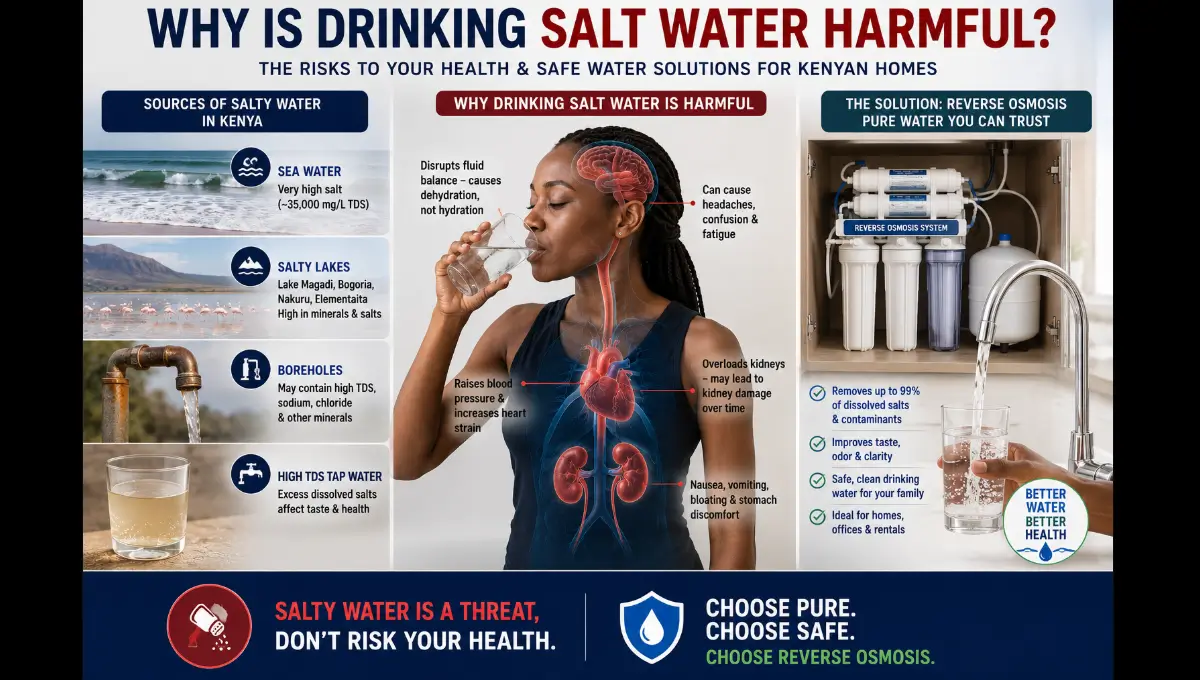
Have you ever wondered why drinking salt water is harmful, even though the human body needs salt to function?
The answer lies in how the kidneys, cells and body fluids maintain the right balance of water and electrolytes. Although sodium is an essential mineral, drinking water with very high concentrations of dissolved salts can disrupt that balance rather than restore it.
This is particularly relevant in Kenya, where households may encounter salty or highly mineralised water from boreholes, wells and groundwater, especially in some coastal areas and parts of the Rift Valley. Kenya also has naturally saline and alkaline lakes, including Lake Magadi, Lake Bogoria, Lake Nakuru and Lake Elementaita. These environments demonstrate just how naturally high dissolved-mineral concentrations can occur in the country’s water systems.
For a household, however, the important question is not simply whether water tastes salty. It is whether the water is suitable for drinking and, if it is not, how the salt and other dissolved contaminants can be reduced effectively.
The good news is that homeowners and tenants do not necessarily have to replace their water source. With appropriate testing and treatment, technologies such as reverse osmosis (RO) can provide a practical point-of-use solution for drinking and cooking water.
Why Is Drinking Salt Water Harmful?
Drinking highly salty water is harmful because the concentration of salt in the water can be greater than what the kidneys can effectively eliminate while maintaining the body’s water balance.
The human body needs sodium and chloride for important functions, including nerve signalling, muscle function and fluid regulation. The problem occurs when too much salt enters the body relative to the amount of fresh water available.
Your kidneys continuously regulate the concentration of substances in your blood by removing waste and excess electrolytes through urine. But removing a large amount of salt requires water.
This creates the central problem with drinking seawater or very salty water: the body may need to use more water to eliminate the excess salt than the amount of water obtained from the salty liquid itself.
The U.S. Geological Survey explains that the kidneys need freshwater to dilute excess salt sufficiently for it to be excreted. When there is too much salt and insufficient freshwater, the body’s water balance can be seriously disrupted.
In simple terms:
Very salty water → excess salt enters the body → kidneys try to remove the excess → water is required to excrete the salt → the body’s water balance can deteriorate.
That is why seawater cannot be treated as a substitute for freshwater.
Why Is Drinking Salt Water Harmful Biology?
The biological explanation comes down to osmosis and electrolyte balance.
The cells throughout your body contain water and dissolved electrolytes. The concentration of these substances is carefully regulated so that cells can function normally.
When the concentration of dissolved salts outside cells becomes excessively high, water tends to move toward the area with the higher concentration of dissolved substances.
This movement of water is associated with osmosis.
If a person consumes water containing an excessive amount of salt without sufficient freshwater to compensate, the concentration of sodium in body fluids can rise. The resulting shift in water balance can cause cells to lose water and can interfere with normal physiological processes.
This is why the issue is not simply that “salt is bad.” Sodium is essential. The problem is excessive sodium relative to available water and the body’s ability to regulate it.
The World Health Organization recognises sodium as an essential nutrient but notes that high sodium intake is a public-health concern, particularly because excessive sodium intake contributes to increased blood pressure and cardiovascular risk.
Why Is Drinking Sea Salt Water Harmful?
The phrase “sea salt water” usually refers to seawater or water containing a concentration of dissolved salts comparable to seawater.
Seawater is extremely salty compared with normal freshwater. According to the U.S. Geological Survey (USGS), seawater has a salinity of approximately 35 parts per thousand, meaning roughly 3.5% of its weight consists of dissolved salts. Sodium and chloride are the dominant dissolved ions.
That concentration is far beyond what people should consume as their normal drinking water.
The USGS explains that seawater is unsuitable for drinking because the human kidneys cannot excrete the salt load without sufficient freshwater to dilute it.
Therefore, drinking seawater does not solve dehydration. It can make the body’s water balance worse.
Does All Salty-Tasting Water Pose the Same Risk?
No. This distinction is important.
Water that tastes slightly salty is not automatically equivalent to seawater.
Water can contain different concentrations of sodium, chloride, calcium, magnesium, sulphates, bicarbonates and other dissolved minerals. The health implications depend on the actual composition and concentration.
The WHO notes that sodium can occur naturally in groundwater and surface water and that concentrations can vary substantially. It also notes that sodium concentrations above around 200 mg/L may produce an unacceptable taste for many consumers.
Therefore, if tap or borehole water tastes salty, the correct response is not to assume that the water is immediately poisonous.
Instead:
Test the water → identify the dissolved substances → determine whether treatment is necessary → select treatment appropriate for the results.
This approach is particularly important in Kenya because groundwater chemistry can vary considerably from one location to another.
Why Salty Water Can Be a Problem for Kenyan Homes
Salty water is not only a concern for people stranded at sea.
Kenyan households can encounter water with elevated dissolved salts or minerals through different sources, including:
- Boreholes
- Shallow wells
- Groundwater
- Some coastal water sources
- Brackish water
- Naturally mineralised water
- Water affected by local geology
- Certain saline or alkaline environments
In some areas, the problem can be particularly noticeable.
For example, a Kenya News Agency report on water shortages in the Magadi area quoted local stakeholders describing salty aquifers along the Magadi Road corridor.
This illustrates an important point for homeowners. drilling a borehole does not automatically guarantee good-quality drinking water.
The water may be available, but its chemical composition still needs to be assessed.
What About Salty Lakes in Kenya?
Kenya’s Great Rift Valley contains several saline or alkaline lakes.
These include:
- Lake Magadi
- Lake Bogoria
- Lake Nakuru
- Lake Elementaita
Research on Kenya’s Rift Valley soda lakes describes these water bodies as alkaline and characterised by high concentrations of ions including sodium, bicarbonate, carbonate and chloride.
Lake Magadi is particularly well known for its saline and alkaline conditions. A Kenyan government county document describes the lake as saline, with extensive soda-ash deposits and dense sodium-carbonate brine.
These lakes are important ecological systems and are not simply examples of “bad drinking water.” Their chemistry supports distinctive ecosystems and wildlife.
The lesson for households is different: natural water is not automatically drinking water.
A water body can look clean and natural while containing concentrations of dissolved minerals that make it unsuitable for human consumption.
Can You Drink Water From a Salty Lake in Kenya?
Water from a saline or alkaline lake should not be assumed to be suitable for drinking simply because it is a natural water source.
Lake water can contain high concentrations of dissolved salts and minerals, as well as other contaminants depending on the location and surrounding environment.
For example, Kenya’s soda lakes have distinctive alkaline chemistry. The National Research Fund’s summary of research on Kenya’s soda lakes describes high concentrations of sodium, bicarbonate, carbonate and chloride in these environments.
If a household needs drinking water, the appropriate approach is to use a verified drinking-water source or treat the water using a system specifically designed for the contaminants identified through testing.
What About Salty Borehole Water in Kenya?
This is where the issue becomes particularly relevant to homeowners.
Boreholes can provide a reliable water supply, but borehole water quality depends on the aquifer and surrounding geology.
Two boreholes located relatively close to one another can have noticeably different water chemistry.
A borehole may produce water with:
- High TDS
- High salinity
- Hardness
- Iron
- Manganese
- Fluoride
- Sediment
- Unpleasant taste or odour
- Microbial contamination
Consequently, installing a borehole should ideally be followed by appropriate water-quality testing.
If you already have borehole water and are concerned about its quality, PureFlex’s guide on how to purify borehole water at home provides additional information about household treatment options.
Is High-TDS Water the Same as Salt Water?
Not exactly.
TDS, or total dissolved solids, measures the overall concentration of dissolved substances in water.
These substances can include:
- Sodium
- Chloride
- Calcium
- Magnesium
- Sulphates
- Bicarbonates
- Other dissolved minerals
Therefore, a high TDS reading does not tell you precisely which substances are present.
This is why a TDS meter can be useful as a quick screening and monitoring tool, but it should not replace proper laboratory water testing where water quality is uncertain.
A household dealing with salty-tasting water should ideally determine what is causing the salinity, rather than relying only on taste or a single TDS measurement.
How Can Salty Water Be Made Suitable for Drinking?
The treatment method depends on the composition of the water.
Simple filters are useful for certain contaminants but generally do not remove large amounts of dissolved salt.
For example:
- Sediment filters remove suspended particles.
- Activated carbon can improve taste and reduce certain organic chemicals.
- UV treatment can address microorganisms.
- Water softeners primarily address hardness.
- Reverse osmosis can substantially reduce dissolved salts and many other dissolved contaminants.
For salty or high-TDS water, reverse osmosis is therefore one of the most relevant household technologies to consider.
You can learn more about what reverse osmosis is and how reverse osmosis purifies water.
How Does Reverse Osmosis Help With Salty Water?
Reverse osmosis uses pressure to push water through a semi-permeable membrane.
The membrane allows water molecules to pass through while rejecting a substantial proportion of dissolved salts and other contaminants.
The process produces two streams:
Permeate: treated water that passes through the membrane.
Reject or concentrate: water containing a higher concentration of the rejected dissolved substances.
This makes RO fundamentally different from ordinary sediment or carbon filtration.
For a household dealing with salty water, the RO membrane is the critical treatment stage for reducing dissolved salts.
However, the system should be selected according to the source-water characteristics. Extremely high-salinity water may require specialised desalination equipment rather than a standard domestic RO system.
What Is the Best Solution for Salty Water in a Kenyan Home?
For most households, the most practical approach is not necessarily to treat every litre of water entering the property.
Instead, homeowners and tenants can consider treating water specifically where high-quality water is most important: the kitchen.
A point-of-use reverse osmosis system can supply treated water for:
- Drinking
- Cooking
- Preparing food
- Making tea and coffee
- Filling drinking bottles
This can be particularly attractive for tenants because an under-sink system focuses on the kitchen rather than requiring a whole-house treatment installation.
PureFlex has prepared a guide to choosing the best under-sink reverse osmosis system in Kenya.
Why an Under-Sink RO System Can Make Sense for Kenyan Tenants
Tenants often face a different problem from homeowners.
A tenant may have:
- Salty municipal or borehole water
- Limited space
- Restrictions on permanent plumbing modifications
- No desire to invest in whole-house infrastructure
- A need for better drinking and cooking water
An under-sink RO system can address the problem at the point of use.
Instead of attempting to desalinate the entire household water supply, the system can provide purified water at the kitchen sink.
For households considering different filtration approaches, PureFlex also explains the options in its guide to home drinking-water filtration systems.
Is a 5-Stage RO System Suitable for Salty Water?
A 5-stage RO system can be suitable for many household applications where dissolved salts and TDS need to be reduced.
However, the number of stages alone does not determine whether a system is suitable.
The important factors include:
- Source-water TDS
- Salinity
- Water pressure
- Hardness
- Chlorine levels
- Sediment
- Iron and manganese
- RO membrane specifications
- Required daily water production
- System recovery rate
PureFlex’s 5-stage reverse osmosis system is one example of a domestic RO configuration.
If your water is particularly salty, it is better to provide the supplier with water-test results before selecting the system.
How Much Does a Reverse Osmosis System Cost in Kenya?
The cost depends on the type and capacity of the RO system required.
A small domestic under-sink system will generally cost from KSH 25,0000 while a larger commercial or high-capacity RO plant will cost as much as Over KSH 500,000.
Other factors that influence the price include:
- RO membrane capacity
- Number of filtration stages
- Storage tank
- Booster pump
- Pre-treatment
- Installation
- Water quality
- Required daily output
- Replacement-filter requirements
For an overview of different RO systems and their pricing considerations, see reverse osmosis machine prices in Kenya.
Rather than choosing a system based solely on price, Kenyan homeowners should first determine what is actually in the water.
Why Testing Salty Water Before Buying a Purifier Matters
One of the most expensive mistakes a homeowner can make is buying a water purifier without knowing the problem it needs to solve.
Imagine purchasing a standard sediment and carbon filter when the actual problem is extremely high TDS.
The filter may make the water look cleaner and improve its taste, but the dissolved salts can remain.
Likewise, installing RO without considering severe hardness, iron or other source-water problems can create unnecessary maintenance problems.
A better process is:
1. Test the water.
2. Identify the contaminants.
3. Determine the required treatment.
4. Select a system based on the results.
5. Install and maintain the system properly.
This is especially important for borehole owners.
Is Drinking Salty Water a Threat to Your Family?
It depends on the degree of salinity and the actual chemical composition of the water.
It would be inaccurate to say that every glass of water with a slightly salty taste is immediately dangerous.
However, persistently salty or highly mineralised water should not be ignored, particularly when it is being used as the household’s main drinking-water source.
There are two separate concerns.
The immediate concern: excessive salt intake
Highly salty water can contribute significantly to sodium intake and can interfere with normal fluid regulation when consumed in large amounts.
The broader concern: unknown water chemistry
Salty water may also contain other dissolved substances. Salinity itself does not tell you whether the water contains fluoride, heavy metals, microbial contaminants or other substances of concern.
This is why testing and appropriate treatment are more reliable than judging water quality by taste alone.
What Should You Do If Your Borehole Water Tastes Salty?
If your borehole water has developed a salty taste or has always tasted salty, consider the following approach:
Test the water
Obtain a water-quality analysis that includes TDS and other relevant chemical and microbiological parameters.
Avoid assuming a basic filter will solve the problem
If dissolved salts are responsible for the taste, sediment and carbon filtration alone may not be enough.
Consider RO where appropriate
If testing confirms high dissolved salts or TDS, reverse osmosis may be an appropriate household treatment technology.
Consider point-of-use treatment
If you mainly need safe, better-quality water for drinking and cooking, an under-sink RO system can be a practical solution without treating the entire house.
Maintain the system
Filters and membranes need appropriate replacement and maintenance to continue performing properly.
PureFlex: A Practical Water Purification Solution for Kenyan Homes
The problem of salty water does not always require finding a completely new water source.
In many situations, the source can remain while the drinking water is treated appropriately at the point of use.
This is where PureFlex Water Solutions fits into the Kenyan household water-treatment market.
PureFlex provides domestic water purification solutions focused on helping households obtain better-quality water for everyday use. You can learn more about PureFlex Water Solutions and the company’s household purification solutions.
For kitchen applications, PureFlex offers kitchen water purifier solutions designed around the needs of households that want purified water where it matters most.
If you already know what type of system you need, you can browse PureFlex water purification products.
If you are unsure which system is appropriate for your salty, borehole or high-TDS water, contact PureFlex and provide as much information as possible about the water source and any available test results.
You can also request a quotation for a household water purification solution.
The Bottom Line: Why Is Drinking Salt Water Harmful?
So, why is drinking salt water harmful?
The biology is straightforward: the human body needs sodium, but it must maintain a carefully controlled balance between salt and water. When a person consumes water containing excessive salt, the kidneys need sufficient freshwater to eliminate that salt. With highly saline water such as seawater, this process can worsen rather than solve the body’s water deficit.
The same principle has practical relevance beyond the ocean.
In Kenya, salty or highly mineralised water can occur in boreholes, groundwater and certain natural water systems, while the country’s saline and alkaline Rift Valley lakes demonstrate the wide range of water chemistry found across the country.
But a salty taste does not mean that a household has no solution.
Test the water first. If high dissolved salts are confirmed, reverse osmosis can provide an effective way to reduce those salts from drinking and cooking water.
For homeowners and tenants, an under-sink RO system can be particularly practical because it focuses treatment on the kitchen without necessarily requiring whole-house desalination.
If your household is dealing with salty tap water, borehole water or high-TDS water in Kenya, the next step should be water testing and selecting a treatment system based on the actual water chemistry—not simply buying the cheapest filter available.
Frequently Asked Questions
Why is drinking salt water harmful?
Drinking highly salty water can disrupt the body’s fluid and electrolyte balance. The kidneys need water to excrete excess salt, so consuming very salty water can make it harder for the body to maintain adequate hydration.
Why is drinking salt water harmful biology?
The biological problem is related to osmosis and electrolyte regulation. Excess salt increases the concentration of dissolved substances in body fluids, causing water to shift and forcing the kidneys to work to eliminate the excess sodium. Adequate freshwater is required for this process.
Why is drinking sea salt water harmful?
Seawater contains a much higher concentration of dissolved salts than freshwater. The kidneys cannot eliminate the resulting salt load without sufficient water, so seawater is not suitable as a drinking-water source.
Is slightly salty tap water dangerous?
Not necessarily. A salty taste can result from elevated sodium, chloride or other dissolved minerals, and the health implications depend on their concentration and composition. Persistent salty taste should, however, prompt water-quality testing rather than being ignored.
Can salty borehole water be made safe to drink?
Yes, depending on the contaminants present. Reverse osmosis can substantially reduce dissolved salts and other dissolved substances, but the correct system should be selected after assessing the borehole water.
Can a normal water filter remove salt from water?
Most basic sediment and activated-carbon filters are not designed to remove significant concentrations of dissolved salts. Reverse osmosis is a more appropriate technology when dissolved salts or high TDS are the primary concern.
Can boiling remove salt from water?
No. Ordinary boiling does not remove dissolved salt. The salt remains in the water unless the process involves collecting and condensing the evaporated water, as in distillation.
Is water from Lake Magadi safe to drink?
Lake Magadi is a naturally saline and alkaline lake with high concentrations of dissolved minerals. It should not be treated as a conventional drinking-water source.
Are there other salty lakes in Kenya?
Yes. Kenya has several saline or alkaline Rift Valley lakes, including Lake Magadi, Lake Bogoria, Lake Nakuru and Lake Elementaita. Their chemistry varies over time and between locations.
What is the best solution for salty water at home in Kenya?
The best solution depends on the water analysis. Where high dissolved salts or TDS are confirmed, a properly selected reverse osmosis system can be an effective household solution. For drinking and cooking, an under-sink RO system can provide point-of-use treatment.
How can I get help choosing a water purifier in Kenya?
PureFlex can help homeowners and tenants evaluate their household water-purification requirements. You can contact PureFlex or request a quotation and provide your water source and, ideally, water-test results.



Leave a Comment