
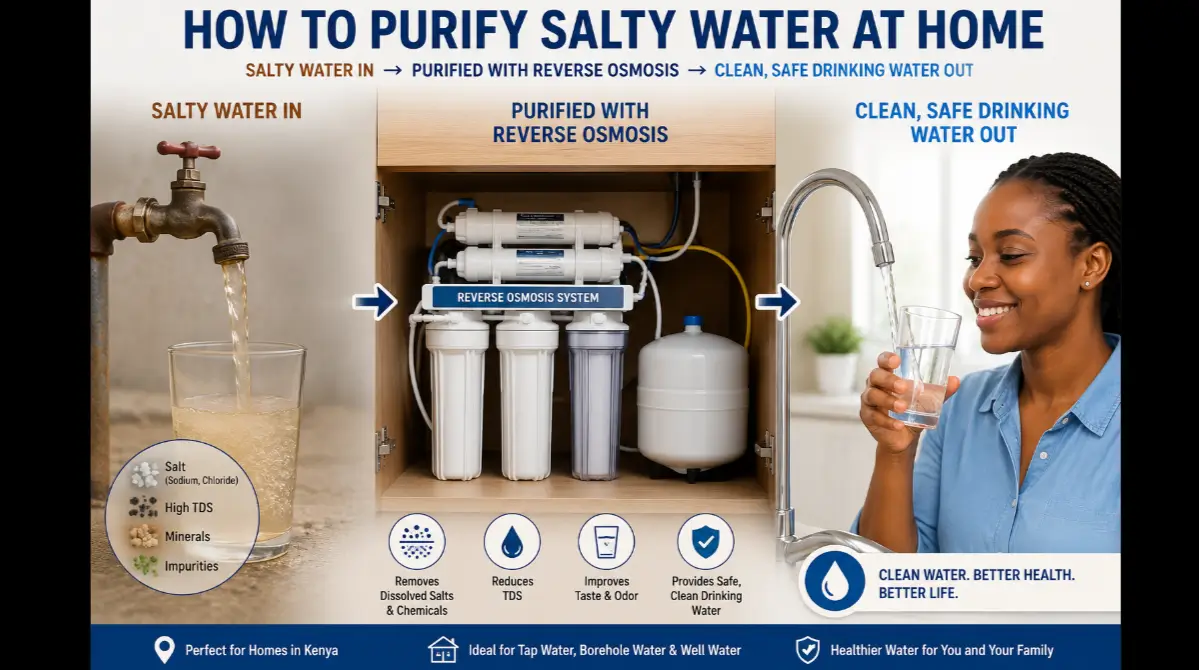
If the water coming from your tap, borehole or well tastes salty, you may be wondering how to purify salty water at home without relying on bottled water every day.
The good news is that salty or high-TDS water can be treated at household level. However, ordinary water filters are usually not enough. Dissolved salts such as sodium and chloride are much smaller than the particles that conventional sediment and carbon filters are designed to remove.
For most homeowners and tenants dealing with salty or brackish water, reverse osmosis (RO) is one of the most practical household treatment technologies because it can remove dissolved salts and other contaminants from water. The U.S. EPA specifically identifies reverse osmosis as a technology that can remove salts from brackish and seawater.
This guide explains how to purify salty water at home, which methods work, which common methods do not, and what Kenyan households should consider before buying a water purification system.
What Does It Mean When Water Is Salty?
Salty water contains elevated concentrations of dissolved minerals and salts. Depending on the source, these may include sodium, chloride, calcium, magnesium, sulphates and other dissolved substances.
Water can become salty for several reasons. In Kenya, common situations include:
- Borehole water with naturally high mineral content
- Groundwater affected by geological formations
- Water sources in or near coastal areas
- Saltwater intrusion into groundwater
- Brackish water sources
- Poorly managed or contaminated water sources
- Water with generally high total dissolved solids (TDS)
Sometimes the problem is immediately noticeable because the water has a salty or unusual taste. However, taste alone cannot tell you exactly what is in the water.
For this reason, households dealing with persistent salty water should consider having the source tested before selecting a purification system.
The World Health Organization recommends a risk-based approach to drinking-water safety, including understanding the quality of the source and selecting treatment technologies appropriate to the particular water-quality problem.
Can You Purify Salty Water at Home?
Yes, salty water can be purified at home, but the treatment method matters.
A basic sediment filter may remove sand, dirt and suspended particles. An activated carbon filter can improve taste and reduce certain chemicals and organic compounds. However, these filters generally do not remove the dissolved salts responsible for salinity.
To substantially reduce dissolved salts, a household normally needs a desalination process such as:
- Reverse osmosis
- Distillation
- In some specialised applications, other membrane or desalination technologies
The WHO identifies reverse osmosis, electrodialysis, multi-effect distillation, solar distillation, multi-stage flash and nanofiltration among technologies used for desalination.
For a typical home, however, reverse osmosis is usually the most practical option because residential RO systems are commercially available and can be installed at the point where drinking and cooking water is needed.
What Is the Best Way to Purify Salty Water at Home?
For most household applications, reverse osmosis is one of the best options for reducing dissolved salts in drinking water.
An RO system uses pressure to push water through a semi-permeable membrane. Water passes through the membrane while a significant portion of dissolved salts and other contaminants is retained in the reject stream.
The EPA describes RO as a membrane separation process that can remove a wide range of contaminants, including dissolved solids, and specifically notes that RO can be used to remove salts from brackish water and seawater.
If you want to understand the technology in more detail, this guide explains how reverse osmosis purifies water.
For a broader explanation of the technology, see what reverse osmosis is and how it works.
How Reverse Osmosis Removes Salt From Water
A household RO system normally combines several treatment stages rather than relying on the RO membrane alone.
A typical system may work approximately as follows:
Stage 1: Sediment filtration
The first filter captures suspended particles such as sand, dirt, rust and other sediment. This protects the downstream filters and membrane.
Stage 2: Activated carbon filtration
Carbon filtration helps reduce chlorine, unpleasant tastes, odours and certain organic contaminants.
Stage 3: Additional carbon or pre-treatment
Depending on the system and source-water quality, another pre-filter may be used to further protect the RO membrane.
Stage 4: Reverse osmosis membrane
This is the key stage for reducing dissolved salts and TDS. Water is forced under pressure through the semi-permeable membrane while much of the dissolved material remains in the reject water.
Stage 5: Post-treatment
A final filter can improve the taste and quality of the treated water before it reaches the dedicated drinking-water tap.
The exact configuration varies between RO systems. Water quality, pressure, TDS, temperature, flow requirements and intended use all affect system selection and performance.
Why Ordinary Water Filters Do Not Remove Salt
One of the biggest misconceptions about salty water is that any water purifier can make it fresh.
That is not the case.
A sediment filter can remove visible particles. A carbon filter can improve taste and reduce certain contaminants. UV systems can be useful for microbial treatment.
But removing dissolved salt requires a different treatment mechanism.
For example, if water contains a high concentration of sodium chloride, passing it through a simple sediment cartridge will not remove the dissolved sodium and chloride ions.
This is why buying a conventional filter simply because the water tastes salty can result in disappointing results.
If your primary problem is high TDS or salinity, look for a system specifically designed to reduce dissolved solids.
Does Boiling Salty Water Remove the Salt?
No. Boiling water does not remove dissolved salt.
Boiling can kill many disease-causing microorganisms, but the dissolved salts remain in the water. As water evaporates, the remaining solution can actually become more concentrated if the steam is not collected and condensed separately.
Therefore, boiling salty borehole or tap water is not an effective household desalination method.
Distillation can remove many dissolved salts because it involves evaporation followed by collection and condensation of the water vapour. However, conventional distillation can be relatively energy-intensive for routine household drinking-water production.
For most Kenyan homes looking for a convenient point-of-use solution, a properly selected RO system is generally more practical.
Can a Water Filter Remove Salt From Borehole Water?
It depends on what is meant by “water filter.”
If the filter is a basic sediment, ceramic or activated-carbon filter, it may improve the appearance, taste or odour of borehole water but may not substantially reduce dissolved salts or TDS.
If the borehole water is salty, a more appropriate approach is to test the water and determine its TDS and other relevant parameters before choosing the treatment system.
This is particularly important because borehole water can contain several different water-quality problems at the same time.
For example, borehole water may contain:
- High TDS
- Hardness
- Iron
- Manganese
- Sediment
- Unpleasant taste or odour
- Microbial contamination
- Other naturally occurring minerals
If your household relies on borehole water, you may also find this guide useful: how to purify borehole water at home.
The right system should address the actual water-quality problem rather than simply treating every borehole as if it had the same composition.
How to Purify Salty Water in a Kenyan Home
For homeowners and tenants in Kenya, a practical approach is to follow these steps.
1. Test the Water First
Before purchasing a purification system, determine what is causing the salty taste.
A basic water analysis can help identify parameters such as TDS, hardness, pH and other contaminants.
This is particularly important where the water comes from a borehole, well or other non-municipal source.
2. Determine Whether You Need Drinking-Water Treatment or Whole-House Treatment
You do not necessarily need to purify every litre of water entering your house.
If the main concern is drinking and cooking water, a point-of-use system installed in the kitchen may be sufficient.
This approach can be particularly attractive to tenants because it avoids the need for extensive modifications to the entire plumbing system.
PureFlex’s guide to home drinking-water filtration systems explains the different approaches households can consider.
3. Consider an Under-Sink RO System
An under-sink RO system is installed beneath the kitchen counter and supplies treated water through a dedicated drinking-water faucet.
This makes it a practical option for households that want purified water for:
- Drinking
- Cooking
- Making tea and coffee
- Preparing food
- Filling drinking bottles
For Kenyan households looking for a compact kitchen solution, PureFlex provides more information about choosing the best under-sink reverse osmosis system in Kenya.
4. Choose the RO System According to the Water Quality
Not every RO system is suitable for every salty-water application.
The salinity and TDS of the source water matter. Very high-salinity water, including seawater, can require systems specifically designed for higher-pressure desalination.
A standard domestic RO system should therefore not automatically be assumed to be suitable for every salty water source.
For a household installation, the appropriate system should be selected based on the source-water analysis, pressure, expected daily consumption and required treated-water quality.
5. Maintain the System
Even a good RO system needs regular maintenance.
Filters gradually become exhausted, while the RO membrane can become less effective if it is not properly maintained or if unsuitable source water is fed into the system.
Routine maintenance may include:
- Replacing sediment filters
- Replacing carbon filters
- Checking the RO membrane
- Checking water pressure
- Inspecting tubing and connections
- Checking the storage tank where applicable
- Monitoring treated-water TDS
- Sanitising components when required
The goal is not simply to install an RO system but to keep it operating properly over time.
What About an Under-Sink Reverse Osmosis System for a Rental House?
An under-sink RO system can be particularly convenient for tenants because it focuses treatment on the kitchen rather than requiring a whole-house installation.
A point-of-use RO system connects to a specific fixture, such as the kitchen sink. The EPA notes that these systems are commonly installed in residential settings and produce treated water through a dedicated point of use.
For a tenant, the main considerations include:
- Available space under the kitchen sink
- Water pressure
- Drain connection
- A suitable location for the storage tank, if included
- Whether the landlord permits minor plumbing modifications
- The quality of the incoming water
If you’re comparing options, you can browse available water purification products or contact PureFlex for guidance on selecting a system.
Is Reverse Osmosis Safe for Drinking Water?
A properly designed, installed and maintained RO system can be used to produce drinking water.
However, the quality of the final water depends on more than the RO membrane itself. Source-water quality, pre-treatment, membrane condition, post-treatment, installation and maintenance all matter.
The WHO notes that desalination systems require appropriate source-water management, treatment and operational controls to ensure safe drinking water.
RO also removes minerals along with salts and other dissolved substances. Depending on the system and source water, post-treatment or remineralisation may therefore be incorporated into the treatment process.
This is one reason it is better to select a complete household water purification system rather than buying an RO membrane and attempting to build a system without understanding the water chemistry.
How Much Does It Cost to Purify Salty Water at Home in Kenya?
The cost depends heavily on the type of system required.
A small point-of-use RO system for drinking and cooking water will generally cost considerably less than a high-capacity system designed to treat water throughout an entire property.
The main factors affecting cost include:
- Source-water TDS
- Required daily capacity
- Number of filtration stages
- RO membrane capacity
- Storage capacity
- Booster-pump requirements
- Pre-treatment requirements
- Installation requirements
- Replacement-filter costs
- Whether remineralisation is included
Before comparing prices, it is important to compare what each system is designed to treat.
PureFlex provides information on reverse osmosis machine prices in Kenya to help households understand the different types of RO systems available.
For a typical kitchen application, a compact domestic system may be sufficient. For a property with very salty water and higher consumption, a larger system or additional pre-treatment may be necessary.
Can a 5-Stage RO System Remove Salt?
A 5-stage RO system can be designed to reduce dissolved salts, but the number of stages alone does not determine performance.
What matters more is the RO membrane, operating pressure, source-water characteristics, membrane condition and overall system design.
For example, a 5-stage system may include sediment filtration, carbon filtration, an RO membrane and post-treatment. The membrane is the stage primarily responsible for reducing dissolved salts.
PureFlex offers a 5-stage reverse osmosis system for household water purification applications.
If the source water has unusually high TDS or salinity, however, it is advisable to confirm that the specific system is rated for the water before installation.
What TDS Level Is Too High for Drinking Water?
TDS is a useful indicator when investigating salty-tasting water, but TDS alone does not tell you whether water is safe to drink.
Two water sources can have similar TDS readings but contain very different dissolved substances.
For that reason, a TDS meter can be useful for monitoring an RO system, but it should not replace appropriate water-quality testing.
A high TDS reading can indicate that further investigation or treatment is needed, particularly when accompanied by salty taste, hardness or other noticeable changes in water quality.
For households dealing with an unfamiliar borehole or well source, laboratory water testing is a better starting point than choosing a purifier solely from a TDS number.
What Is the Difference Between Salty Water and Hard Water?
Salty water and hard water are not necessarily the same thing.
Salty water generally refers to water containing elevated dissolved salts, particularly when sodium and chloride contribute significantly to the taste.
Hard water contains elevated concentrations of minerals such as calcium and magnesium.
A household may have:
- High TDS but relatively moderate hardness
- High hardness but little noticeable saltiness
- Both high hardness and high salinity
- Other contaminants in addition to either
This distinction matters because different treatment technologies address different problems.
RO can reduce a broad range of dissolved substances, while other treatment systems may be more appropriate for specific problems such as hardness or iron.
What Should Kenyan Homeowners Do If Tap Water Suddenly Tastes Salty?
If water that normally tastes normal suddenly becomes salty, do not assume that installing a filter is automatically the answer.
First, investigate the change.
Possible steps include:
- Check whether the taste affects all taps or only one.
- Determine whether neighbours are experiencing the same issue.
- Identify whether the water source has changed.
- Test the water if the problem persists.
- Check TDS and other relevant water-quality parameters.
- Select treatment based on the test results.
If the issue is persistent and the water is intended for drinking, using an appropriate treatment system can provide an additional level of control at the point of consumption.
Why PureFlex Is a Practical Option for Home Water Purification in Kenya
PureFlex Water Solutions focuses on household water purification solutions designed for the Kenyan market.
The company provides kitchen water purifier solutions and RO systems for households looking to improve the quality of their drinking and cooking water.
For homeowners and tenants, the emphasis should be on selecting a system that matches the actual water-quality problem rather than buying the most expensive purifier available.
If you are unsure which system is appropriate, you can contact PureFlex with information about your water source and requirements.
You can also request a quotation if you already know the type of system you need.
The Bottom Line: How to Purify Salty Water at Home
If you are searching for how to purify salty water at home, the most important point is that ordinary filtration is usually not enough to remove dissolved salts.
For most household drinking-water applications, reverse osmosis is one of the most practical technologies for reducing salinity and TDS. It can be installed as a point-of-use system, making it especially useful for kitchens in both owner-occupied and rental homes.
However, the best system depends on the actual water quality.
If your water comes from a borehole, well or another source with a salty taste, start by testing the water. Once you know the TDS, hardness and other relevant parameters, you can choose an RO system or combination of treatment technologies designed for those conditions.
For Kenyan homeowners and tenants who want a convenient drinking-water solution without treating the entire house, an under-sink RO system can be an effective starting point.
Frequently Asked Questions
Can I purify salty water with a normal water filter?
Usually not. Sediment and activated-carbon filters can remove particles and improve taste, but they generally do not remove the dissolved salts responsible for salinity. Reverse osmosis is specifically designed to reduce dissolved salts and other dissolved contaminants.
Does boiling salty water make it safe to drink?
Boiling can kill many microorganisms but does not remove dissolved salt. Therefore, boiling alone is not a desalination method.
What is the best water purifier for salty borehole water?
Reverse osmosis is often an appropriate technology for reducing dissolved salts in borehole water. However, the water should ideally be tested first because borehole water can contain other contaminants that may require additional pre-treatment.
Can reverse osmosis remove sodium from water?
Yes. RO membranes can substantially reduce sodium and other dissolved salts. The actual removal performance depends on the membrane, system design, operating conditions and source-water quality. The CDC identifies RO as a household treatment technology capable of removing aqueous salts, including sodium and chloride.
Does RO remove all the salt from water?
No treatment system should be described as removing every contaminant completely. RO can achieve substantial reduction of dissolved salts, but performance depends on the membrane and operating conditions. Some treated water remains as a concentrated reject stream.
Can I use an RO system for borehole water?
Yes, RO can be used for borehole water, but the system should be selected according to the borehole’s water quality. High levels of sediment, hardness, iron or other contaminants may require pre-treatment before the water reaches the RO membrane.
Is an under-sink RO system suitable for tenants?
It can be. Under-sink RO systems treat water at a specific point of use, making them a practical option where the household primarily needs purified water for drinking and cooking. Tenants should consider available space and obtain permission for any plumbing modifications required by their landlord.
How do I know whether my water is too salty?
A salty taste can be an indication, but taste is not a reliable measurement of water quality. A TDS meter can provide a useful initial indication of dissolved solids, while laboratory testing provides more detailed information about what is actually present in the water.
Does RO waste water?
Yes. RO produces treated water and a concentrated reject stream. The proportion varies according to the system and operating conditions. The EPA notes that RO systems reject part of their feed water as concentrate, which should be considered when choosing and operating a system.
Where can I get a reverse osmosis system in Kenya?
PureFlex Water Solutions provides household RO and water purification solutions in Kenya. Homeowners and tenants can explore available systems, request a quotation, or contact PureFlex for assistance choosing a system based on their water source and requirements.
Can PureFlex help me choose a system for salty water?
Yes. If you know your water source, TDS or laboratory test results, sharing those details when requesting a quotation can help determine which purification approach is appropriate. You can request a water purification quotation from PureFlex for a system suited to your household requirements.
For more information about PureFlex’s approach to household water purification in Kenya, visit PureFlex Water Solutions.

Leave a Comment