
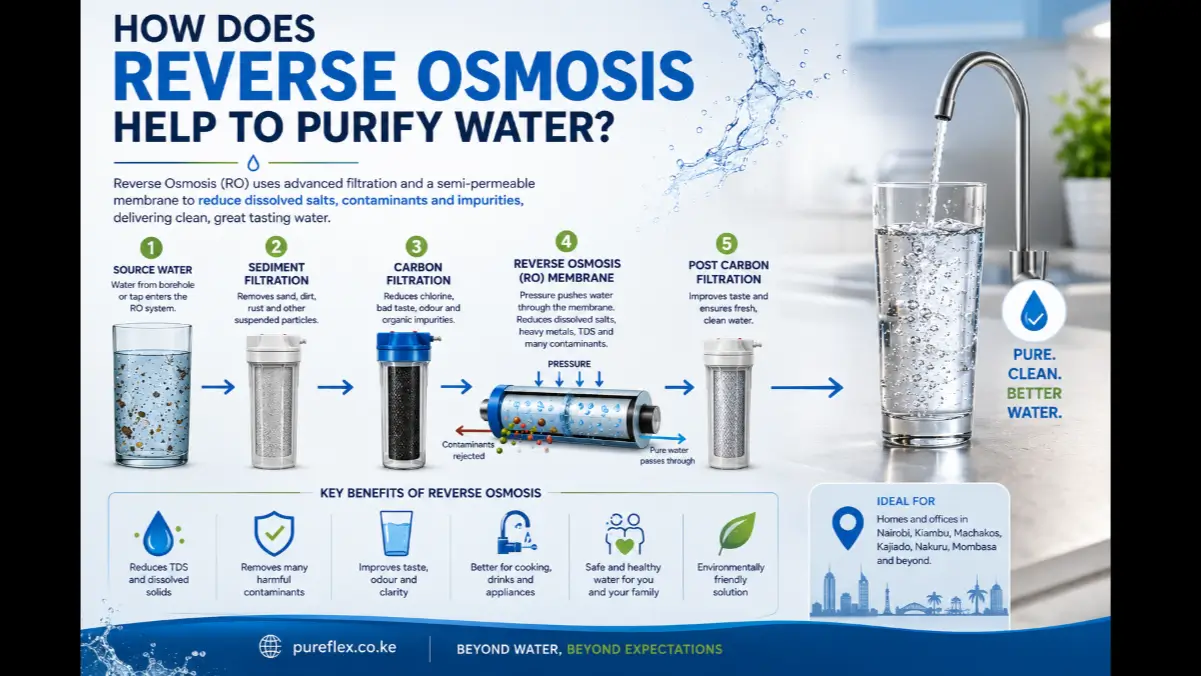
If you have ever wondered how reverse osmosis helps to purify water, the answer comes down to one key process: RO uses pressure to push water through a semi-permeable membrane that allows water molecules to pass while reducing many dissolved substances and other contaminants.
For Kenyan homes, this makes reverse osmosis particularly interesting where drinking water has high TDS, salty taste, hardness, unpleasant taste or other dissolved-water-quality concerns.
RO is also well suited to point-of-use drinking-water treatment. A system can be installed beneath the kitchen sink so that purified water is available from a dedicated tap without requiring the entire household water supply to be treated. The U.S. Environmental Protection Agency describes point-of-use RO systems as systems connected to a single fixture, such as a kitchen sink, and notes that they can also be used in offices and commercial kitchens.
For homeowners in Nairobi, Kiambu, Kajiado, Machakos, Nakuru, Mombasa and other parts of Kenya, understanding how RO works can make it much easier to choose the right water purification system.
What Is Reverse Osmosis?
Reverse osmosis is a membrane-based water treatment process.
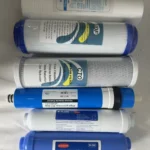
In a typical RO system, water passes through several stages before reaching the RO membrane. Pressure then forces the water through the semi-permeable membrane.
The membrane acts as a highly selective barrier. Water that passes through becomes the permeate, while the concentrated stream containing substances rejected by the membrane becomes the reject or concentrate water.
A simplified process looks like this:
Source water → sediment filtration → carbon filtration → RO membrane → post-filtration → purified drinking water
This is why an RO system is more than simply a single filter.
The different stages work together to protect the membrane, improve water quality and produce better-tasting drinking water.
How Does Reverse Osmosis Help to Purify Water?
Reverse osmosis helps purify water by reducing a broad range of dissolved and suspended substances through membrane separation.
According to the U.S. EPA, RO can remove or reduce a wide range of contaminants, including many inorganic substances, dissolved solids, radionuclides and synthetic organic chemicals. RO can also be used to remove salts from brackish water.
This makes RO particularly useful in situations where conventional sediment or carbon filtration alone cannot adequately address the problem.
For example, a sediment filter can remove particles, while activated carbon is useful for reducing chlorine, taste and odour. Neither is designed to perform the same dissolved-solids reduction as an RO membrane.
That distinction is particularly important for borehole water in Kenya.
How Reverse Osmosis Works Step by Step
Understanding the individual stages makes the technology much easier to understand.
Step 1: Water Enters the RO System
Water from the household supply enters the purification system.
The source could be:
- Borehole water
- Municipal water
- Stored household water
- Another suitable water source
The quality of the incoming water determines how the system should be configured.
For borehole users, this is particularly important because groundwater quality can vary significantly between locations.
A borehole in Ruiru or Juja may have a different water profile from one in Kitengela, Ngong, Athi River or Mombasa.
That is why water testing should come before selecting an RO system.
Step 2: Sediment Filtration Removes Larger Particles
The first filtration stages commonly remove larger suspended particles such as:
- Sand
- Dirt
- Rust
- Silt
- Sediment
This protects the downstream components and helps prevent the RO membrane from becoming prematurely clogged.
If borehole water contains significant sediment, appropriate pre-filtration becomes particularly important.
Step 3: Activated Carbon Improves Taste and Protects the Membrane
Carbon filtration is commonly used before the RO membrane.
Activated carbon can help reduce chlorine, unpleasant tastes, odours and certain organic compounds.
This stage is important because the RO membrane needs appropriate protection from the characteristics of the incoming water.
The result is not only better-looking water but also better conditions for the RO membrane to operate.
Step 4: Pressure Pushes Water Through the RO Membrane
This is the stage that makes reverse osmosis different from ordinary filtration.
Water is placed under pressure and forced through a semi-permeable membrane.
The membrane allows water to pass while rejecting many substances that are too large or otherwise unable to pass through it effectively.
The EPA describes RO as a process where pressure forces water through a semi-permeable membrane, producing treated water and a concentrated reject stream.
This is where RO can substantially reduce dissolved solids and many other contaminants.
Step 5: Purified Water Is Collected
The water that passes through the membrane is collected as treated water.
In an under-sink system, it can be stored in a small pressure tank or handled according to the specific system design before being delivered through a dedicated drinking-water faucet.
This gives the homeowner convenient access to purified water directly at the kitchen sink.
What Does Reverse Osmosis Remove From Water?
RO can reduce a broad range of dissolved substances, although actual performance depends on the membrane, system design, incoming-water quality and operating conditions.
RO is particularly useful for reducing:
- Dissolved salts
- Many dissolved minerals
- TDS
- Certain heavy metals
- Some inorganic contaminants
- Some microorganisms
- Certain chemical contaminants
The EPA notes that RO systems can potentially remove contaminants including lead, VOCs, PFAS, arsenic, bacteria and viruses, although performance varies by system and contaminant.
This is one reason homeowners should avoid choosing a purifier based solely on marketing claims.
The right question is not simply “Does RO purify water?” but “What does my water contain, and is RO appropriate for those contaminants?”
Why RO Is Useful for Borehole Water in Kenya
Borehole water is one of the strongest use cases for investigating RO.
Groundwater can contain naturally occurring minerals and dissolved substances picked up as water moves through geological formations.
Some homeowners notice:
- Salty taste
- High TDS readings
- Hardness
- Scale on kettles
- Deposits around taps
- Unpleasant taste
- Metallic taste
- Staining
However, these symptoms alone cannot tell you exactly what is in the water.
Testing is the better starting point.
For homeowners who want to understand the broader treatment process, see this guide on how to purify borehole water at home.
Does Reverse Osmosis Remove TDS?
Yes, reverse osmosis is specifically useful for reducing many dissolved substances that contribute to TDS.
Total dissolved solids (TDS) refers to the concentration of dissolved substances in water. A high TDS reading does not, by itself, identify which substances are present or establish that water is unsafe.
However, it can be a useful indicator when assessing water-treatment requirements.
For example, homeowners in parts of Kajiado County, Machakos County, Kiambu County and other areas using borehole water may encounter water with noticeable mineral content.
RO can be an appropriate technology where water testing indicates that substantial dissolved-solids reduction is required.
Does Reverse Osmosis Remove Salt From Water?
Yes. Reverse osmosis can reduce dissolved salts, which is one reason it is used for treating brackish and saline water.
The EPA specifically identifies RO as a technology that can be used to remove salts from brackish water and seawater.
This can be particularly relevant in parts of Mombasa County, Kilifi County and other coastal areas, where some water sources may have elevated salinity.
However, the correct system should be selected according to the actual water-quality conditions.
Does Reverse Osmosis Remove Hardness?
RO can substantially reduce many dissolved minerals that contribute to hardness.
For a homeowner, this can potentially help with issues such as:
- Scale formation
- Mineral deposits
- Unpleasant taste
- Appliance deposits
However, if the objective is to treat the entire household water supply, a different treatment configuration may be appropriate.
For drinking and cooking water, an under-sink RO system provides a more targeted approach.
RO vs Ordinary Water Filters
A common misconception is that all water filters work in essentially the same way.
They do not.
| Treatment | Main purpose | Dissolved-solids reduction |
|---|---|---|
| Sediment filter | Removes suspended particles | Limited |
| Activated carbon | Taste, odour and certain chemicals | Limited |
| UF | Fine filtration and reduction of many microorganisms/particles | Generally limited |
| RO | Broad reduction of many dissolved substances | Yes |
This is why RO is often considered when the water problem involves TDS, salinity or dissolved substances, rather than simply visible sediment.
RO vs UF: Which Is Better?
Neither technology is automatically better for every household.
The better choice depends on the water.
Choose RO when:
- TDS is high
- Water has a salty taste
- Dissolved salts are a concern
- Significant dissolved-solids reduction is required
- The water test indicates that RO is appropriate
Consider UF when:
- The water does not require substantial dissolved-solids reduction
- Fine filtration is required
- Retaining dissolved minerals is desirable
- The water-quality profile is appropriate for UF
For homeowners trying to decide between the two technologies, an under-sink RO or UF system can provide convenient point-of-use treatment in the kitchen.
Why Under-Sink RO Is Popular for Kenyan Kitchens
One of the biggest advantages of an under-sink RO system is that it treats water where it is consumed.
Instead of installing a large purification system throughout the house, the system can be positioned beneath the kitchen counter.
The result is:
Existing water supply → under-sink RO → dedicated drinking-water tap
This approach is especially attractive for modern kitchens in:
- Nairobi
- Kiambu
- Ruiru
- Ruaka
- Kiambu Town
- Thika
- Syokimau
- Kitengela
- Kajiado
- Machakos
- Nakuru
Homeowners in these areas can have very different water sources and quality profiles, so point-of-use RO provides a flexible approach to drinking-water treatment.
Pureflex’s under-sink reverse osmosis systems in Kenya are designed around this type of kitchen application.
Why Choose an Under-Sink System Instead of a Countertop Purifier?
Both approaches can work, but they suit different kitchens.
Under-sink RO
Best suited for homeowners who want:
- A cleaner countertop
- A permanent installation
- Purified water directly from a dedicated faucet
- Equipment hidden inside the kitchen cabinet
Countertop RO
Can be useful where:
- Cabinet space is limited
- The homeowner is renting
- Major plumbing modifications are undesirable
- A portable or visible solution is preferred
Pureflex’s kitchen water purification solutions allow homeowners to consider different point-of-use configurations based on their kitchen and water-treatment needs.
What About Cabinet RO Systems?
Some households need more than a compact under-sink setup.
A cabinet RO system can be considered where there is:
- Higher household water demand
- More available installation space
- A need for a larger-capacity purification setup
- A dedicated utility or kitchen area
The important thing is to match system capacity to actual household consumption rather than automatically choosing the largest system available.
Can RO Be Used for Office Drinking Water?
Yes.
Point-of-use RO is not limited to residential kitchens. The EPA notes that point-of-use RO systems can also be installed in commercial office spaces and kitchens.
This creates an opportunity for businesses that want a more permanent drinking-water solution rather than relying entirely on bottled water.
For example, RO can be considered for:
- Nairobi offices
- Corporate offices in Westlands
- Businesses in Kilimani
- Offices along Mombasa Road
- Industrial businesses in Athi River
- Offices in Thika
- Businesses in Nakuru CBD
- Hospitality establishments
- Dining rooms and staff kitchens
For offices with higher consumption, the appropriate solution may differ from a compact household under-sink unit.
Is Reverse Osmosis Water Safe to Drink?
A properly designed and maintained RO system can be used for drinking-water treatment, but the phrase “RO water is automatically safe” should be avoided.
The safety of the finished water depends on:
- Source-water quality
- System design
- Appropriate pretreatment
- Membrane performance
- Filter condition
- Installation
- Maintenance
- Storage and handling
Kenya’s Water Services Regulatory Board states that water quality affects both public health and the aesthetic quality of water as a consumable product.
For this reason, homeowners should assess the source water and select an appropriate treatment system rather than assuming that any RO system will solve every water-quality problem.
Does RO Waste Water?
RO produces two streams:
- Treated water
- Reject/concentrate water
The reject stream contains a higher concentration of substances rejected by the membrane and is normally discharged or handled according to the system design.
The amount of reject water varies significantly by system.
The EPA notes that conventional point-of-use RO systems can produce substantial reject-water volumes and that system efficiency varies.
This is an important factor when comparing RO systems.
When buying an RO system for a Kenyan home, don’t look only at the number of filtration stages. Ask about:
- Recovery rate
- Water production capacity
- Membrane specification
- Operating pressure
- Replacement-filter availability
- Maintenance requirements
How Often Do RO Filters Need Replacement?
An RO system contains consumable components.
Depending on the system, these may include:
- Sediment/PP filters
- Activated carbon filters
- RO membrane
- Post-carbon filter
- Other cartridges
Replacement intervals depend on source-water quality, water consumption and the particular system.
A household using heavily mineralized or sediment-laden borehole water may need more frequent maintenance than a household with cleaner source water.
This is why the long-term running cost should be considered when buying an RO system.
A cheap system that is difficult to maintain may ultimately be less convenient than a system with readily available replacement filters and support.
What Should You Test Before Buying an RO System?
Before selecting an RO system, consider testing the source water for parameters relevant to the intended use.
Depending on the water source, this can include:
- TDS
- pH
- Hardness
- Iron
- Manganese
- Chloride
- Sulphate
- Nitrate
- Microbiological parameters
- Other contaminants relevant to the local water source
KEBS provides testing services and maintains Kenya’s standards framework for products and services.
For a private borehole, testing is especially useful because water quality can vary considerably between properties, even within the same county.
Why Water Testing Matters in Nairobi and Other Kenyan Counties
Water-treatment requirements are not identical everywhere.
A homeowner in Ruiru, Kiambu County may be dealing with a different source-water profile from someone in Kitengela, Kajiado County.
Likewise:
- Machakos County — borehole users may have different mineral and hardness concerns.
- Nakuru County — source-water characteristics can vary between residential areas and properties.
- Mombasa County — salinity can be an important consideration in some water sources.
- Kilifi County — groundwater conditions can differ considerably between locations.
- Kiambu County — homeowners using boreholes may require different filtration configurations depending on the source.
- Nairobi County — households may use municipal water, borehole water or stored water, each requiring its own assessment.
This is why Pureflex should not simply sell the same purifier to every customer.
The better approach is to understand the customer’s water source, water-quality problem, household size and kitchen setup before recommending a system.
How to Choose the Right RO System for Your Home
Before buying, ask these questions:
What is your water source?
Is it:
- Borehole water?
- Municipal water?
- Stored water?
- Another source?
What does your water test show?
This determines whether RO is appropriate and whether additional pretreatment may be required.
How many people will use the purified water?
A one- or two-person household may have very different requirements from a large family.
How much kitchen space do you have?
This can determine whether an under-sink, countertop or cabinet configuration makes more sense.
Do you want the system hidden?
If you want an uncluttered kitchen counter, an under-sink system is particularly attractive.
Can you easily obtain replacement filters?
This is one of the most overlooked questions when purchasing a purifier.
Where Can You Buy an RO Water Purifier in Kenya?
For homeowners searching for an RO water purifier in Kenya, Pureflex focuses on point-of-use purification solutions for kitchens and other drinking-water applications.
The range includes solutions suited to:
- Residential kitchens
- Under-sink installations
- Countertop applications
- Cabinet installations
- Drinking-water points
- Office environments
If you’re in Nairobi, Ruiru, Ruaka, Kiambu, Thika, Juja, Kitengela, Ngong, Athi River, Machakos, Nakuru, Mombasa or Kilifi, the right system should be determined by your actual water source and intended application.
You can view available Pureflex water purification products or explore the company’s kitchen water purifier solutions.
Get an RO System That Fits Your Water and Kitchen
Buying an RO system should not be about choosing the system with the most stages or the lowest price.
It should be about choosing the right technology for your water.
If you have salty borehole water in Kitengela, high-TDS water in Kajiado, mineral-rich groundwater in parts of Machakos, or simply want better-tasting drinking water in a Nairobi kitchen, the appropriate RO configuration can be very different from what another household needs.
Pureflex can help you evaluate the application and identify a suitable point-of-use solution.
For homeowners considering an under-sink installation, start with the detailed guide to the best under-sink reverse osmosis system in Kenya.
If you’re ready to discuss your requirements, contact Pureflex or request a quotation.
Conclusion
So, how does reverse osmosis help to purify water?
RO uses pressure to force water through a semi-permeable membrane, reducing many dissolved substances and contaminants while producing a treated-water stream. It is particularly valuable when the water contains high TDS, dissolved salts or other contaminants that conventional sediment and carbon filters cannot adequately address.
For Kenyan households, RO can be especially useful as a point-of-use drinking-water solution. An under-sink RO system can sit beneath the kitchen counter and provide purified water through a dedicated tap, while countertop and cabinet configurations provide alternatives for different kitchen layouts and household demands.
The best system, however, starts with the water.
Test the water. Understand the problem. Choose the appropriate purification technology.
For a home in Nairobi, Kiambu, Kajiado, Machakos, Nakuru, Mombasa or elsewhere in Kenya, Pureflex can help you find a practical RO solution for your kitchen.
Frequently Asked Questions
How does reverse osmosis help to purify water?
Reverse osmosis purifies water by using pressure to push it through a semi-permeable membrane. The membrane reduces many dissolved substances and contaminants, producing a treated-water stream and a concentrated reject stream.
What does reverse osmosis remove from water?
RO can reduce many dissolved solids, salts, inorganic substances and other contaminants. The exact contaminants and removal performance depend on the membrane, system design and source-water conditions.
Does reverse osmosis remove TDS?
Yes. RO is designed to reduce many dissolved substances that contribute to TDS and is commonly considered when water has high dissolved-solids levels.
Does reverse osmosis remove salt from borehole water?
Yes. RO can reduce dissolved salts and is used for treating brackish and saline water. If borehole water tastes salty, testing should be carried out before selecting the appropriate system.
Is RO better than a normal water filter?
It depends on the water-quality problem. Conventional sediment and carbon filters are useful for particular contaminants and characteristics, while RO is more appropriate when substantial reduction of dissolved substances is required.
Is RO better than UF for borehole water?
Not automatically. RO is generally more suitable when high TDS or dissolved salts are the concern. UF may be appropriate where substantial dissolved-solids reduction is not required. A water test can help determine the better option.
Can I install reverse osmosis under my kitchen sink?
Yes. Point-of-use RO systems are commonly installed beneath kitchen sinks and connected to a dedicated drinking-water faucet.
Is reverse osmosis suitable for Kenyan borehole water?
It can be, particularly where testing identifies high TDS, salinity or other dissolved-water-quality concerns. The system should be selected according to the actual borehole-water characteristics.
Does reverse osmosis waste water?
RO produces both treated water and reject water. The amount of reject water depends on the system design and operating conditions. More efficient RO systems can reduce water wastage.
How often should an RO membrane be replaced?
There is no single replacement interval that applies to every system. Membrane life depends on source-water quality, pretreatment, water consumption, operating conditions and maintenance.
Do RO systems need replacement filters?
Yes. Most RO systems use pre-filters and post-filters in addition to the RO membrane. These components require periodic replacement to maintain system performance.
Can RO water be used for cooking?
Yes, treated water from a properly designed and maintained RO system can be used for drinking and cooking. The suitability of the finished water depends on the source water, system configuration, maintenance and intended use.
Should I test my water before buying an RO system?
Yes. Testing helps identify the actual water-quality problem and can prevent homeowners from purchasing a system that is unsuitable or unnecessarily complex for their water.
Where can I buy an under-sink RO system in Kenya?
Pureflex provides home-focused water purification solutions, including under-sink RO systems. View the under-sink RO guide or contact Pureflex to discuss your requirements.
Can Pureflex help me choose an RO system for my home?
Yes. You can request a quotation and provide details about your water source, location, household requirements and preferred installation. Pureflex can then help identify a suitable purification configuration.
Leave a Comment