
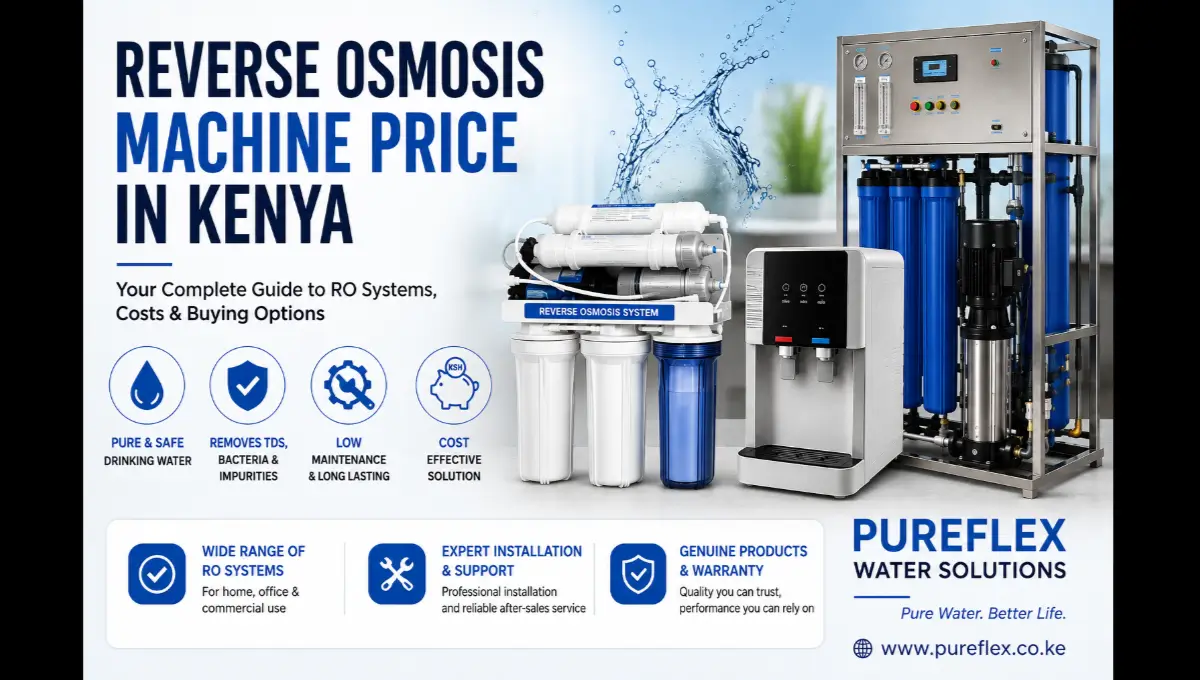
A reverse osmosis (RO) system is one of the most effective water purification technologies available in Kenya today, trusted for both home drinking water and large-scale commercial water treatment. From compact under-sink units to industrial-grade purification plants, RO systems are designed to deliver safe, clean, and great-tasting water by removing dissolved salts, contaminants, and impurities at a molecular level.
In Kenya, RO machine pricing varies widely because systems are built for different applications, water sources, and output capacities. A domestic unit may start from around KSh 25,000, while fully equipped commercial RO plants can exceed KSh 1 million, depending on specifications, automation, and installation requirements.
This makes it essential to choose based on water demand, source quality, and intended use rather than price alone.
Reverse Osmosis Machine Prices in Kenya
The following table provides an indicative 2026 price guide for common RO system categories in Kenya. Prices can change depending on the membrane specification, pump, pre-treatment, storage, automation, installation and water-quality requirements.
| RO System Type | Typical Capacity | Indicative Price in Kenya |
|---|---|---|
| 5 stage Basic Under-Sink RO System | 100–400 GPD | KSh 25,000–40,000 |
| 7 stage under-sink RO system | 100-400 GPD | kSH 30,000-5000 |
| Cabinet RO Water Purifier | Domestic | KSh 45,000–80,000 |
| RO Water Dispenser | Domestic/Office | KSh 32,000–60,000 |
| 125 LPH Commercial RO | 125 L/h | KSh 180,000–300,000 |
| 250 LPH Commercial RO | 250 L/h | KSh 230,000–575,000 |
| 500 LPH Commercial RO | 500 L/h | KSh 370,000–775,000 |
| 750 LPH Commercial RO | 750 L/h | KSh 500,000–650,000 |
| 1,000 LPH Commercial RO | 1,000 L/h | KSh 580,000–1,200,000 |
| 2,000 LPH Commercial RO | 2,000 L/h | KSh 950,000–1,500,000 |
These are planning ranges rather than fixed Pureflex quotations. Current Kenyan listings illustrate why prices vary: for example, public listings show 250 LPH systems around KSh 230,000–575,000, 500 LPH systems around KSh 370,000–775,000 and 1,000 LPH systems from roughly KSh 580,000 to KSh 1.2 million depending on configuration.
For a specific system, it is better to request a quotation from Pureflex than rely on a generic online price.
How Much Does a Domestic Reverse Osmosis System Cost in Kenya?
For a typical household, an under-sink or compact domestic RO system is usually the most practical option.
A 5-stage 100 GPD reverse osmosis system, for example, can produce approximately 378 litres per day under rated conditions. That is more than sufficient for the drinking and cooking requirements of many households.
Pureflex offers domestic RO solutions for customers looking for a compact drinking-water purification system rather than a commercial water-treatment plant.
See the 5 Stage Reverse Osmosis System for a product-specific option.
Domestic RO systems can include:
- PP sediment filtration
- Activated carbon filtration
- RO membrane
- Post-carbon filtration
- Mineral or alkaline filtration on selected models
- Pressurised storage tank
- Dedicated drinking-water faucet
- Booster pump where required
The number of stages alone should not determine your purchase. A well-designed 5-stage RO system can be more appropriate than a poorly configured 7-stage system.
Under-Sink Reverse Osmosis System Price in Kenya
An under-sink RO system is designed to fit beneath a kitchen counter and deliver purified water through a separate drinking-water faucet.
This is generally one of the most cost-effective RO options for households because it focuses on producing drinking and cooking water rather than treating every litre used in the house.
Typical applications include:
- Nairobi homes
- Apartments
- households
- homes
- Offices
- Airbnb properties
- Small restaurants
- Rental apartments
If space and appearance matter, an under-sink system is often preferable to a larger open-frame treatment plant.
Pureflex’s guide to the best under-sink reverse osmosis systems in Kenya explains the differences between domestic systems and what to consider before purchasing.
Cabinet RO System Price in Kenya
A cabinet RO system places the filtration components inside an enclosed cabinet. This creates a cleaner appearance and protects the equipment from dust and accidental interference.
Cabinet systems can be useful where the purifier will be installed in a visible kitchen, office, reception area or commercial environment.
The final price depends heavily on:
- RO membrane capacity
- Number and type of filters
- Booster pump
- Storage capacity
- Cabinet construction
- Mineral or alkaline stages
- Automatic controls
- Water-quality requirements
A cabinet system should therefore be compared according to its actual specifications, rather than simply its advertised number of filtration stages.
RO Water Dispenser Price in Kenya
An RO water dispenser combines purification and water dispensing in one appliance. Some modern units also provide temperature control or instant heating, making them particularly attractive for offices and modern kitchens.
Current Kenyan retail listings show domestic RO dispensers around the KSh 32,000–40,000 level for some models, while more advanced systems can cost considerably more.
The major advantage is convenience: the user does not necessarily need a conventional under-sink installation.
For households or offices where space, appearance and convenience are priorities, a countertop or integrated kitchen water purifier may be worth considering.
250 LPH RO Machine Price in Kenya
A 250 LPH reverse osmosis machine produces approximately 250 litres of treated water per hour under its rated operating conditions.
It can be suitable for:
- Small water businesses
- Offices
- Schools
- Restaurants
- Clinics
- Institutions
- Small-scale packaged-water operations
Current Kenyan public listings show considerable variation, with 250 LPH systems listed from approximately KSh 230,000 to KSh 575,000, depending on whether the price covers only the RO machine or a more complete treatment setup.
This distinction is extremely important.
A quotation for a 250 LPH RO membrane system may not include:
- Raw-water storage
- Sand filtration
- Activated carbon filtration
- Water softener
- Antiscalant dosing
- UV sterilisation
- Product-water storage
- Installation
- Plumbing
- Electrical work
Consequently, two suppliers can quote very different prices for what appears to be the same 250 LPH machine.
500 LPH Reverse Osmosis Machine Price in Kenya
A 500 LPH RO system produces approximately 500 litres of purified water per hour and is more appropriate for businesses or institutions with higher water requirements.
Public Kenyan prices currently range widely. Examples include systems listed around KSh 370,000, KSh 550,000 and KSh 775,000, depending on configuration and whether the quotation represents the machine alone or a more complete setup.
For a commercial installation, the water analysis should be completed before purchasing the machine.
1,000 LPH Reverse Osmosis Machine Price in Kenya
A 1,000 LPH RO plant can produce up to approximately 1,000 litres of treated water per hour under its rated conditions.
It is commonly considered for:
- Water vending businesses
- Bottled-water operations
- Hotels
- Schools
- Hospitals and healthcare facilities
- Manufacturing
- Large offices
- Institutions
Current Kenyan listings place 1,000 LPH RO systems at approximately KSh 580,000 to KSh 1.2 million or more, depending on the treatment configuration.
A 1,000 LPH machine should not be selected simply because it has greater capacity. If the actual requirement is 250 LPH, purchasing a significantly larger plant can increase capital, electricity, maintenance and pre-treatment costs unnecessarily.
What Determines the Price of an RO Machine in Kenya?
1. Capacity
Capacity is one of the most obvious price factors.
A 100 GPD domestic purifier and a 1,000 LPH commercial plant are fundamentally different systems. Higher-output machines generally require larger membranes, higher-capacity pumps, stronger frames and more extensive pre-treatment.
2. Water Source
The source of water can have a major impact on the final system cost.
Municipal water may require relatively straightforward pre-filtration, while borehole water may require additional treatment for hardness, iron, manganese, fluoride, salinity or high TDS.
This is why borehole water purification should begin with understanding the actual water chemistry rather than choosing a machine based on price alone.
3. TDS and Dissolved Minerals
RO membranes are particularly useful when the objective is to reduce dissolved solids.
However, TDS is only one measurement. A water analysis can provide a much better picture of what treatment is required.
4. Pre-Treatment
Commercial RO systems often require pre-treatment to protect the membrane.
Depending on the source, this can include:
- Sand or multimedia filtration
- Activated carbon
- Sediment filtration
- Water softening
- Iron removal
- Antiscalant dosing
- UV disinfection
Adding these components increases the initial price but can be important for reliable operation.
5. Automation
Automatic systems can control functions such as:
- Tank filling
- Backwashing
- Membrane flushing
- Low-pressure protection
- High-level shutdown
- System operation
Automation can increase the purchase price but reduce manual intervention.
6. Construction Materials
The frame, pump, housings, piping and other components also affect the cost.
For commercial installations, buyers should look beyond the headline price and examine the actual specifications and component quality.
Is a Cheap RO Machine Worth Buying?
Not necessarily.
A low purchase price can be attractive, but the cheapest machine may not be the cheapest system to operate.
Before comparing quotations, ask:
What exactly is included?
A proper comparison should consider:
| Cost Component | Why It Matters |
|---|---|
| RO membrane | Determines treatment performance and replacement cost |
| High-pressure pump | Affects pressure, reliability and energy use |
| Pre-treatment | Protects the RO membrane |
| Storage tanks | Determines how much treated water is available |
| Controls | Affect automation and ease of operation |
| Installation | Can add substantially to the project cost |
| Water testing | Helps determine the correct treatment design |
| Spare filters | Important for ongoing maintenance |
| Warranty | Provides additional protection after purchase |
| After-sales support | Important for commercial systems |
The cheapest quotation is not automatically the best value.
RO Machine vs Water Filter: Which Should You Buy?
The answer depends on the problem you are trying to solve.
A conventional sediment or carbon filter can be suitable when the main concern is suspended particles, chlorine, taste or odour.
RO becomes more relevant when dissolved contaminants and high TDS are a concern.
Pureflex explains the technology in more detail in How Reverse Osmosis Purifies Water.
For households that want to improve drinking water without treating the entire house, a home drinking-water filtration system can be a more targeted approach.
How Much Does It Cost to Install an RO Machine in Kenya?
Installation costs vary because there is no single installation requirement for every RO system.
A domestic under-sink system may require relatively straightforward plumbing, while a commercial RO plant can require:
- Raw-water storage
- Product-water storage
- Drain connections
- Electrical installation
- Feed-water pumps
- Pre-treatment equipment
- Product-water distribution
- Machine-room preparation
For this reason, commercial RO installations are best quoted after reviewing the site, water source and required production capacity.
Contact Pureflex for assistance with selecting an appropriate system.
How to Choose the Right Reverse Osmosis Machine in Kenya
Instead of starting with your budget, start with these five questions:
1. What is your water source?
Municipal, borehole, well, rainwater or another source?
2. What is the water quality?
Ideally, obtain a water-quality analysis before selecting a commercial RO system.
3. How much purified water do you need?
A household may need a domestic RO system, while a water business may require 250 LPH, 500 LPH, 1,000 LPH or more.
4. Where will the system be installed?
Kitchen, office, commercial premises, treatment room or dedicated plant area?
5. What should the quotation include?
Ask whether the price covers installation, pre-treatment, tanks, pumps, controls and commissioning.
This approach can prevent the common mistake of buying a machine that is either too small for the application or unnecessarily expensive for the actual requirement.
Are RO Systems Suitable for Borehole Water in Kenya?
Yes, RO systems can be used for borehole water, but the correct configuration depends on the characteristics of the borehole water.
Borehole water can vary significantly between locations. One borehole may have relatively low TDS but high hardness, while another may have elevated salinity, iron, fluoride or other parameters.
That is why a water test should guide the design of a commercial RO plant.
For households considering RO for borehole water, see How to Purify Borehole Water at Home.
For broader water-quality and standards information, the Kenya Bureau of Standards (KEBS) publishes Kenya’s gazetted standards and related standards information.
Where to Buy a Reverse Osmosis Machine in Kenya
Pureflex Water Solutions provides water purification solutions for residential and commercial applications in Kenya.
Rather than selling every customer the same RO machine, the focus should be on matching the system to the intended application, water source and required output.
You can browse available water purification products or request a quotation if you already know your required capacity.
To learn more about the company and its water-treatment solutions, visit the Pureflex Water Solutions page.
Frequently Asked Questions
How much is a reverse osmosis machine in Kenya?
The price depends on the type and capacity. Domestic systems can start at around KSh 25,000, while commercial RO systems can range from approximately KSh 230,000 for smaller 250 LPH systems to more than KSh 1 million for larger 1,000–2,000 LPH installations. Public Kenyan listings show substantial price variation based on configuration.
How much is a 250 LPH RO machine in Kenya?
A 250 LPH RO machine can cost approximately KSh 230,000–575,000, depending on the equipment included. A complete water-treatment setup can cost more than the RO machine itself.
How much is a 500 LPH reverse osmosis machine in Kenya?
A 500 LPH RO system can range from approximately KSh 370,000 to KSh 775,000 or more, depending on the configuration, pre-treatment and whether installation is included.
How much is a 1,000 LPH RO machine in Kenya?
A 1,000 LPH system can cost approximately KSh 580,000 to KSh 1.2 million or more. The final price depends on the membrane system, pre-treatment, automation, storage and installation requirements.
What is the cheapest RO system for a home in Kenya?
A compact domestic under-sink RO system is generally among the most affordable options for producing purified drinking water at home. Current Kenyan listings show domestic RO products from around KSh 25,000, although specifications vary considerably.
Is a 5-stage RO system enough for a Kenyan home?
For many households, a properly configured 5-stage RO system can provide effective drinking-water purification. However, the ideal configuration depends on the source water. Borehole water with specific problems such as excessive hardness, iron or high TDS may require additional pre-treatment.
Does RO remove TDS?
Yes. Reverse osmosis membranes are designed to reduce dissolved salts and many other dissolved substances. The actual rejection performance depends on the membrane, feed-water conditions, pressure and system design.
How often should RO filters be replaced?
Replacement intervals depend on water quality, consumption and filter type. Sediment and carbon filters generally require more frequent replacement than the RO membrane. A system should be maintained according to its operating conditions rather than relying on a single universal replacement schedule.
Should I buy a 250 LPH, 500 LPH or 1,000 LPH RO machine?
Choose according to your required production volume. A smaller system may be adequate for a small operation, while a water-vending or bottling business with higher demand may require 500 LPH, 1,000 LPH or more. A water-treatment specialist can calculate the appropriate capacity based on daily demand and operating hours.
Final Verdict: What Is the Best RO Machine Price in Kenya?
There is no single “best” reverse osmosis machine price in Kenya because domestic and commercial RO systems serve completely different purposes.
For a household, paying for a large commercial plant makes little sense when an appropriately sized under-sink or cabinet RO system can provide the required drinking water.
For a business, choosing the cheapest machine can be equally problematic if the system lacks the pre-treatment, capacity or components needed for the actual water source.
The better approach is to compare capacity, water quality, membrane specification, pre-treatment, pump, automation, installation, warranty and after-sales support alongside the price.
If you are unsure which system you need, contact Pureflex Water Solutions with your water source, estimated daily consumption and intended application. The right system can then be selected based on the actual treatment requirement rather than a generic price list.
Looking for a reverse osmosis machine in Kenya? Explore Pureflex products or request a customised quotation.
Leave a Comment