
Is your borehole water salty, does your tap water have an unpleasant taste or odour, or are you simply uncomfortable drinking water directly from the kitchen tap?
A kitchen water purifier can give your household a dedicated source of treated drinking water without requiring you to purify every litre of water used around the home.
This is particularly useful in Kenya, where households rely on different water sources. A home in Nairobi may rely on municipal supply, while a household in Kajiado, Ngong, Syokimau, Machakos or Nakuru may depend partly or entirely on borehole water. In Mombasa and other coastal areas, water characteristics can also differ considerably from those experienced inland.
The important point is that there is no single water purifier that is automatically best for every Kenyan kitchen.
The right choice depends on your water source, water quality, household requirements, available kitchen space and what you want the purifier to achieve.
At Pureflex Water Solutions, we focus on practical purification solutions for modern Kenyan kitchens, including under-sink reverse osmosis systems and countertop water purifiers.
Why Do Kenyan Homes Need a Kitchen Water Purifier?
Water can look clean and still contain substances you may not want in your drinking water.
Kenya’s Water Services Regulatory Board (WASREB) states that potable water should be free from disease-causing organisms and harmful chemicals, should have low turbidity and colour, should not be saline, and should not have offensive taste or smell. WASREB also notes that surface water sources rarely meet these requirements without adequate treatment. (WASREB Drinking Water Quality Guidelines)
That makes the question less about whether water looks clean and more about whether the water entering your glass is appropriate for drinking.
Common concerns among Kenyan households include:
- Salty or mineral-tasting borehole water
- High TDS
- Hard water
- Sediment and visible particles
- Unpleasant taste or odour
- Concerns about water from storage tanks
- Municipal water quality concerns
- River or surface water requiring treatment
- Water that changes in taste or appearance depending on the source
A kitchen purifier provides a convenient way to address drinking-water needs at the point where water is actually consumed.
What Is a Kitchen Water Purifier?
A kitchen water purifier is a filtration or purification system designed to treat water for household drinking and food preparation.
Unlike a whole-house treatment system, a kitchen purifier normally focuses on a specific point of use—usually the kitchen sink or countertop.
This can make sense because you may not need highly purified water for:
- Washing floors
- Flushing toilets
- Cleaning outdoor spaces
- Washing cars
- General household cleaning
Instead, you can concentrate your investment on the water your family actually drinks and uses for cooking.
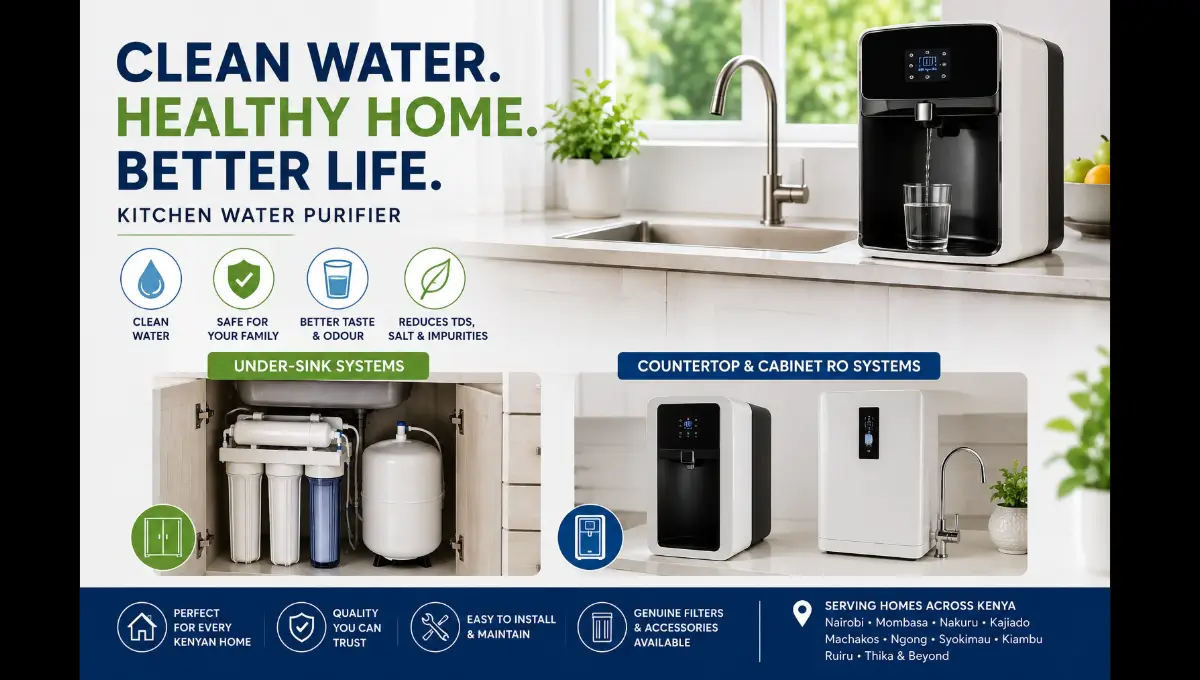
Pureflex offers two particularly practical categories for Kenyan kitchens:
Under-Sink Water Purifiers
The filtration system is installed inside the cabinet beneath the kitchen sink.
The result is a cleaner countertop with purified drinking water available through a dedicated tap.
Countertop Water Purifiers
The purification unit sits on the kitchen counter and provides convenient access to treated drinking water without requiring the same type of under-cabinet installation.
Both options can be excellent. The better choice depends on your home and how you want to use the system.
Best Kitchen Water Purifier for Salty Borehole Water
If you have ever filled a glass from a borehole supply and thought:
“Why does this water taste salty?”
you need to look beyond ordinary sediment filtration.
A sediment filter can reduce suspended particles, but it does not perform the same function as reverse osmosis when the concern is dissolved salts and high TDS.
For many households with challenging borehole water, a properly selected reverse osmosis (RO) kitchen water purifier can therefore be a much more suitable option.
RO uses a semi-permeable membrane to reduce dissolved substances from water.
However, borehole water varies significantly from one location to another.
A borehole in Kajiado may have very different characteristics from one in Kiambu, Machakos, Nakuru or Mombasa.
That is why Pureflex recommends considering the actual water quality before choosing a system.
If your borehole water is salty, consider checking:
- TDS
- Hardness
- pH
- Chloride
- Fluoride
- Iron
- Manganese
- Other relevant chemical parameters
- Microbiological quality
The results can help determine whether you need an under-sink RO purifier alone or additional pre-treatment.
For households specifically researching RO for challenging borehole water, our detailed guide to the best undersink reverse osmosis systems in Kenya explains what to consider before buying.
Kitchen Water Purifier for Municipal Water
Not every Kenyan household needs a heavy-duty RO system.
If your home receives municipal water and your main concerns are taste, odour, chlorine, sediment or the condition of household plumbing and storage, a different filtration configuration may be more appropriate.
Municipal water is treated before distribution, but water quality at the point of consumption can also be influenced by factors such as household storage tanks and plumbing.
This is one reason point-of-use filtration can be attractive.
Instead of treating the entire household supply, you can install a kitchen water purifier specifically for drinking and cooking.
A kitchen purifier can provide treated water for:
- Drinking
- Cooking
- Making tea and coffee
- Preparing family meals
- Filling reusable bottles
- Making beverages
The correct filtration stages depend on the incoming water.
Don’t buy an RO purifier simply because it has more stages.
The right system is the one that addresses your actual water-quality problem.
What About River Water in Kenya?
River and other untreated surface-water sources require additional caution.
WASREB’s drinking-water guidelines indicate that surface water rarely meets potable-water requirements without adequate treatment. (WASREB Drinking Water Quality Guidelines)
Therefore, if your household is using untreated river water, a small kitchen purifier should not automatically be assumed to make the source safe.
The appropriate treatment process depends on the quality of the raw water.
Depending on the results of water testing, treatment may involve combinations of:
- Sediment removal
- Filtration
- Activated carbon
- Disinfection
- Ultrafiltration
- Reverse osmosis
- Other appropriate treatment processes
This is particularly important if the source has significant turbidity or microbiological contamination.
Test the water first, then choose the treatment.
Under-Sink vs Countertop Kitchen Water Purifier
For most Kenyan households looking for drinking-water purification, the decision eventually comes down to two popular options.
Under-Sink Water Purifier
An under-sink system is installed inside the kitchen cabinet.
Advantages include:
- Keeps the countertop uncluttered
- Looks neat and discreet
- Suitable for permanent installations
- Can provide dedicated purified drinking water
- Excellent for modern kitchens and apartments
- Suitable for RO systems
Best for:
Homeowners, families, apartments and households looking for a permanent kitchen purification solution.
Countertop Water Purifier
A countertop purifier sits directly on the kitchen counter.
Advantages include:
- Convenient
- Easy to access
- Minimal installation
- Suitable where cabinet space is limited
- Useful for renters
- Easy to relocate
- Can provide a practical drinking-water solution without extensive plumbing modifications
Best for:
Renters, apartments, smaller kitchens and households prioritising convenience.
Which Kitchen Water Purifier Is Best for Your Home?
Here’s a simple way to think about it.
| Your situation | Potentially suitable option |
|---|---|
| Salty borehole water | RO system |
| High TDS | RO system |
| Municipal water with taste/odour concerns | Carbon-based filtration or RO, depending on water quality |
| Limited kitchen counter space | Under-sink purifier |
| Rented apartment | Countertop purifier |
| Modern permanent kitchen installation | Under-sink purifier |
| Need highly treated drinking water | RO system |
| Untreated river water | Water testing + appropriate multi-stage treatment |
| Want convenient purified water without major installation | Countertop purifier |
This table is a starting point—not a substitute for water testing where water quality is uncertain.
What Should You Look for in a Kitchen Water Purifier?
1. Start With Your Water Source
Before looking at brands or prices, ask:
Where does my water come from?
Is it:
- Borehole water?
- Municipal water?
- River water?
- Rainwater?
- A combination of sources?
Your water source gives you the first clue about the treatment required.
2. Check the TDS
TDS—or total dissolved solids—is particularly relevant when dealing with borehole water.
A high TDS reading can indicate substantial dissolved mineral content, although TDS alone does not tell you whether water is microbiologically safe or identify every contaminant present.
If your water tastes salty or strongly mineralised, TDS testing is a useful starting point.
3. Look at the Filtration Stages
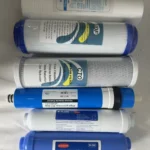
A typical multi-stage RO system may contain:
Sediment filter → Carbon filter → RO membrane → Post-carbon filter
Each stage has a different role.
Don’t assume:
7 stages = better than 5 stages.
Instead ask:
What does each stage remove, and why is it needed for my water?
4. Consider Kitchen Space
This is one of the biggest reasons people choose between an under-sink and countertop system.
If your kitchen has limited counter space, an under-sink purifier can keep the equipment hidden.
If you’re renting or don’t want plumbing modifications, a countertop unit may be more convenient.
5. Check Filter Availability
A water purifier is not a one-time purchase.
Filters eventually need replacement.
Before buying, find out:
- How frequently filters need replacement
- Whether replacement cartridges are available locally
- Cost of replacement filters
- RO membrane replacement requirements
- Whether installation and servicing are available
A purifier that is difficult to maintain can become frustrating even if the initial purchase price looks attractive.
How Much Does a Kitchen Water Purifier Cost in Kenya?
There isn’t one fixed price for a kitchen water purifier in Kenya.
Pricing depends on:
- Technology
- Number and type of filtration stages
- RO membrane capacity
- Storage capacity
- Automatic or manual operation
- Installation requirements
- Replacement filter costs
- Brand and build quality
Rather than choosing purely on the lowest upfront price, consider the total cost of ownership.
A slightly more expensive system with readily available replacement filters and reliable support may be more practical over several years.
You can view Pureflex’s current range of water purification products through the Pureflex Water Solutions shop.
Kitchen Water Purifier for Nairobi, Mombasa, Nakuru, Kajiado & Beyond
Water-quality concerns aren’t limited to one Kenyan city.
Pureflex Water Solutions serves customers looking for practical kitchen purification solutions across Kenya, including areas such as:
Nairobi
Homes and apartments relying on municipal supply, stored water or mixed sources can benefit from point-of-use purification.
Mombasa
Coastal water conditions can differ from inland areas, making it particularly important to select purification based on the actual water quality rather than assumptions.
Nakuru
Households using borehole or other local water sources may need different filtration approaches depending on mineral content and other water characteristics.
Kajiado and Ngong
Borehole-dependent households may encounter mineralised or high-TDS water, making water testing particularly useful before choosing an RO purifier.
Machakos
Homes using borehole and other local sources can benefit from matching purification technology to the actual water characteristics.
Syokimau
Modern apartments and homes often prioritise compact, convenient drinking-water solutions, making under-sink and countertop systems practical options.
Kiambu, Ruiru, Thika and Other Areas
Households across Kiambu County and surrounding areas can also benefit from point-of-use water purification tailored to their source and kitchen requirements.
The key principle remains the same throughout Kenya:
Don’t choose your purifier based only on where you live. Choose it based on the water you actually receive.
Why Choose Pureflex Water Solutions?
Pureflex Water Solutions focuses specifically on practical purification solutions for Kenyan kitchens and workplaces.
For homes, our focus is on:
- Under-sink RO purifiers
- Countertop water purifiers
- Drinking-water filtration
- Replacement filters and accessories
- Installation and support
We don’t believe every household needs the same purifier.
Instead, we help customers consider their water source, water-quality concerns, kitchen space and intended use before selecting a solution.
If you’re ready to explore your options, you can contact Pureflex Water Solutions and discuss your water purification requirements.
If you’re already sure you need a system, you can also request a water purification quote.
A Better Way to Choose a Kitchen Water Purifier
The easiest mistake to make is to search for:
“Which is the best water purifier?”
A better question is:
“Which water purifier is best for my water?”
Someone in Syokimau may need a compact countertop purifier.
A homeowner in Kajiado dealing with salty borehole water may need RO.
A household in Nairobi may want point-of-use treatment for municipal water.
A family using an untreated surface-water source may require a more comprehensive treatment approach.
Different problems require different solutions.
That’s why Pureflex takes a water-first approach.
Know your water. Choose the right purifier. Enjoy better drinking water.
Pureflex Water Solutions
Beyond Water, Beyond Expectations.
Frequently Asked Questions
What is the best kitchen water purifier in Kenya?
There is no single best purifier for every Kenyan home. The right option depends on the water source and quality. For high-TDS or salty borehole water, an RO system may be appropriate, while other water sources may require different filtration.
Is an RO purifier good for salty borehole water?
Yes, reverse osmosis can reduce dissolved salts and TDS, making it a suitable technology for many households dealing with salty or highly mineralised borehole water. However, water testing and appropriate pre-treatment may be necessary.
What is better, an under-sink or countertop water purifier?
An under-sink purifier is ideal if you want a permanent, discreet installation with minimal countertop clutter. A countertop purifier is often more convenient for renters, smaller kitchens or households that don’t want extensive installation.
Can a kitchen purifier remove dirt from water?
Many systems include sediment filtration designed to reduce suspended particles. However, the type and level of filtration required depends on the source and amount of sediment.
Can a kitchen water purifier remove salt?
A reverse osmosis system can reduce dissolved salts. A standard sediment or basic carbon filter should not be assumed to perform the same function.
Can I use a kitchen purifier for river water?
Untreated river water should be assessed before selecting a treatment system. Surface water can contain microbiological and other contaminants, and WASREB notes that surface-water sources rarely meet potable requirements without adequate treatment.
Does high TDS mean water is unsafe?
Not necessarily. TDS measures dissolved substances collectively and does not identify individual contaminants or determine microbiological safety. It is useful for understanding water characteristics but should not be treated as a complete water-safety test.
How often should kitchen purifier filters be changed?
It depends on the purifier, incoming water quality and household consumption. Follow the manufacturer’s recommended replacement schedule and monitor the system’s performance.
Does a kitchen RO system require electricity?
Some RO systems can operate without electricity, while others use a booster pump or additional electronic features and therefore require power. The requirements depend on the specific system and incoming water pressure.
How much space does an under-sink purifier need?
The space requirement varies by system. The filtration cartridges, membrane, tubing and, where applicable, storage tank need to fit inside the kitchen cabinet. It’s worth checking cabinet dimensions before purchasing.
Can I install a water purifier in an apartment?
Yes. Both countertop and under-sink systems can be suitable for apartments. The best choice depends on available space, plumbing arrangements and whether you are permitted to make modifications.
Do I need to purify all the water in my house?
Not necessarily. If your main concern is drinking and cooking water, a point-of-use kitchen purifier can provide treated water specifically where you need it rather than treating the entire household supply.
Ready for Cleaner Drinking Water in Your Kitchen?
Whether you’re in Nairobi, Mombasa, Nakuru, Kajiado, Machakos, Ngong, Syokimau, Kiambu, Ruiru, Thika or elsewhere in Kenya, the first step is understanding your water.
Salty borehole water? High TDS? Unpleasant taste? Municipal water concerns?
Don’t guess which purifier you need.
Talk to Pureflex Water Solutions and find a practical kitchen water purification solution suited to your home.
Beyond Water, Beyond Expectations.
Leave a Comment