
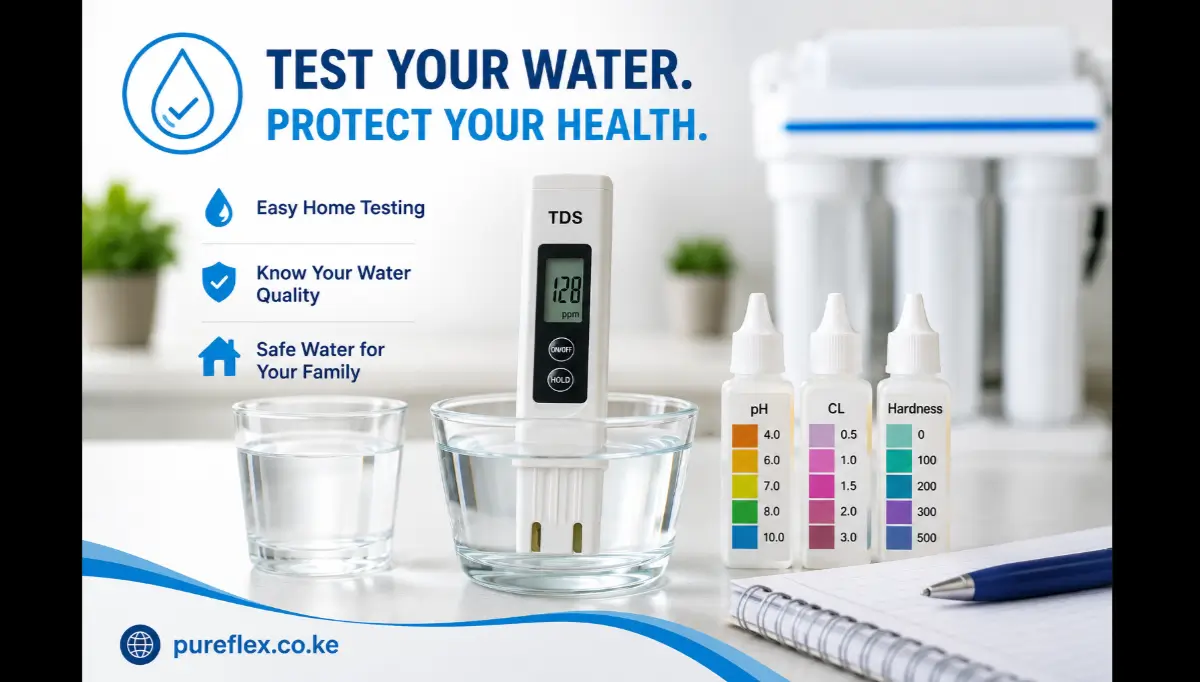
Clear, good-tasting water is not necessarily safe drinking water. Water can look perfectly clean while containing dissolved salts, metals, chemicals, or microorganisms that cannot be detected by sight, smell, or taste.
That is why learning how to test water quality at home can be useful for households using tap water, borehole water, rainwater, water tanks, or other private water sources.
For Kenyan households, testing is particularly useful when moving into a new home, installing a borehole, experiencing changes in water taste or appearance, or considering a water filtration system.
This guide explains how to test water quality at home, which parameters you can check yourself, what the results mean, and when you should send a sample to a professional laboratory.
Why Should You Test Your Water at Home?
Water quality can change between the original source and the tap.
For example, water supplied to a property may be affected by:
- Old or corroded plumbing
- Storage tanks that are not adequately maintained
- Borehole conditions
- Runoff and environmental contamination
- Agricultural activities
- Changes in groundwater quality
- Poorly maintained filtration systems
- Contamination after plumbing repairs
In Kenya, different water sources can also have very different characteristics. Borehole water, for example, may have elevated levels of dissolved minerals, while surface water can be more vulnerable to microbial contamination.
The Water Resources Authority (WRA) conducts water-quality monitoring and provides laboratory services covering physical, chemical and biological parameters.
Home testing therefore works best as a screening and monitoring tool, rather than a replacement for comprehensive laboratory analysis.
What Does Water Quality Actually Mean?
Water quality is not determined by a single number.
A useful water-quality assessment can involve several categories of parameters:
| Parameter | What it can tell you |
|---|---|
| pH | Whether water is acidic or alkaline |
| TDS | Approximate concentration of dissolved substances |
| Electrical conductivity | Indicates the water’s ability to conduct electricity and can help assess dissolved ions |
| Turbidity | Indicates suspended particles or cloudiness |
| Hardness | Indicates calcium and magnesium levels |
| Chlorine | Helps assess residual disinfectant in treated water |
| Nitrates | Can indicate contamination from agricultural or other sources |
| Iron | May cause staining, metallic taste and discoloration |
| Microbiological parameters | Help determine whether disease-causing organisms may be present |
Kenya’s water-quality framework covers physical, chemical and microbiological considerations. KEBS also maintains standards and testing information relating to drinking water and other water-quality parameters.
How to Test Water Quality at Home
You do not necessarily need a laboratory to perform basic water-quality checks.
A home water-testing setup can include a combination of simple instruments and test kits.
1. Start With a Visual Inspection
Before using any equipment, examine the water carefully.
Pour a sample into a clean, transparent glass and check for:
- Cloudiness
- Floating particles
- Unusual colour
- Sediment
- Oil-like films
- Visible debris
You can also observe whether sediment settles at the bottom after the sample has stood undisturbed for some time.
However, visual inspection only provides an initial indication. Clear water can still contain contaminants that cannot be seen.
2. Check the Water’s Smell and Taste Carefully
Unusual smells or tastes can indicate a change in water quality.
Depending on the source, you may notice:
- A chlorine smell
- Metallic taste
- Earthy or musty odour
- Sulphur-like smell
- Unusual salty taste
Taste and smell should not be treated as a safety test. They can alert you to a possible change, but they cannot confirm that water is safe to drink.
If water suddenly develops an unusual odour, colour or taste, investigate the source rather than assuming that it is safe.
3. Measure TDS With a TDS Meter
A TDS meter is one of the simplest instruments for home water testing.
TDS means total dissolved solids. It provides an estimate of the concentration of dissolved substances in water and is commonly expressed in parts per million (ppm) or mg/L.
To use a TDS meter:
- Collect water in a clean container.
- Turn on the meter.
- Place the probe into the sample according to the manufacturer’s instructions.
- Allow the reading to stabilize.
- Record the result.
- Repeat the measurement if necessary.
A TDS meter is particularly useful for comparing water before and after filtration.
For example, you can test:
Source water → filtration system → drinking-water tap
If the readings change substantially after treatment, the meter can help you monitor the performance of the system.
However, a TDS meter does not tell you whether water is microbiologically safe and does not identify individual contaminants. A low TDS reading should therefore not automatically be interpreted as proof that water is pure.
4. Measure pH
A digital pH meter or suitable water-testing kit can be used to measure the acidity or alkalinity of water.
pH testing can be useful when investigating:
- Borehole water
- Rainwater
- Treated water
- Water-treatment systems
- Corrosion-related concerns
For accurate measurements, follow the manufacturer’s instructions and calibrate a digital meter as recommended.
pH is an important water-quality parameter, but pH alone cannot determine whether water is safe to drink.
5. Test Water Hardness
Hard water contains elevated concentrations of minerals, particularly calcium and magnesium.
You may notice signs such as:
- Scale around taps
- Deposits on kettles and heating elements
- Reduced soap lather
- White marks on bathroom fixtures
Hardness test strips or drop-count titration kits can provide a more useful assessment than simply observing scale.
Testing hardness can help determine whether additional treatment may be appropriate for household use.
6. Check Chlorine Levels in Treated Water
If your water comes from a treated municipal supply, chlorine testing can be useful for monitoring residual chlorine.
A chlorine test kit can indicate whether measurable chlorine remains in the water.
This is particularly relevant when investigating changes in taste or when monitoring water at different points in a building’s plumbing system.
For regulated drinking-water systems, however, testing should be interpreted against the applicable standards rather than using an arbitrary home-test target.
7. Use Specific Test Kits for Nitrates, Iron and Other Contaminants
Some home test kits are designed to measure particular parameters.
Depending on your water source and concerns, you may test for:
- Nitrates
- Nitrites
- Iron
- Copper
- Lead
- Fluoride
- Hardness
- Chlorine
- Alkalinity
The appropriate tests depend heavily on the source of the water.
For example, a household using borehole water may have different testing priorities from a household using treated municipal water.
If there is a known contamination risk, a laboratory test is generally more appropriate than relying exclusively on inexpensive home strips.
How to Test if Water Is Pure
If you are searching for how to test water is pure, the most important point is that there is no single home test that can prove water is completely pure.
Instead, think of water testing as answering different questions.
Is it clear?
A visual inspection can help.
How many dissolved substances are present?
A TDS meter provides an approximate indication.
Is the pH within the desired range?
A pH meter or test kit can measure it.
Is it hard water?
A hardness test can provide an indication.
Is chlorine present?
A chlorine test kit can measure residual chlorine.
Could microorganisms be present?
A microbiological laboratory test is needed for meaningful confirmation.
Could heavy metals or specific chemicals be present?
Use appropriate laboratory analysis or a validated test designed specifically for that contaminant.
This distinction is important because a TDS meter, for example, measures dissolved conductivity-related substances but does not identify individual contaminants or establish microbiological safety.
Can You Test Drinking Water With a TDS Meter?
Yes, but only for a limited purpose.
A TDS meter is useful for screening and comparison, especially when monitoring a filtration or reverse osmosis system.
For example, if untreated water consistently records a high TDS reading and treated water records a substantially lower reading, the difference can help you monitor the treatment process.
However, TDS should not be confused with water purity.
A water sample can have a low TDS reading while still containing contaminants that a TDS meter cannot detect.
For this reason, anyone asking how to test water quality at home should use TDS as one part of a broader testing approach.
How to Test Water Quality in Your Area in Kenya
If you want to test water quality in your area, start by identifying your water source.
Municipal or piped water
For piped water, investigate the water service provider and consider testing water directly from the household tap if there is a concern about quality.
WASREB provides drinking-water quality guidelines and regulates water-service quality in Kenya. It also provides information for consumers concerning water services and complaints.
Borehole water
Borehole water should not automatically be assumed to be safe simply because it comes from underground.
Testing can help identify issues involving:
- TDS
- Hardness
- pH
- Iron
- Fluoride
- Nitrates
- Other minerals
- Microbiological contamination
For more comprehensive testing, the Water Resources Authority’s laboratory services can analyse water for domestic and other applications. WRA states that its laboratories perform more than 40 different tests and operate laboratories across Kenya.
Rainwater
Rainwater can pick up contaminants from:
- Roof surfaces
- Gutters
- Storage tanks
- Dust and debris
- Bird or animal droppings
Testing both the collected water and the storage system can therefore be useful before using rainwater as a drinking-water source.
River or surface water
Surface water can be exposed to agricultural runoff, sewage, industrial pollution and other environmental contaminants.
Because of this, surface-water users should not rely on appearance, taste or a basic TDS reading to determine whether the water is safe for drinking.
The WRA specifically monitors water quality and pollution in Kenya’s surface and groundwater resources.
Home Water Testing vs Laboratory Water Testing
The best option depends on what you want to know.
| Home testing | Laboratory testing |
|---|---|
| Quick | More comprehensive |
| Convenient | More detailed |
| Useful for routine monitoring | Useful for confirming contamination |
| Good for selected parameters | Can test a much wider range of parameters |
| Relatively inexpensive | Usually costs more |
| Does not replace professional analysis | Better for health and contamination investigations |
For example, a household may use a TDS meter and pH meter regularly, while sending a water sample to a laboratory periodically for more comprehensive testing.
KEBS lists water testing capabilities that include parameters such as pH, nitrates, nitrites, sulphates, chlorides, iron, zinc, calcium, potassium, sodium, lead, cadmium and arsenic, as well as microbiological testing for water.
When Should You Test Your Water?
Consider testing your water when:
- Moving into a new house
- Installing a new borehole
- Starting to use a new water source
- Installing a water-treatment system
- Replacing plumbing
- Cleaning or replacing a storage tank
- Water develops an unusual taste, smell or colour
- There has been flooding near the water source
- You suspect contamination
- You want to establish a baseline before installing filtration
- You want to monitor an existing filtration system
Testing before installing a purifier is particularly useful because the right treatment system depends on the quality and characteristics of the source water.
What Should You Do After Testing Your Water?
The test results should guide the treatment decision.
For example:
- High TDS: investigate the dissolved substances and consider treatment appropriate for the specific water chemistry.
- Hard water: consider treatment designed for hardness where necessary.
- High iron: investigate iron-removal options.
- Unusual pH: investigate the source and select appropriate treatment.
- Microbiological contamination: address the source and use appropriate disinfection or treatment.
- Multiple contaminants: a more comprehensive treatment system may be necessary.
For households dealing with dissolved contaminants or seeking a point-of-use drinking-water solution, reverse osmosis can be an option worth evaluating. Learn more about how reverse osmosis purifies water and explore home drinking water filtration systems.
Testing First Can Help You Choose the Right Water Purifier
One of the most common mistakes when buying a water purifier is choosing a system before understanding the water.
A purifier should address the contaminants or water-quality problems actually present in the source.
For example, a household with relatively low TDS but a microbiological concern may have different treatment requirements from a household with high TDS, hardness or dissolved minerals.
Testing can therefore help answer an important question:
What does this water actually need?
Once you understand the results, you can evaluate the appropriate treatment option rather than buying equipment based solely on taste, appearance or advertising claims.
For households considering point-of-use drinking-water treatment, see the 5-stage reverse osmosis system or browse the PureFlex water purification equipment.
How to Get Better Results From Home Water Testing
For more reliable home measurements:
- Use clean sample containers.
- Follow the testing equipment manufacturer’s instructions.
- Calibrate digital meters where required.
- Do not touch test strips or probes unnecessarily.
- Take samples from the actual point where drinking water is collected.
- Record the date, location and test result.
- Repeat unusual results before making major treatment decisions.
- Send samples for laboratory analysis when contamination is suspected.
- Compare results over time rather than relying on a single measurement.
- Keep records of filter changes and treatment-system maintenance.
This creates a useful water-quality history for your home.
Frequently Asked Questions About Testing Water Quality at Home
Can I test my water quality at home?
Yes. You can perform basic tests at home using equipment such as TDS meters, pH meters, hardness kits, chlorine test kits and other parameter-specific tests. However, home testing does not replace comprehensive laboratory analysis.
How do I know if my tap water is safe?
You cannot reliably determine drinking-water safety simply by looking at, smelling or tasting the water. Testing should be based on the water source and potential contamination risks. For suspected contamination, professional laboratory analysis is more appropriate.
How do you test water is pure?
There is no single home test that proves water is completely pure. Different tests measure different characteristics. TDS, pH, hardness and chlorine tests can provide useful information, while microbiological and chemical laboratory tests are needed to investigate specific safety concerns.
Does a TDS meter test water purity?
No. A TDS meter estimates the concentration of dissolved substances but does not identify individual contaminants and cannot confirm that water is microbiologically safe.
What is the best way to test borehole water in Kenya?
Start with a comprehensive laboratory analysis appropriate for the borehole and intended use. Basic home measurements such as TDS, pH and hardness can then be useful for ongoing monitoring.
Where can I test water quality in Kenya?
The Water Resources Authority provides laboratory water-testing services and states that its laboratories perform a range of chemical and microbiological analyses. KEBS also provides water-testing and standards information.
How often should I test my drinking water?
The appropriate frequency depends on the source and risk. Water from a private borehole, rainwater system or other non-municipal source may require a different testing schedule from regulated piped water. Test promptly whenever there is a significant change in taste, smell, colour, source conditions or treatment performance.
Should I test water before buying a water purifier?
Yes. Testing first can help identify the characteristics of the water and make it easier to select a treatment system that addresses the actual problem.
Final Thoughts
Knowing how to test water quality at home gives you a better understanding of what is coming out of your tap, but no single home test can answer every water-safety question.
Use simple instruments such as TDS and pH meters for routine screening and monitoring, and use appropriate laboratory testing when you need to investigate microorganisms, heavy metals, chemicals or other specific contaminants.
For Kenyan households, the most practical approach is:
Identify the water source → test the important parameters → interpret the results → choose treatment based on the actual water quality → monitor the treated water over time.
If your results indicate that your drinking water needs additional treatment, explore PureFlex water purification solutions in Kenya or contact PureFlex for guidance on suitable water-treatment equipment.
Leave a Comment