
If you have ever wondered what is reverse osmosis, how an RO water purifier works, whether it is suitable for Kenyan water, or how much a reverse osmosis system costs, you are in the right place.
Reverse osmosis (RO) is a water purification process that uses pressure and a semi-permeable membrane to separate water from many dissolved substances and contaminants. It is widely used in residential drinking-water systems, offices, restaurants and commercial water-treatment plants.
For homeowners in Kenya, RO can be particularly useful when drinking water contains high levels of dissolved minerals, salts or other contaminants that ordinary sediment and carbon filters may not adequately reduce.
This guide explains what reverse osmosis is, what it is used for, how an RO system works, how to maintain one, how to empty an RO tank, how much RO systems cost in Kenya and where to get reverse osmosis water.
If you are ready to compare systems, you can also explore Pureflex water purification products.
What Is Reverse Osmosis?
Reverse osmosis is a membrane-based water purification technology in which pressure is applied to water to push it through a semi-permeable membrane.
The membrane allows water molecules to pass while restricting many dissolved substances and contaminants. The result is a treated-water stream called permeate and a separate concentrated stream known as reject or concentrate water.
In simple terms:
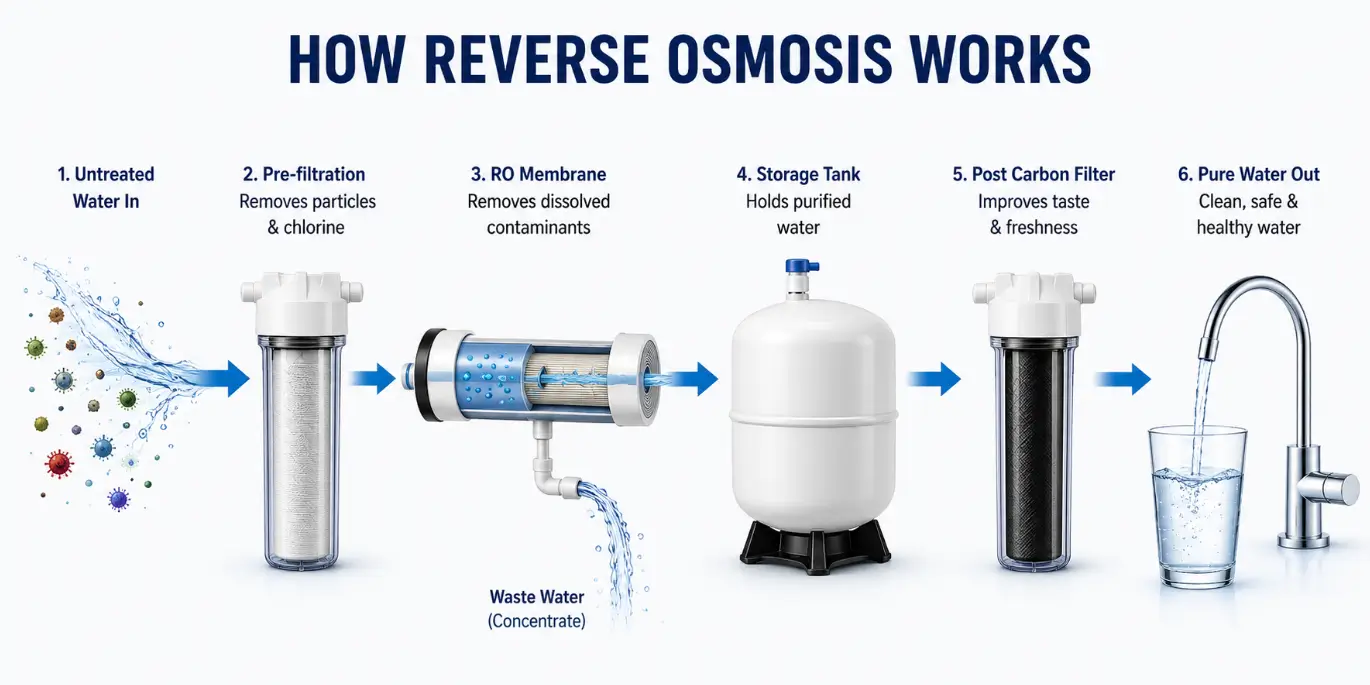
Untreated water → Pre-filters → RO membrane → Post-treatment → Purified drinking water
Unlike a basic sediment filter, which mainly captures particles, RO is designed to address many substances that are dissolved in water.
The technology is used in both point-of-use systems, such as under-sink household purifiers, and larger commercial water-treatment plants.
For households, a properly configured RO system can provide purified water specifically for drinking and cooking, without requiring the entire home’s water supply to pass through the RO membrane.
What Is the Purpose of Reverse Osmosis?
The primary purpose of reverse osmosis is to reduce dissolved contaminants and produce purified water.
RO can reduce a broad range of contaminants, including dissolved solids and various inorganic and organic substances. The exact contaminants removed and the percentage reduction depend on the membrane, system design, feed-water quality and operating conditions.
An RO system can therefore be useful when the goal is to:
- Reduce total dissolved solids (TDS)
- Reduce dissolved salts
- Improve water taste
- Reduce certain heavy metals
- Reduce some inorganic contaminants
- Reduce certain organic contaminants
- Produce purified drinking and cooking water
- Treat certain borehole-water problems
- Provide consistent drinking-water quality at home or in an office
However, RO should not be viewed as a universal solution for every water problem. Water testing is important when dealing with untreated borehole or other uncertain water sources because additional pre-treatment may be required.
The U.S. Environmental Protection Agency’s overview of drinking-water treatment technologies explains that RO and nanofiltration are pressure-driven membrane processes capable of removing a wide range of contaminants.
How Does Reverse Osmosis Work?
Understanding how RO works becomes much easier when you look at the system as a series of stages.
A typical domestic RO purifier combines several filtration technologies rather than relying on the membrane alone.
Step 1: Sediment Filtration
The incoming water first passes through a sediment filter.
This stage helps capture larger suspended particles such as:
- Sand
- Dirt
- Rust
- Dust
- Sediment
Removing these particles helps protect the subsequent filters and RO membrane.
Step 2: Carbon Filtration
The water then passes through activated carbon filtration.
Carbon filters can reduce substances such as chlorine and compounds responsible for unpleasant taste and odour.
This stage is particularly important because some RO membranes can be damaged by chlorine exposure.
Step 3: Additional Pre-Filtration
Many systems include another carbon or sediment filtration stage before the RO membrane.
The purpose is to further condition the water and protect the membrane from particles and chemicals that could shorten its operating life.
Step 4: The RO Membrane
This is the central purification stage.
Water is pressurised and forced against the semi-permeable RO membrane. A portion passes through the membrane as treated water while the concentrated contaminants remain in the reject stream.
This is what makes RO different from ordinary filtration.
A conventional filter may physically trap particles or adsorb certain compounds. The RO membrane provides a much finer separation process capable of reducing many dissolved substances.
Step 5: Storage
In many domestic systems, purified water is stored in a pressurised tank.
The tank allows purified water to be available when the user opens the dedicated drinking-water faucet rather than requiring the RO membrane to produce the full flow instantly.
Step 6: Post-Carbon or Final Treatment
Before drinking, the stored water may pass through a post-carbon filter.
This final stage can help improve taste and freshness.
Some systems also incorporate mineral or alkaline stages. These should be viewed as additional treatment features rather than automatically assuming that more stages mean better purification.
What Is a 5-Stage Reverse Osmosis System?
A 5-stage RO system is a common domestic configuration.
A typical arrangement may include:
| Stage | Typical Function |
|---|---|
| 1 | PP sediment filtration |
| 2 | Carbon filtration |
| 3 | Additional carbon/sediment filtration |
| 4 | RO membrane |
| 5 | Post-carbon filtration |
The exact configuration can differ between manufacturers.
For example, Pureflex’s 5 Stage Reverse Osmosis System is designed for domestic drinking-water purification and offers a practical solution for homes and small offices.
For a broader comparison of domestic systems, see the best under-sink reverse osmosis systems in Kenya.
How to Maintain a Reverse Osmosis System
An RO system is not a completely maintenance-free appliance.
Regular maintenance helps protect the membrane, maintain water quality and prevent the system from becoming inefficient.
1. Replace Sediment and Carbon Filters
Pre-filters gradually become loaded with the material they remove.
A clogged sediment filter can restrict water flow, while exhausted carbon filters may no longer adequately protect the RO membrane.
Replacement frequency depends on:
- Water quality
- Daily consumption
- Filter capacity
- TDS
- Sediment levels
- Chlorine levels
There is no single replacement interval that applies to every household.
2. Monitor Water Quality
If your RO system has a TDS meter, periodically compare the feed-water and treated-water readings.
A significant change in RO performance can indicate that the membrane or another component requires attention.
However, TDS is not a complete water-quality test. A low TDS reading does not automatically prove that water is safe from every possible contaminant.
3. Check Water Pressure
RO membranes require adequate pressure to operate effectively.
Low pressure can result in:
- Slow production
- Poor tank filling
- Lower water recovery
- Reduced membrane performance
If your system suddenly becomes much slower than normal, pressure should be one of the things checked.
4. Inspect Tubing and Connections
Look periodically for:
- Leaking connections
- Loose tubing
- Damaged pipes
- Dripping faucets
- Water around the storage tank
- Unusual noises from the pump
Small leaks can become larger problems if ignored.
5. Replace the RO Membrane When Necessary
The RO membrane generally lasts longer than sediment and carbon filters, but it eventually loses performance.
Its lifespan depends heavily on:
- Feed-water quality
- Pre-treatment
- Operating pressure
- Maintenance
- Water consumption
- Membrane quality
A membrane should therefore be replaced based on performance and the manufacturer’s recommendations rather than simply replacing it at an arbitrary date.
6. Keep the Storage Tank and Faucet Hygienic
The storage tank and drinking-water faucet are part of the drinking-water pathway.
During servicing, the system should be properly sanitised according to the manufacturer’s maintenance instructions.
NSF notes that reverse osmosis systems are covered by NSF/ANSI 58, which includes requirements relating to materials, structural integrity, TDS reduction, efficiency, recovery and contaminant-reduction performance.
Importantly, certification to a standard does not mean a system removes every possible contaminant; buyers should check the specific performance claims relevant to their water.
How to Empty a Reverse Osmosis Tank
There are several reasons you might need to empty an RO storage tank, including maintenance, sanitisation or replacing filters.
The procedure is straightforward for most conventional domestic systems.
Step 1: Turn Off the Water Supply
Locate the RO system’s feed-water valve and close it.
If your system has a power supply or booster pump, switch it off as well.
Step 2: Open the RO Faucet
Open the dedicated purified-water faucet over the sink.
This allows water stored in the tank to flow out.
Step 3: Allow the Tank to Drain
Leave the faucet open until the flow becomes very weak or stops.
Depending on tank size and pressure, this can take several minutes.
Step 4: Close the Faucet
Once the tank has emptied, close the faucet.
Step 5: Continue With Maintenance
You can now proceed with filter replacement or other servicing required for your particular system.
Important: Do not disconnect pressurised components or dismantle the tank unnecessarily. If you are unsure about a valve, connection or pressure setting, have the system serviced by a qualified technician.
How Often Should You Empty an RO Tank?
You do not normally need to empty an RO storage tank every day.
The tank is designed to store purified water for normal use.
Emptying may be appropriate when:
- Replacing filters
- Sanitising the system
- Servicing the tank
- Troubleshooting water-quality problems
- The manufacturer specifically recommends it
Regularly wasting stored purified water simply to “refresh” the tank is generally unnecessary unless recommended for your particular system.
How Much Does Reverse Osmosis Cost in Kenya?
The cost of reverse osmosis in Kenya depends heavily on the type and capacity of the system.
A domestic under-sink RO purifier can cost substantially less than a commercial 250 LPH, 500 LPH or 1,000 LPH RO plant.
Indicative categories include:
| System | Typical Application |
|---|---|
| Under-sink RO | Home drinking and cooking |
| Cabinet RO | Home or office |
| RO water dispenser | Home or office convenience |
| 250 LPH RO | Small commercial applications |
| 500 LPH RO | Medium commercial applications |
| 1,000 LPH RO | Larger commercial applications |
The price is influenced by membrane capacity, pumps, filters, storage, automation, pre-treatment and installation requirements.
For a detailed Kenyan price comparison, read Reverse Osmosis Machine Price in Kenya.
For most households, there is little reason to purchase a commercial RO plant when the actual requirement is simply purified drinking water at the kitchen sink.
Is Reverse Osmosis Expensive to Run?
The running cost depends on the system and the quality of the incoming water.
Ongoing costs can include:
- Sediment filters
- Carbon filters
- RO membrane replacement
- Electricity for systems with pumps
- Sanitisation and servicing
- Water used as RO reject/concentrate
RO systems also produce a reject-water stream because not all feed water passes through the membrane. The EPA notes that RO can reject a portion of incoming water and that pre-treatment may be necessary to protect the membrane from fouling or plugging.
Where practical, reject water can sometimes be collected for non-drinking uses, provided its quality and intended use are appropriate.
Where Can I Get Reverse Osmosis Water in Kenya?
There are several ways to access RO-treated water in Kenya.
Install an RO System at Home
For regular household consumption, installing an RO system at the point where drinking water is needed is often the most convenient option.
An under-sink system can provide purified water through a dedicated faucet while leaving the rest of the home’s water supply untreated.
Pureflex offers domestic systems through its water purification product range.
Buy RO Water From a Water Refill Business
Some water-refill businesses provide purified or RO-treated water for customers who do not have a purifier at home.
The quality of water from refill businesses can vary, so consumers should consider the source water, treatment process, storage practices and hygiene controls before relying on any supplier.
Use an RO Water Dispenser
For offices and modern kitchens, an RO dispenser can combine water purification with convenient dispensing.
This can be useful where installation space is limited or where users want a more integrated appliance.
Install a Commercial RO System
Businesses with high water requirements may need a dedicated commercial RO plant.
The correct capacity should be calculated from expected daily demand rather than choosing a machine simply because it has a higher LPH rating.
Is Reverse Osmosis Suitable for Borehole Water in Kenya?
It can be, but borehole water should not automatically be treated as though every borehole has the same water quality.
Borehole water can contain different combinations of:
- Dissolved minerals
- Hardness
- Iron
- Manganese
- Fluoride
- Salts
- Sediment
- Other contaminants
A water analysis is therefore an important first step.
If you are considering RO for a borehole at home, read How to Purify Borehole Water at Home.
The analysis can help determine whether the RO membrane can be used with standard pre-treatment or whether additional treatment is required before the RO stage.
Does Reverse Osmosis Remove All Contaminants?
No.
This is one of the most important points to understand before buying an RO system.
RO can reduce a broad range of contaminants, but no single water-treatment technology removes every possible contaminant under every condition. The actual performance depends on the membrane, system design, feed water and operating conditions.
This is why the correct approach is:
Test the water → identify the problem → choose the treatment → maintain the system.
For specific contaminant-reduction claims, consumers should review the manufacturer’s technical information and relevant certification rather than relying solely on marketing statements.
Is RO Water Safe to Drink?
A properly designed and maintained RO system can be used to produce drinking water when the source water and treatment system are appropriate.
However, the quality of the final water depends on more than the RO membrane.
The system should be correctly installed and maintained, and the incoming water should be suitable for the chosen treatment process.
For this reason, households using untreated borehole or other private water sources should consider professional water testing before selecting an RO system.
What Is the Difference Between RO and a Normal Water Filter?
The biggest difference is the type of treatment.
A conventional sediment filter primarily removes suspended particles, while activated carbon filtration is commonly used to improve taste and reduce chlorine and certain organic compounds.
RO uses pressure to force water through a semi-permeable membrane and can reduce many dissolved substances that conventional filters do not target as effectively.
If your main concern is sediment or chlorine, a conventional filtration system may be sufficient.
If dissolved minerals, high TDS or certain dissolved contaminants are the concern, RO may be more appropriate.
Which Reverse Osmosis System Is Best for a Home in Kenya?
There is no single RO system that is best for every Kenyan household.
The right system depends on:
- Water source
- Water quality
- Household size
- Daily drinking-water consumption
- Available installation space
- Budget
- Required purification level
For many homes, a compact 5-stage under-sink RO system offers a practical balance between purification and convenience.
Pureflex’s 5 Stage Reverse Osmosis System is one option for households looking for a domestic drinking-water purifier.
For kitchen-focused solutions, see the Pureflex kitchen water purifier range.
Reverse Osmosis for Homes, Offices and Businesses in Kenya
RO technology can be scaled to suit different applications.
A homeowner may only need a compact under-sink system. An office may require a higher-capacity dispenser or purifier, while a water business may require a commercial RO plant capable of producing hundreds or thousands of litres per hour.
Pureflex Water Solutions provides water purification solutions for residential and commercial applications in Kenya.
You can learn more about Pureflex Water Solutions or contact the team to discuss your water-treatment requirements.
If you already know the type of system you need, you can also request a quotation.
Frequently Asked Questions
What is reverse osmosis in simple terms?
Reverse osmosis is a water purification process that uses pressure to push water through a semi-permeable membrane. The membrane allows treated water to pass while retaining many dissolved substances and contaminants.
What is the purpose of reverse osmosis?
The purpose of RO is to reduce dissolved contaminants and produce purified water. It is commonly used for drinking water where reducing TDS, dissolved salts and other contaminants is important.
How does reverse osmosis work?
Water passes through pre-filters before being pressurised against an RO membrane. Treated water passes through the membrane while a concentrated reject stream carries away retained substances.
How do I maintain a reverse osmosis system?
Regular maintenance includes replacing sediment and carbon filters, monitoring performance, checking leaks and pressure, maintaining the storage tank and replacing the RO membrane when its performance declines.
How do I empty an RO tank?
Turn off the feed-water supply, open the dedicated RO faucet and allow the stored water to drain until the flow stops or becomes very weak. The tank can then be serviced or sanitised according to the manufacturer’s instructions.
How much does reverse osmosis cost in Kenya?
Domestic RO systems can start from tens of thousands of Kenyan shillings, while larger commercial systems can cost hundreds of thousands or more. The final price depends on capacity, filtration stages, pumps, storage, pre-treatment and installation. See the Pureflex guide to reverse osmosis machine prices in Kenya for a detailed comparison.
Where can I get reverse osmosis water in Kenya?
You can obtain RO water from suitable water-refill providers or install an RO purifier at home or in an office. For regular household use, having an RO system at the point of use can provide convenient access to purified drinking water.
Is RO good for borehole water?
RO can be suitable for borehole water, but the system should be selected based on the actual water analysis. Some borehole sources require additional pre-treatment before the water reaches the RO membrane.
Does RO remove TDS?
Yes. Reducing dissolved solids is one of the principal applications of RO. The actual reduction depends on membrane performance, feed-water conditions and system design.
Does reverse osmosis waste water?
RO produces a reject or concentrate stream because some incoming water does not pass through the membrane. System efficiency varies, so buyers should consider recovery performance when comparing RO systems.
Final Thoughts: Is Reverse Osmosis Right for You?
Reverse osmosis is more than simply another type of water filter. It is a pressure-driven membrane purification process designed to reduce many dissolved substances and contaminants from water.
For a Kenyan household, the best starting point is not the number of stages printed on the box or the lowest advertised price. Instead, consider where your water comes from, what is in it, how much purified water you need and where the system will be installed.
For many homes, an under-sink RO system provides a convenient way to produce purified drinking and cooking water without treating the entire household supply.
If you are ready to compare your options, shop Pureflex water purification systems, explore the best under-sink RO systems in Kenya, or request a quotation from Pureflex.
For professional guidance on selecting an RO system for your home, office, borehole or business in Kenya, contact Pureflex Water Solutions.

Leave a Comment