
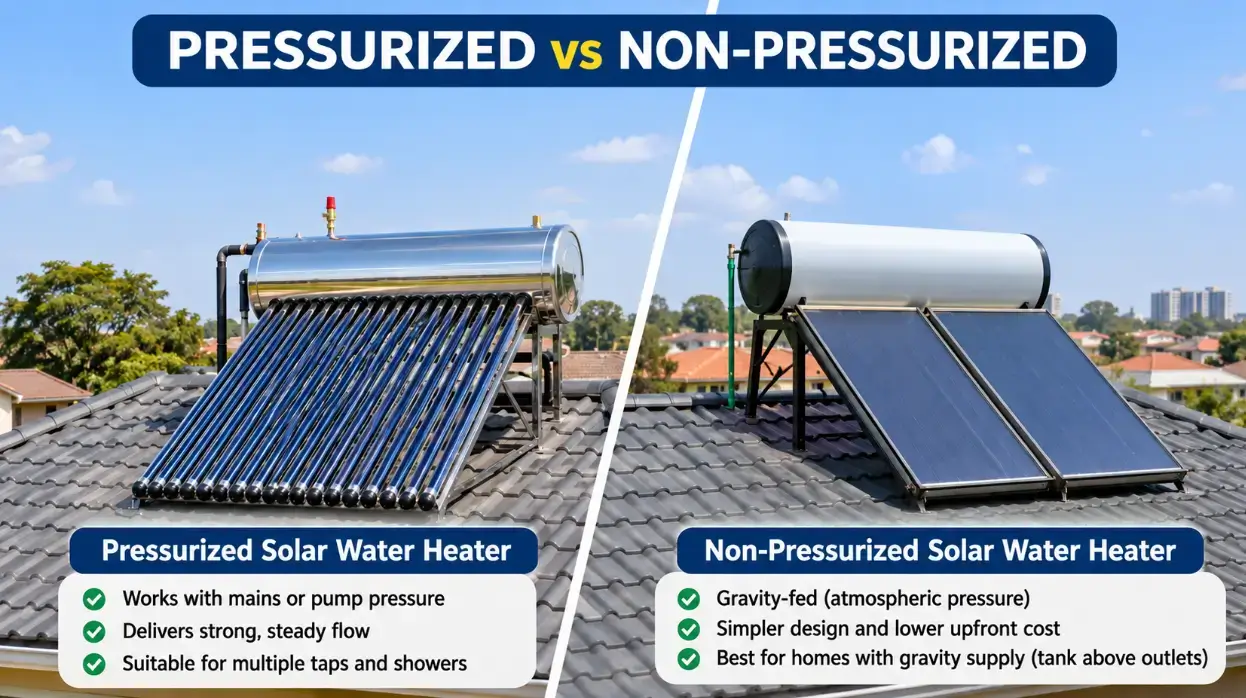
Choosing between a pressurized and non-pressurized solar water heater can be confusing, especially when both systems promise reliable hot water and lower electricity bills. However, they work differently, and choosing the wrong one can result in weak showers, plumbing complications or unnecessary installation costs.
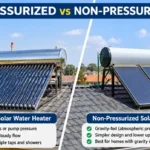
The main difference between a pressurized and non-pressurized solar water heater is how water is stored and delivered. A pressurized system uses a closed, pressure-rated tank to supply hot water under pressure. A non-pressurized system uses a vented tank and relies mainly on gravity to deliver hot water.
So, which is better for your home in Kenya?
The answer depends on your water supply, plumbing arrangement, shower fittings, household size and budget. This guide compares both systems, explains their advantages and disadvantages, debunks common myths and helps you decide which solar water heater is right for your property.
What Is a Pressurized Solar Water Heater?
A pressurized solar water heater is designed to store and supply domestic hot water under pressure. Its storage tank is a closed vessel built to withstand a specified operating pressure.
When cold water enters the tank from a pressurized supply, hot water leaves through the outlet as water is drawn from the system. The available hot-water pressure therefore depends largely on the incoming supply pressure and the system design.
Pressurized solar water heaters are commonly suitable for homes with:
- Booster or pressure pumps.
- Adequately pressurized municipal water supplies.
- Multiple bathrooms and showers.
- Modern mixer taps and shower fittings.
- Plumbing systems designed for pressurized hot-water distribution.
One important consideration is the tank’s maximum working pressure. A pressurized solar water heater must have the correct pressure and temperature relief protection, as specified by its manufacturer and applicable installation requirements.
For homes requiring this configuration, Pureflex offers a 200L pressurized solar water heater.
What Is a Non-Pressurized Solar Water Heater?
A non-pressurized solar water heater uses an atmospheric, vented storage tank. Unlike a pressurized system, the tank is not designed to operate as a sealed vessel under mains or booster-pump pressure.
Instead, hot water flows from the tank to the outlets mainly through gravity. The height difference between the tank and the shower or tap determines the available water pressure.
For example, a tank positioned sufficiently above the bathroom can provide better gravity-fed flow than one installed only slightly above the shower.
Non-pressurized solar water heaters are commonly suitable for:
- Homes using gravity-fed plumbing.
- Properties with elevated water storage.
- Households with modest hot-water pressure requirements.
- Installations where the tank can sit sufficiently above the outlets.
- Homeowners looking for a lower-cost solar water heating option.
The main limitation is that gravity-fed pressure may not be sufficient for every modern shower or mixer fitting. The installation must account for the required flow rate and vertical height.
Pureflex also supplies a 300L non-pressurized solar water heater for homes that use gravity-fed hot-water distribution.
Solar Water Heater Options Available at Pureflex
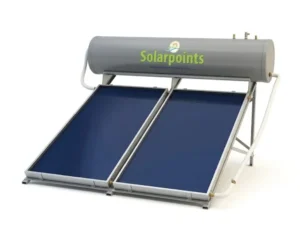
200L Pressurized Solar Water Heater in Kenya – Solarpoints
Price range: KSh 120,000.00 through KSh 140,000.00 Select options This product has multiple variants. The options may be chosen on the product page300L Pre-Heat Pressurized Coil Solar Water Heating System
Original price was: KSh 155,000.00.KSh 148,000.00Current price is: KSh 148,000.00. Add to cart300L Solar Water Heater for Homes in Kenya | Solarpoints
Price range: KSh 150,000.00 through KSh 175,000.00 Select options This product has multiple variants. The options may be chosen on the product pageHousehold Solar Water Heating System in Kenya | 200L & 300L
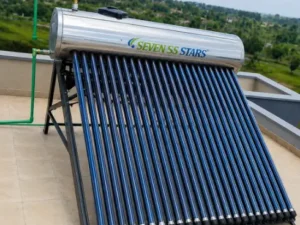
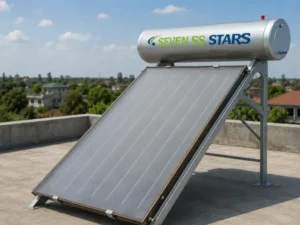
Price range: KSh 185,000.00 through KSh 238,000.00 Select options This product has multiple variants. The options may be chosen on the product pagePressurized Seven Stars Solar Water Heater Stainless – 150L – 350L
Price range: KSh 110,250.00 through KSh 226,625.00 Select options This product has multiple variants. The options may be chosen on the product pageSolarpoints 200L Flat Plate Pressurized Solar Water Heater
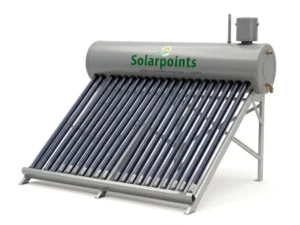
Price range: KSh 125,000.00 through KSh 144,000.00 Select options This product has multiple variants. The options may be chosen on the product pageSolarpoints 300L Non Pressurized Solar Water Heater in Kenya
Price range: KSh 106,000.00 through KSh 116,000.00 Select options This product has multiple variants. The options may be chosen on the product page


Pressurized vs Non-Pressurized Solar Water Heater: Key Differences
| Feature | Pressurized solar water heater | Non-pressurized solar water heater |
|---|---|---|
| Tank design | Closed, pressure-rated tank | Vented, atmospheric tank |
| Water delivery | Uses mains or pump pressure | Relies mainly on gravity |
| Shower pressure | Depends on incoming supply pressure | Depends on tank height |
| Mixer compatibility | Generally better suited to pressurized mixers | Depends on mixer requirements |
| Multiple bathrooms | Suitable when correctly sized | Depends on available gravity flow |
| Installation | Requires pressure-rated plumbing and safety components | Requires suitable tank elevation and venting |
| Initial cost | Generally higher | Generally lower |
| Pressure pump | Can be used within the system’s rated limits | Must not pressurize the tank |
| Installation flexibility | More flexible in pressurized plumbing arrangements | Limited by gravity requirements |
| Best application | Homes with pressurized domestic plumbing | Homes with gravity-fed plumbing |
The comparison is about tank design and water delivery. It does not mean that one system necessarily heats water faster or produces hotter water than the other.
Advantages and Disadvantages of Pressurized Solar Water Heaters
A pressurized solar water heater can be a practical choice for modern homes that require stronger hot-water delivery. However, it also comes with higher equipment and installation requirements.
Advantages of Pressurized Solar Water Heaters
1. Stronger hot-water delivery
A pressurized system can deliver hot water at a pressure closer to the cold-water supply. This makes it suitable for homes that require stronger showers and better water flow.
However, the system does not generate pressure by itself. Its performance depends on the incoming water pressure and the plumbing arrangement.
2. Better compatibility with mixer showers
Many modern mixer showers combine hot and cold water. They work best when the hot and cold supplies have compatible pressure.
A pressurized solar water heater is generally better suited to these installations, provided the available pressure meets the manufacturer’s requirements.
3. Suitable for multiple hot-water outlets
A correctly sized pressurized system can supply several bathrooms, showers and taps.
Its performance depends on the tank capacity, incoming water supply, pipe diameter and the number of outlets operating simultaneously.
4. Suitable for modern homes
Homes with booster pumps, modern bathroom fittings and pressurized plumbing can benefit from a compatible pressurized solar water heating system.
5. Greater flexibility in plumbing arrangements
Because the tank is designed to operate under pressure, the system can integrate with appropriately designed pressurized domestic plumbing without relying on gravity alone.
Disadvantages of Pressurized Solar Water Heaters
1. Higher initial purchase cost
Pressurized systems generally cost more because they require pressure-rated tanks, fittings and safety components.
2. More demanding installation
The installer must consider working pressure, thermal expansion, pressure-control arrangements, relief valves and safe discharge.
3. Requires suitable incoming water pressure
A pressurized tank does not automatically increase water pressure. If the incoming supply is weak, a correctly selected booster pump may be necessary.
4. More components to maintain
Pressure-control and safety valves require periodic inspection. Some components may need servicing or replacement over time.
5. Incorrect installation can be dangerous
Excessive pressure, unsuitable fittings or incorrectly installed safety devices can result in leaks, equipment damage or tank failure.
When Should You Choose a Pressurized Solar Water Heater?
Consider a pressurized system if:
- Your home uses a booster or pressure pump.
- You receive adequately pressurized municipal water.
- You have modern mixer showers or rain showers.
- You want stronger hot-water flow.
- Your home has several bathrooms.
- You expect multiple hot-water outlets to operate at the same time.
- Your plumbing system is designed for pressurized hot-water distribution.
A pressurized solar water heater is particularly worth considering when upgrading an existing home with modern bathroom fittings.
Advantages and Disadvantages of Non-Pressurized Solar Water Heaters
A non-pressurized solar water heater is a practical option for homes with gravity-fed plumbing. Its simpler design can reduce the initial purchase cost, but the installation must provide sufficient height for water delivery.
Advantages of Non-Pressurized Solar Water Heaters
1. Lower initial cost
Non-pressurized systems generally cost less than comparable pressurized systems because their tanks do not need the same pressure-rated construction.
2. Simpler installation
They usually require fewer pressure-control components. The main installation considerations include suitable tank positioning, venting, pipe sizing and safe water delivery.
3. Suitable for gravity-fed plumbing
Homes with elevated water storage can use gravity to supply hot water to showers and taps.
4. Practical for basic household requirements
A correctly installed system can supply bathrooms, kitchen sinks and other domestic outlets when the available gravity pressure is sufficient.
5. Fewer pressure-related components
Since the tank operates at atmospheric pressure, it does not require the same pressure-control arrangement as a closed pressurized tank.
6. Straightforward operation
Many integrated gravity-fed systems use natural circulation without requiring a separate circulation pump.
Disadvantages of Non-Pressurized Solar Water Heaters
1. Lower water pressure
Hot-water flow depends on gravity. It may be weaker than the flow from a pressurized system.
2. Tank height is critical
The storage tank must sit sufficiently above the shower and other outlets. Insufficient height can result in weak water flow.
3. Limited compatibility with some mixer showers
Certain modern mixer showers require more pressure than a gravity-fed system can provide.
4. Simultaneous usage can affect flow
Opening several hot-water outlets may reduce the available flow at each outlet, depending on the pipework and available gravity head.
5. Less flexible installation
The required height and gravity-fed pipe arrangement can limit where the system can be installed.
6. Cannot be directly pressurized
Connecting a booster pump in a way that exposes the atmospheric tank to pressure can cause tank failure, leaks and serious safety risks.
When Should You Choose a Non-Pressurized Solar Water Heater?
Consider a non-pressurized system if:
- Your home uses gravity-fed water.
- You have an elevated water tank.
- Your hot-water requirements are relatively straightforward.
- Your showers and taps operate comfortably at low pressure.
- You want to keep the initial installation cost lower.
- You have sufficient height between the solar tank and the hot-water outlets.
A non-pressurized solar water heater can be an excellent option for a home with properly designed gravity-fed plumbing.
Which System Is Recommended for Different Homes in Kenya?
The best choice depends on the property’s water supply, bathroom fittings and daily hot-water requirements.
| Home or installation type | Recommended option | Reason |
|---|---|---|
| Home with a booster pump | Pressurized | Designed for pressurized hot-water delivery |
| Home with gravity-fed plumbing | Non-pressurized | Works with an elevated water supply |
| Modern bathroom with mixer shower | Usually pressurized | Better suited to compatible balanced-pressure plumbing |
| Single-storey home with basic showers | Either | Depends on pressure and tank height |
| Two-storey home | Depends on plumbing | Pressure or gravity head must meet upper-floor requirements |
| Home with several bathrooms | Usually pressurized | Better suited to higher-flow distribution when correctly sized |
| Home with a limited installation budget | Non-pressurized | Generally lower initial system cost |
| Property with weak incoming water pressure | Requires assessment | A suitable pump or alternative arrangement may be needed |
These are general recommendations, not absolute rules. A well-designed gravity system can work in a multi-storey property if the tank is sufficiently elevated. Similarly, a pressurized system can perform poorly if its pump, pipework or tank is incorrectly sized.
Pressurized vs Non-Pressurized: Does One Heat Water Faster?
This is a common misconception.
Pressurization does not determine how quickly a solar water heater heats water.
It describes how water is stored and delivered, not how efficiently solar energy is collected.
Heating performance depends on:
- Solar collector type and design.
- Collector surface area.
- Available sunlight.
- Tank insulation.
- Initial water temperature.
- Water volume.
- System circulation and heat-transfer arrangement.
A well-designed non-pressurized solar water heater can heat water effectively. A pressurized system does not automatically heat water faster simply because it delivers stronger water pressure.
When comparing two systems, examine their collector specifications, storage capacity, insulation and heating arrangement rather than relying on pressure classification alone.
How to Decide Which Solar Water Heater Is Right for Your Home
Start by understanding your existing water supply and how you use hot water.
Step 1: Identify How Water Reaches Your Bathrooms
Check your home’s water supply arrangement.
Ask yourself:
- Does water flow from an elevated roof tank without a pump?
- Does a booster pump push water through the house?
- Does the property receive direct municipal water pressure?
- Does the water pressure change significantly when several taps are opened?
If your home uses a booster pump or adequately pressurized mains supply, a pressurized solar water heater may be appropriate.
If your home relies on gravity, a non-pressurized system may be suitable.
Step 2: Check Your Shower Performance
Think about the type of shower installed in your home.
If you have a rain shower, thermostatic mixer or modern mixer shower, check its minimum operating pressure and flow requirements.
A gravity-fed solar water heater may not provide enough pressure for some fittings.
If you have a conventional shower that operates comfortably with gravity-fed water, a non-pressurized system may be sufficient.
Step 3: Consider How Many People Use Hot Water
Estimate your household’s daily hot-water demand.
Consider:
- Number of people living in the house.
- Number of bathrooms.
- How frequently people shower.
- Whether several people use hot water simultaneously.
- Whether the kitchen and laundry also require hot water.
A larger household may require a larger storage tank. However, tank capacity alone does not determine water pressure.
For example, a 300L non-pressurized system does not automatically provide stronger showers than a 200L pressurized system. The two capacities describe storage volume, not outlet pressure.
Step 4: Assess the Installation Location
A non-pressurized system needs sufficient elevation above the hot-water outlets.
The greater the vertical distance between the water surface in the tank and the outlet, the greater the available static pressure.
For example:
- A 2-metre water head provides approximately 0.2 bar of static pressure.
- A 5-metre water head provides approximately 0.5 bar of static pressure.
Actual pressure at the shower will be lower because of pipe friction, fittings, valves and other restrictions.
A pressurized system offers more flexibility in water delivery, but the installation must still comply with the tank’s working-pressure limits.
Step 5: Compare the Total Installation Cost
Do not compare purchase prices alone.
Include:
- Solar water heater purchase price.
- Installation materials and labour.
- Additional pumps, if required.
- Pressure-control and safety components.
- Plumbing modifications.
- Electrical backup requirements, where applicable.
- Future servicing and maintenance.
A cheaper non-pressurized system may become less attractive if your home requires substantial plumbing changes to achieve adequate gravity pressure.
Likewise, a pressurized system may be unnecessary expenditure if your existing gravity-fed plumbing already provides sufficient hot-water flow.
A Simple Self-Assessment: Which System Should You Consider?
Use the following questions to identify the system that may suit your home.
1. How is water supplied to your house?
- Booster pump or adequately pressurized mains supply: consider pressurized.
- Elevated tank and gravity-fed supply: consider non-pressurized.
2. What type of shower do you use?
- Mixer or rain shower with specific pressure requirements: check whether a pressurized system is needed.
- Basic gravity-compatible shower: either system may work.
3. Do you use several bathrooms simultaneously?
- Frequently: consider a properly sized pressurized system.
- Rarely or never: a gravity-fed option may be sufficient.
4. Can you install the solar tank high enough above your bathrooms?
- Yes: a non-pressurized system may work.
- No: consider a suitable pressurized arrangement.
5. Is your priority lower initial cost or stronger water delivery?
- Lower initial cost: consider non-pressurized.
- Stronger, more consistent hot-water delivery: consider pressurized, provided the incoming supply is adequate.
This assessment is a starting point, not a substitute for checking actual water pressure, flow rate and plumbing compatibility.
Common Myths About Pressurized vs Non-Pressurized Solar Water Heaters
Myth 1: Pressurized Solar Water Heaters Heat Water Faster
Fact: Pressurization describes how water is stored and delivered, not how quickly solar energy heats it.
Heating performance depends on collector design, available sunlight, insulation, water temperature and system configuration.
Myth 2: Non-Pressurized Solar Water Heaters Cannot Supply Showers
Fact: They can supply showers when the installation provides sufficient gravity head and the shower fittings are suitable for low-pressure operation.
The problem arises when homeowners expect gravity-fed systems to deliver the same flow as high-pressure showers.
Myth 3: You Can Connect a Pressure Pump to Any Solar Water Heater
Fact: This is unsafe.
A non-pressurized tank is not designed to withstand mains or booster-pump pressure. Connecting a pressure pump directly to an atmospheric tank can cause tank failure, leaks or serious injury.
A pressurized system must also operate within its specified pressure rating and have the required safety protection.
Myth 4: Pressurized Systems Are Always More Efficient
Fact: Water pressure does not determine solar heating efficiency.
A properly installed non-pressurized system can heat water effectively. Collector design, insulation, system sizing and installation quality matter more when assessing heating performance.
Myth 5: Pressurized Means Indirect Heating
Fact: These terms describe different aspects of a solar water heater.
- Pressurized or non-pressurized describes the tank’s operating pressure and water delivery.
- Direct or indirect describes how heat reaches the domestic water.
An indirect system transfers heat through a heat exchanger. A direct system heats the water that is stored or circulated for domestic use.
Therefore, do not assume that every pressurized system is indirect or that every non-pressurized system is direct.
Does Hard or Borehole Water Affect Your Choice?
Water quality is another important consideration for Kenyan homeowners, especially properties using borehole water.
Hard water contains dissolved minerals that can form scale when heated. The effect depends on the water chemistry, temperature and system design.
An indirect solar water heater uses a separate heat-transfer circuit to transfer heat to the domestic water. This can reduce direct exposure of the collector circuit to scale-forming domestic water, depending on the design.
However, pressurization alone does not prevent scaling or corrosion.
The tank material, heat exchanger, water chemistry and maintenance requirements should all be considered.
For properties using borehole water, consider testing the water before selecting a system. The results can help determine whether additional treatment or a particular heat-transfer arrangement is appropriate.
Important Installation Mistakes to Avoid
Whichever system you choose, avoid these common mistakes:
- Connecting a booster pump directly to a non-pressurized tank.
- Installing a pressurized tank without the required pressure and temperature relief protection.
- Failing to check the maximum working pressure of the tank.
- Choosing a shower mixer that requires more pressure than the system can supply.
- Selecting tank capacity without considering household consumption.
- Assuming a larger tank automatically produces stronger water pressure.
- Ignoring water quality, scaling and corrosion protection.
- Installing a solar water heater without considering safe access for inspection and maintenance.
A qualified installer should assess the complete plumbing arrangement before installation.
FAQs on pressurized vs non pressurized solar water heater
Which is better, a pressurized or non-pressurized solar water heater?
A pressurized system is generally more suitable for homes with pressure pumps, mixer showers and pressurized plumbing. A non-pressurized system is suitable for gravity-fed installations with adequate tank height. The better option depends on the property’s plumbing and hot-water requirements.
Can I use a pressure pump with a non-pressurized solar water heater?
You should not connect a pressure pump in a way that pressurizes a non-pressurized tank. The tank is designed to operate at atmospheric pressure. Any alternative pumping arrangement must keep the tank protected from pressure.
Does a pressurized solar water heater need a pressure pump?
Not necessarily. It can use an adequately pressurized mains supply. A booster pump may be needed where the incoming pressure is insufficient, but the pump must be correctly selected and controlled to remain within the system’s rated pressure.
Does a non-pressurized solar water heater have low water pressure?
It usually delivers lower pressure than a pressurized system because it relies on gravity. The actual flow depends on the height of the tank above the outlet and the resistance in the pipework.
Is a 300L pressurized solar water heater better than a 200L non-pressurized system?
Not automatically. These are two separate considerations: storage capacity and delivery pressure. A 300L system stores more water, while pressurization affects how water is delivered. Choose capacity according to household demand and system type according to plumbing requirements.
Can both systems work during cloudy weather?
Both systems can collect solar energy from available sunlight, including diffuse sunlight, but heating performance falls when solar radiation is reduced. A suitable electric backup element or another compatible backup heating source can provide additional hot water when solar energy is insufficient.
Can I replace a non-pressurized solar water heater with a pressurized one?
Yes, but the existing plumbing must be assessed first. The replacement may require changes to the pipework, pressure-control arrangement, safety valves and water supply. Do not assume that the existing connections are suitable for a pressurized tank.
Which solar water heater is cheaper in Kenya?
Non-pressurized solar water heaters generally have a lower initial purchase cost because of their simpler tank design. However, the total cost depends on capacity, collector type, materials, installation requirements and any additional plumbing work.
Final Verdict
Choose a pressurized solar water heater when your home needs stronger hot-water delivery, uses pressurized plumbing or has modern shower fittings that require balanced water pressure.
Choose a non-pressurized solar water heater when your home uses gravity-fed plumbing, has sufficient tank elevation and does not require high-pressure shower performance.
Neither system is universally better. The right choice is the one that works with your existing plumbing, meets your household’s hot-water demand and fits your installation budget.
Pureflex Water Solutions supplies solar water heating systems for residential applications in Kenya, including pressurized solar water heaters and non-pressurized solar water heaters.
For other configurations, explore the flat plate solar water heater, the household solar water heating system, the 200L solar water heater and the 300L solar water heater for homes in Kenya.
Contact Pureflex with your water supply arrangement, number of bathrooms and preferred tank capacity to get guidance on the appropriate system.
Further Reading
For additional technical guidance, consult:
- Plumbing Africa – Solar geysers: high-pressure vs low-pressure, discussing pressure differences and installation considerations.
Solar Water Heaters Available at Pureflex
200L Pressurized Solar Water Heater in Kenya – Solarpoints
Price range: KSh 120,000.00 through KSh 140,000.00 Select options This product has multiple variants. The options may be chosen on the product page300L Pre-Heat Pressurized Coil Solar Water Heating System
Original price was: KSh 155,000.00.KSh 148,000.00Current price is: KSh 148,000.00. Add to cart300L Solar Water Heater for Homes in Kenya | Solarpoints
Price range: KSh 150,000.00 through KSh 175,000.00 Select options This product has multiple variants. The options may be chosen on the product pageHousehold Solar Water Heating System in Kenya | 200L & 300L
Price range: KSh 185,000.00 through KSh 238,000.00 Select options This product has multiple variants. The options may be chosen on the product pagePressurized Seven Stars Solar Water Heater Stainless – 150L – 350L
Price range: KSh 110,250.00 through KSh 226,625.00 Select options This product has multiple variants. The options may be chosen on the product pageSolarpoints 200L Flat Plate Pressurized Solar Water Heater
Price range: KSh 125,000.00 through KSh 144,000.00 Select options This product has multiple variants. The options may be chosen on the product pageSolarpoints 300L Non Pressurized Solar Water Heater in Kenya
Price range: KSh 106,000.00 through KSh 116,000.00 Select options This product has multiple variants. The options may be chosen on the product page



Leave a Comment