Is water refilling business profitable in Kenya? Absolutely! A properly managed water refilling station can become a highly rewarding business, especially in residential neighbourhoods where households, offices and businesses need affordable drinking water every day.
Unlike businesses that depend on occasional purchases, drinking water is a product that customers consume repeatedly. A household may purchase drinking water several times a week, while offices, restaurants, shops and institutions require consistent supplies.
This creates an opportunity for entrepreneurs to establish a reliable source of recurring income.
Even better, starting a water refilling business does not necessarily require owning a borehole, purchasing expensive water tankers or investing in a large bottling factory. You can start by purchasing water from an established fresh-water distributor, using municipal water, treating river water or purifying borehole water, depending on your location and available resources.
The real opportunity lies in choosing the right water source, investing in suitable purification equipment, establishing a loyal customer base and managing operating costs.
At Pureflex Water Solutions, we supply, install and service water refilling stations and commercial water purification equipment across Kenya. This guide explains why the business is profitable, how much revenue you could generate and practical strategies for increasing your earnings.
1. Why Is a Water Refilling Business Profitable?
The profitability of a water refilling business comes from a combination of regular demand, repeat customers, flexible pricing and the ability to serve a relatively large market.
Here are the main reasons this business has strong commercial potential.
Consistent demand for drinking water
Water is an essential product. Households need it for drinking, cooking and preparing beverages. Offices, restaurants, schools, salons and other businesses also require drinking water.
In many Kenyan neighbourhoods, customers prefer purchasing purified drinking water rather than investing in individual household purification systems.
This creates repeat business.
Instead of constantly searching for new customers, a refill station can build a regular customer base that returns whenever its water containers are empty.
Affordable operating model
A neighbourhood refill station does not necessarily need a large workforce or expensive machinery.
Depending on the business model, you may only need:
- A suitable water purification system or verified treated-water supply.
- A clean water storage tank.
- Dispensing taps.
- A bottle rinsing station.
- A packing and handling area.
- Basic plumbing and drainage.
- A clean, accessible shop.
A small business can initially be owner-operated, reducing labour expenses.
Flexible water sourcing
One major advantage is that you have several options for obtaining water.
You can purchase already-treated water from established distributors, use municipal water, or establish your own treatment arrangement using an appropriate raw-water source.
This flexibility allows entrepreneurs to enter the industry without necessarily investing in expensive water abstraction infrastructure.
Opportunities for expansion
A refill station can start by serving walk-in customers and gradually introduce additional revenue streams.
These include:
- Home and office water delivery.
- Supplying restaurants and retail shops.
- Supplying schools and other institutions.
- Selling sealed drinking water bottles, where appropriately licensed.
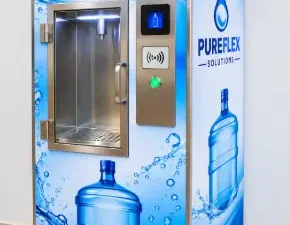
- Installing water vending machines.
- Operating additional refill outlets.
- Supplying water to events and functions.
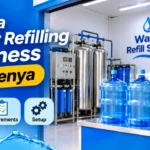
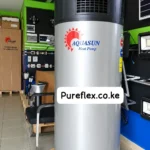
Complete Water refill Station Prices
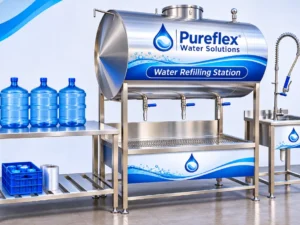
Water Refilling Machine in Kenya – Complete Water Refilling Station
Original price was: KSh 180,000.00.KSh 160,000.00Current price is: KSh 160,000.00. Add to cart
2. How Much Can You Make From a Water Refilling Business in Kenya?
The amount of money you can make depends on your daily sales volume and the price you charge per litre.
In the Kenyan market, water refill prices can range between KSh 10 and KSh 30 per litre, depending on the neighbourhood, customer purchasing power, competition, delivery arrangements and the quality of the service.
For illustration, consider what happens when a refill station sells different quantities of water daily.
Water refilling business revenue projections
Assuming the station operates for 30 days each month:
| Daily sales | Price per litre | Daily revenue | Monthly revenue |
|---|---|---|---|
| 50 litres | KSh 10 | KSh 500 | KSh 15,000 |
| 100 litres | KSh 15 | KSh 1,500 | KSh 45,000 |
| 200 litres | KSh 20 | KSh 4,000 | KSh 120,000 |
| 300 litres | KSh 20 | KSh 6,000 | KSh 180,000 |
| 500 litres | KSh 25 | KSh 12,500 | KSh 375,000 |
| 500 litres | KSh 30 | KSh 15,000 | KSh 450,000 |
| 1,000 litres | KSh 20 | KSh 20,000 | KSh 600,000 |
These figures represent gross sales revenue, not net profit. Actual earnings depend on water procurement, electricity, rent, labour, transportation, filter replacements, maintenance, testing and other operating expenses.
Nevertheless, the figures demonstrate the potential of building a business around a product that customers purchase repeatedly.
Example: A neighbourhood water refill station
Imagine establishing a refill station in a residential neighbourhood with apartments and several thousand potential residents.
Suppose you attract:
- 20 households purchasing 20 litres weekly.
- 10 households purchasing 40 litres weekly.
- 5 small businesses purchasing 40 litres weekly.
Your daily sales would be:
| Customer category | Weekly quantity |
|---|---|
| 20 households | 400 litres |
| 10 households | 400 litres |
| 5 small businesses | 200 litres |
| Total | 1000 litres |
At KSh 20 per litre, the station generates KSh 20,000 in weekly revenue.
Over 30 operating days, that translates to KSh 80,000 in monthly revenue.
The important lesson is that you do not need hundreds of customers to establish a viable water refilling business. A relatively small number of consistent customers can generate substantial sales.
3. How to Make More Profit From Your Water Refilling Business
Generating sales is important, but the real objective is to maximise the money retained after paying operating expenses.
Here are practical strategies that can help your water refilling business outperform competing stations.
1. Offer free delivery within your neighbourhood
This is one of the most effective ways to differentiate your business.
Many customers would rather have water delivered to their doorstep than carry heavy 10-litre and 20-litre containers from a shop.
You can introduce free delivery within a defined neighbourhood for orders meeting a minimum quantity.
For example:
- Free delivery for orders of 20 litres or more within your immediate neighbourhood.
- Scheduled deliveries for apartment buildings.
- Free delivery for regular customers ordering several containers.
- Special delivery arrangements for offices and small businesses.
The secret is to keep delivery routes short and group orders from nearby customers.
Instead of making separate trips for every household, organise deliveries by estate, apartment block or street.
This reduces transportation expenses while increasing the number of litres sold per trip.
Business advantage: Convenience becomes your competitive advantage, encouraging repeat purchases and customer loyalty.
2. Introduce weekly and monthly water subscriptions
Instead of waiting for customers to remember when they need water, give them an opportunity to subscribe.
For example, offer:
- Weekly household water deliveries.
- Monthly office water supply packages.
- Scheduled apartment deliveries.
- Regular supply arrangements for restaurants and shops.
A subscription model makes it easier to forecast demand and plan water production.
It also helps establish predictable cash flow.
You can offer different subscription quantities depending on household size and consumption patterns.
3. Target apartment buildings and residential estates
A single apartment building can provide several potential customers within a small geographical area.
Rather than spending money advertising across an entire town, concentrate on residential estates with high population density.
Approach:
- Apartment managers.
- Landlords.
- Residential associations.
- Caretakers.
- Property management companies.
Introduce your water refill service and provide convenient ordering through WhatsApp.
You can also arrange a central collection point or scheduled deliveries for residents.
The more households you serve within a small geographical area, the lower your average delivery cost becomes.
4. Supply offices, restaurants and small businesses
Do not limit your business to households.
Offices, restaurants, salons, barbershops, retail shops and other commercial establishments regularly consume drinking water.
Some businesses may require larger quantities and more predictable supply arrangements.
Approach them with competitive bulk pricing and scheduled deliveries.
A few reliable commercial customers can help stabilise your daily sales, particularly during periods when walk-in traffic is low.
5. Sell different quantities and offer value-added services
Give customers more than one purchasing option.
For example, offer:
- 5-litre refills.
- 10-litre refills.
- 20-litre refills.
- Sealed drinking water bottles, subject to applicable requirements.
- Office water delivery.
- Bulk water supply.
You can also sell compatible reusable water containers and other water-related accessories.
This allows you to serve customers with different budgets and consumption requirements.
6. Introduce a customer loyalty programme
Encourage repeat purchases through simple incentives.
For example:
- A discount after a specified number of purchases.
- A free refill after reaching a defined spending threshold.
- Referral rewards for introducing new customers.
- Special rates for monthly subscribers.
You do not need an expensive loyalty application.
A simple customer register or WhatsApp-based ordering system can help you track repeat purchases.
The objective is to make customers choose your station consistently rather than switching between competitors.
7. Use WhatsApp as your sales channel
WhatsApp can become one of your most valuable marketing tools.
Create a WhatsApp Business profile with:
- Your shop location.
- Operating hours.
- Water refill prices.
- Delivery coverage.
- Available products and services.
- Ordering instructions.
Post daily updates on WhatsApp Status and encourage customers to save your business number.
You can also create neighbourhood customer groups or broadcast lists, with customers’ consent, for delivery schedules and promotional offers.
A customer should be able to order water without having to visit your shop or make several telephone calls.
8. Control operating expenses
High sales do not automatically translate into high profits.
Monitor the following expenses:
- Incoming water costs.
- Electricity consumption.
- RO reject-water losses, where applicable.
- Replacement filters and membranes.
- Equipment servicing.
- Rent and salaries.
- Delivery and transportation.
- Cleaning and sanitation.
- Water testing.
Choose equipment that matches your water source and expected daily demand.
An oversized system may increase your initial investment and operating costs without generating additional sales.
Similarly, using an unsuitable treatment system may result in excessive filter replacements, membrane damage and unnecessary maintenance.
4. What Water Sources Can You Use for a Water Refilling Business?
You do not have to own a borehole to operate a water refilling station.
The right water source depends on your location, available infrastructure, water quality and business model.
Here are four practical options.
A. Buying water from fresh-water distributors
This is an attractive option for entrepreneurs who want to enter the water business without investing in their own large-scale treatment plant.
You purchase already-treated water from a reliable bulk water distributor and sell it to customers through your refill station or delivery service.
Your business makes money from the difference between your purchase cost and selling price, after accounting for operating expenses.
For example, you can establish a neighbourhood distribution point and serve customers who prefer buying water closer to their homes.
Before choosing this model:
- Verify the distributor’s water source.
- Request current water quality test reports.
- Confirm the supplier’s applicable approvals.
- Inspect transportation and storage hygiene.
- Establish a reliable supply arrangement.
- Calculate transportation and handling costs.
B. Using municipal water
Municipal water is another practical source for a water refilling station.
It is particularly attractive in areas with reliable municipal supply because the entrepreneur can avoid the cost of drilling a borehole or purchasing bulk water.
However, municipal water should not automatically be assumed to be suitable for direct drinking-water refilling.
Its quality can change during distribution and storage.
Depending on laboratory results, the treatment arrangement may include:
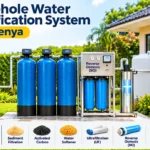
- Sediment filtration.
- Activated carbon filtration.
- Ultrafiltration.
- Reverse osmosis, where necessary.
- UV sterilisation or another suitable disinfection process.
The treatment system should be designed around actual water quality rather than unnecessary filtration stages.
C. Using river water
Entrepreneurs in areas with access to rivers may consider river water as a potential source for a commercial water treatment business.
However, river water requires careful treatment because it can contain:
- Suspended sediments.
- Organic matter.
- Microorganisms.
- Turbidity.
- Agricultural runoff.
- Other chemical contaminants.
A suitable treatment plant may require screening, coagulation and flocculation, sedimentation, media filtration, activated carbon, ultrafiltration and disinfection, depending on the source-water analysis.
Where dissolved contaminants are present, additional treatment may also be necessary.
River water should never be supplied as drinking water simply because it looks clear after filtration. Laboratory testing and appropriate treatment are essential.
D. Using salty borehole water
Salty borehole water presents a particularly interesting opportunity for water refilling businesses in parts of Kenya.
Areas experiencing saline groundwater may have limited access to affordable drinking water.
An entrepreneur with access to such a source can establish a commercial water purification station using reverse osmosis technology.
A typical treatment arrangement may include:
- Raw-water storage.
- Sediment filtration.
- Activated carbon or other required pretreatment.
- Water softening or antiscalant dosing where necessary.
- Commercial reverse osmosis.
- UV sterilisation or suitable final disinfection.
- Treated-water storage.
- Hygienic dispensing equipment.
The exact configuration depends on the laboratory analysis.
RO systems can reduce dissolved salts and several other dissolved contaminants, making them particularly useful for saline groundwater.
However, the system must also account for concentrate or reject-water management, membrane maintenance and water recovery.
Important: Not every water source requires reverse osmosis. A laboratory water analysis should determine the appropriate treatment technology before equipment is purchased.
5. Which Water Refilling Machine Should You Buy?
The purification machine is one of the most important investments in your business.
However, the biggest mistake entrepreneurs make is purchasing equipment based on advertised capacity or price without considering the quality of their incoming water.
A municipal-water refill station may need a different configuration from a commercial RO plant treating salty borehole water.
Here are some common equipment options.
Municipal water refilling systems
These systems are suitable for businesses using municipal water where laboratory results support a relatively simple treatment arrangement.
Depending on the source, the equipment may include sediment filters, activated carbon, ultrafiltration, UV sterilisation and appropriate storage and dispensing components.
Commercial reverse osmosis systems
Commercial RO systems are suitable for water requiring significant reduction of dissolved salts and other contaminants.
They are particularly useful for businesses treating saline borehole water.
Common commercial production capacities include:
- 125 litres per hour.
- 250 litres per hour.
- 500 litres per hour.
- 1,000 litres per hour.
- Higher-capacity customised systems.
Choose production capacity based on projected daily sales, operating hours, storage capacity and actual operating conditions.
Complete water refilling stations
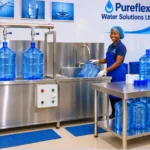
A complete refill station can simplify the setup process by bringing several essential components together.
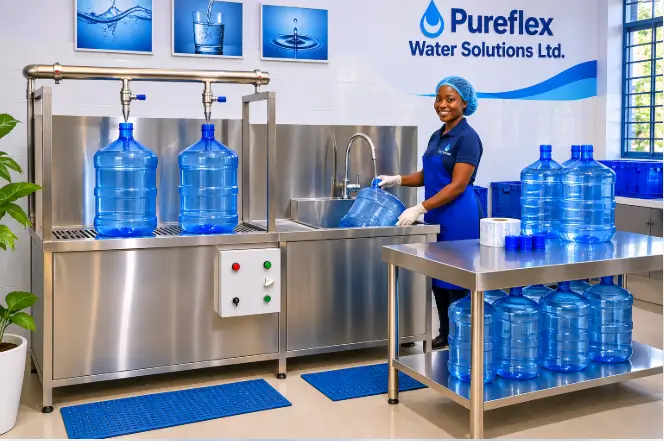
A typical configuration includes:
- Water storage tank.
- Dispensing taps.
- Water purification system.
- UV steriliser, where required.
- Bottle rinser.
- Stainless steel packing table.
- Plumbing and connecting accessories.
Pureflex supplies complete water refilling stations as well as customised commercial purification systems.
Explore our complete water refilling machine in Kenya to see an example of an integrated neighbourhood refill station.
6. How Much Should You Invest in a Water Refilling Business?
Your startup capital depends on the business model.
A simple distribution business using purchased treated water will have different equipment requirements from a commercial RO station treating salty borehole water.
Your budget should account for:
| Investment area | What to consider |
|---|---|
| Water purification equipment | Suitable treatment technology and capacity |
| Storage | Raw-water and treated-water tanks |
| Dispensing equipment | Filling taps, plumbing and accessories |
| Premises | Rent, renovations and drainage |
| Hygiene | Bottle rinsing, cleaning and sanitation |
| Licensing | Applicable business and regulatory requirements |
| Branding | Signage, uniforms and marketing |
| Working capital | Water, electricity, labour and maintenance |
Do not spend your entire budget on the purification machine.
You need enough working capital to operate the business while building your customer base.
For an overview of possible investment levels, read our guide on water refilling business startup costs in Kenya.
7. Where Should You Locate Your Water Refilling Business?
Location can determine whether your station attracts 50 litres or 500 litres of daily sales.
Look for areas where residents regularly purchase drinking water.
Good locations include:
- Residential estates.
- Apartment complexes.
- Busy neighbourhood shopping centres.
- Areas with limited access to affordable purified drinking water.
- Locations near offices and commercial establishments.
- Areas with a high concentration of tenants.
Before renting a shop, conduct basic market research.
Visit existing refill stations and observe their customer traffic.
Find out what competitors charge, what customers complain about and whether there is an opportunity to offer better service.
Also assess the availability of water, electricity, drainage, parking and accessible premises.
A strategically located small station can perform better than a large, expensive facility in an area with limited demand.
8. How to Beat Competition in the Water Refilling Business
The water refilling industry can be competitive, particularly in established residential neighbourhoods.
However, competing on price alone is not a sustainable strategy.
Instead, build a business around convenience, reliability, cleanliness and customer experience.
Consider these strategies:
Offer reliable delivery: Customers should know that they can order water and receive it within an agreed period.
Maintain consistent quality: Test your water and maintain your equipment. Trust is one of the most valuable assets in this industry.
Keep your shop clean: Customers should see a hygienic environment, clean dispensing taps and properly handled containers.
Maintain convenient operating hours: Make it easy for customers to purchase water before work, after work and during weekends.
Build a recognisable brand: Invest in professional shop signage, branded containers where appropriate and consistent customer communication.
Use Google Business Profile: Make it easy for nearby customers to find your station when searching for water refilling services.
Offer transparent pricing: Display your refill prices clearly and avoid surprising customers with additional charges.
Reward loyal customers: Subscriptions, referrals and repeat-purchase incentives can help retain your customer base.
The objective is to become the preferred water supplier in your neighborhood.
9. Legal and Water Quality Requirements
A profitable water refilling business must also operate responsibly.
Before opening, establish which licences, inspections and certifications apply to your particular business model.
Consider the following:
- Business registration.
- Relevant county business permits.
- Public health and food hygiene requirements.
- Applicable KEBS standards and certification requirements.
- Water quality testing through an appropriate laboratory.
- Water abstraction approvals where applicable.
- Staff hygiene and medical certification where required.
Requirements may differ between customer-container refill stations, bulk water distribution and packaged drinking-water production.
For example, using a borehole as a commercial source may involve additional water abstraction requirements.
Refer to the Kenya Bureau of Standards guidance on bottled water and water refills and the WASREB drinking water quality guidelines.
10. How Pureflex Water Solutions Helps You Start a Profitable Water Refilling Business
Starting a water refilling business involves more than purchasing a machine and opening a shop.
You need a suitable treatment system, proper installation, reliable equipment and ongoing technical support.
Pureflex Water Solutions provides end-to-end support for entrepreneurs looking to enter the water refilling industry.
Our services include:
Water refilling equipment supply
We supply water refilling machines, commercial RO systems, municipal water purification systems, storage tanks, UV sterilisers, bottle rinsers and dispensing equipment.
Water quality assessment and treatment recommendations
Different water sources require different treatment approaches. We help establish the appropriate equipment configuration based on your water source and intended production capacity.
Professional installation
Our team handles equipment installation, plumbing connections, system integration and commissioning.
Complete station setup from as low as 120,000
We help entrepreneurs establish functional water refilling stations, including equipment arrangement, storage, dispensing and Free shop branding.
Equipment servicing and maintenance
We provide ongoing technical support, troubleshooting, replacement filters and maintenance services to help keep your business operating reliably.
Whether you want to start a small neighbourhood refill shop, establish a commercial RO water station or expand an existing water distribution business, Pureflex can help you choose the right solution.
11. Frequently Asked Questions About Water Refilling Business Profitability
Is water refilling business profitable in Kenya?
Yes. A water refilling business can be profitable in Kenya because drinking water has consistent demand and customers make repeat purchases. Profitability depends on daily sales volume, selling price, water sourcing costs, operating expenses and customer retention.
How much can a water refilling business make per month?
Monthly revenue depends on the number of litres sold and the price per litre. For example, selling 500 litres daily at KSh 20 per litre generates KSh 300,000 in monthly gross revenue over 30 days. Actual profit is determined after deducting operating expenses.
How much should I charge per litre of purified water?
Pricing depends on your neighbourhood, customer purchasing power, competition, water procurement costs and delivery arrangements. In the market considered in this guide, refill prices range between KSh 10 and KSh 30 per litre.
Can I start a water refilling business without owning a borehole?
Yes. You can purchase treated water from an established distributor or use municipal water where the source and treatment arrangement are suitable. You do not have to own a borehole to enter the industry.
Can I use municipal water for a water refilling business?
Yes. Municipal water can be used as a source for a refill station, provided appropriate testing confirms its quality and the treatment system meets applicable drinking-water requirements.
Can I use river water for a water refilling business?
Yes, provided the source can be legally and sustainably accessed and the water receives appropriate treatment. River water may require extensive pretreatment, filtration and disinfection before it is suitable for drinking.
Can I sell water from a salty borehole?
Yes. Salty borehole water can be treated using a suitably designed reverse osmosis system. However, the treatment configuration should be based on laboratory analysis, including salinity and other relevant contaminants.
Is a 250 LPH or 500 LPH water purification machine better?
The right capacity depends on your expected daily demand. A 250 LPH system may suit a smaller station, while a 500 LPH system can support higher production requirements. Remember to consider actual operating hours, storage and RO recovery when planning your production.
Can I make money by delivering water to customers?
Yes. Home and office delivery can increase sales by reaching customers who cannot conveniently visit your shop. Grouping orders within the same neighbourhood and setting minimum delivery quantities can help control transportation costs.
Does Pureflex supply and install complete water refilling stations?
Yes. Pureflex Water Solutions supplies and installs complete water refilling stations and commercial water purification equipment. We also provide customised systems, technical guidance, servicing and maintenance.
Does Pureflex offer after-sales support?
Yes. Pureflex provides equipment servicing, maintenance guidance, troubleshooting and replacement filtration components to support the continued operation of your water refilling business.
Final Verdict: Is a Water Refilling Business Worth Investing In?
A water refilling business is worth considering for entrepreneurs looking for an opportunity built around a product that people purchase regularly.
Its greatest advantage is flexibility. You can start with a small neighbourhood station, purchase treated water from a distributor, use municipal water where suitable or invest in a commercial purification plant for borehole or river water.
You can then increase sales through free neighbourhood delivery, household subscriptions, commercial supply arrangements and strategic partnerships with apartment managers.
The key is to start with the right equipment, control operating expenses and build a loyal customer base.
You do not have to figure everything out alone.
Pureflex Water Solutions is ready to help turn your water business idea into a working business.
We supply, install and service water refilling stations and commercial water purification systems in Kenya.
Whether you are starting from scratch or expanding an existing water business, we can help you identify the right equipment and plan your installation.
Leave a Comment