
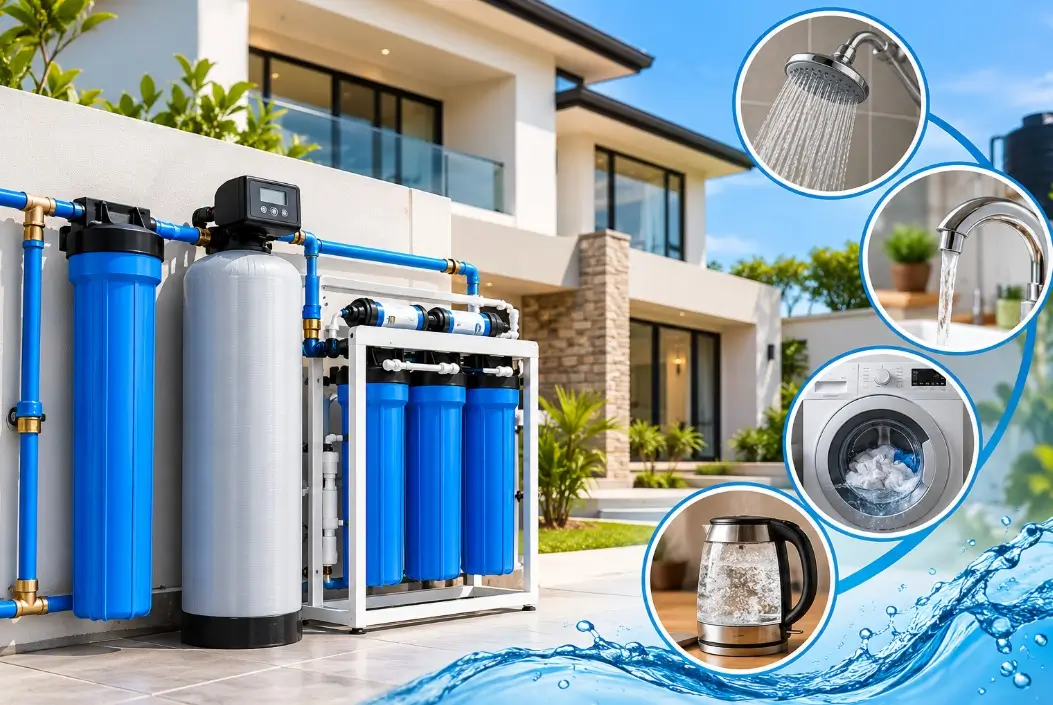
A whole house water filter system treats water before it reaches the taps, showers and other outlets in your home. But there is no single system that works best for every house. The right choice depends on your water source and the problem you need to solve. In Kenya, homeowners may need sediment filtration, activated carbon, ultrafiltration (UF), reverse osmosis (RO), water softening, or a combination of these systems.
If you use borehole water, this choice becomes even more important. Some homes have salty water or high TDS. Others have hard water, sediment, iron or microbial concerns. The right treatment starts with understanding your water.
What Is a Whole House Water Filter System?
A whole house water filter system is installed on the main water line entering your home.
It treats water before the water reaches your:
- Kitchen taps
- Bathroom taps
- Showers
- Washing machines
- Water heaters
- Other household outlets
This is different from an under-sink purifier. An under-sink system treats water at one point, usually the kitchen tap. A whole house system treats water for the wider property.
This type of setup is also called point-of-entry water treatment.
Do You Need a Whole House Water Filter?
You may need one if your water is causing problems around the house.
Common signs include:
- White scale around taps
- Blocked showerheads
- Scale inside water heaters
- Salty water
- High TDS
- Sand or dirt in the water
- Bad taste or smell
- Staining on bathroom fittings
- Concerns about borehole water
If the problem affects several outlets, treating only your kitchen drinking water may not be enough.
For a wider look at the different types of filters available in Kenya, see our guide on how to choose the right water filter in Kenya.
Which Water Filtering System Is Best for Your House?
The best water filtering system for a house depends on the problem.
| Water problem | Treatment to consider |
|---|---|
| Sand, dirt or sediment | Sediment filtration |
| Taste or odour | Activated carbon |
| Fine particles and some microorganisms | Ultrafiltration |
| Salty or high-TDS water | Reverse osmosis |
| Hard water and scale | Water softener |
| Several problems | Combination system |
This is why homeowners should avoid choosing a system simply because it has more stages.
More stages do not always mean better treatment.
The goal is to use the right treatment for the water entering your home.
Reverse Osmosis for Salty Borehole Water
Reverse osmosis is especially useful when the main problem is salty or high-TDS borehole water.
A normal sediment filter can remove particles. Carbon can improve taste and reduce some substances. But these filters do not provide the same reduction of dissolved salts as an RO membrane.
RO uses pressure to push water through a semi-permeable membrane. The membrane reduces many dissolved substances, including salts and other dissolved solids.
This makes RO worth considering when borehole water has:
- A salty taste
- High TDS
- High mineral content
- Persistent mineral deposits
- Poor taste when used for cooking
You can read more about how reverse osmosis purifies water before choosing an RO system.
Can RO Treat the Whole House?
Yes, but the system must be sized for the home.
A common setup is:
Source water → Pre-treatment → RO → Treated-water tank → House supply
The RO produces treated water into a storage tank. A suitable pump can then supply the treated water to the house.
This approach is useful when a home has salty borehole water and needs treatment beyond a single kitchen tap.
Ultrafiltration for Home Water Filtration
Ultrafiltration is another option for residential water treatment.
UF uses a fine membrane to remove suspended particles and many microorganisms. However, UF does not work in the same way as RO.
This matters if your main problem is salty water.
UF is not a substitute for RO when the main problem is dissolved salts or high TDS.
UF may be useful when the main concern is fine particles or certain microbial contaminants. The right setup still depends on the source water and test results.
Water Softeners for Hard Water and Scale
A water softener solves a different problem.
Hard water contains minerals such as calcium and magnesium. These minerals can form scale around taps, showerheads, kettles and water heaters.
You may notice:
- White deposits
- Scale on showerheads
- Deposits on taps
- Reduced soap lather
- Scale inside water heaters
A softener is designed to reduce hardness-causing minerals.
However, a softener is not the same as an RO system.
If your water is salty, RO may be more appropriate. If the main problem is hardness and scale, a softener may be the better choice.
Some homes may need both.
What About Sediment and Carbon Filters?
Not every home needs RO.
If your main problem is sand, dirt or rust, a sediment filter may be enough.
Activated carbon can also help improve taste and odour. It can also reduce some chemicals, depending on the type of carbon and the water being treated.
These filters can also work as pre-treatment before UF or RO.
For example:
Sediment → Carbon → RO
can help protect the RO membrane from particles and improve the overall treatment process.
Whole House Water Filtration for Borehole Water in Kenya
Borehole water can vary greatly from one location to another.
A borehole in Nairobi may have different water characteristics from one in Ruiru, Kiambu, Thika, Kajiado, Machakos, Nakuru or Mombasa.
Even two boreholes in the same area can have different water quality.
One home may have high TDS and salty water.
Another may have hard water and scale, iron and staining or even have sediment.
This is why there is no single whole house water filter system that is automatically best for every Kenyan home.
Test Your Water Before Choosing a System
Water testing can help you understand what your home actually needs.
Useful tests may include:
- TDS
- pH
- Hardness
- Turbidity
- Iron
- Manganese
- Fluoride
- Nitrates
- Microbiological tests
A TDS meter can help you check dissolved-solids levels. However, it cannot identify individual contaminants or prove that water is safe to drink.
For more guidance, read our article on how to test water quality at home in Kenya.
For more detailed analysis, the Water Resources Authority laboratory services cover chemical and microbiological water testing in Kenya. Water Resources Authority
Can One System Solve Every Water Problem?
Usually, no.
Different water problems need different treatment.
For salty borehole water:
Sediment → Carbon → RO → Storage → House
For hard water:
Sediment → Softener → House
For sediment and fine filtration:
Sediment → UF → House
For homes with several water problems, a combination system may be needed.
The important point is to treat the actual problem rather than buying the system with the most filters.
How Much Does a Whole House Water Filter System Cost in Kenya?
The cost depends on the type of treatment your home needs.
A simple sediment and carbon system costs less than a complete RO system with pre-treatment, storage and pumping.
The final cost can depend on:
- Water quality
- Required flow rate
- Household size
- Number of bathrooms
- Storage capacity
- Treatment technology
- Installation requirements
- Filter replacement needs
This is why comparing prices alone can be misleading.
How to Choose the Right System for Your Home
Start with the water problem.
If you have salty or high-TDS borehole water, investigate reverse osmosis.
When you have severe scale and hard water, investigate water softening.
If you have sand or sediment, start with sediment filtration.
When you need fine filtration, consider UF.
If you have several problems, you may need a combination of treatments.
The best system is the one that matches your water.
Final Thoughts
A whole house water filter system can make sense when water-quality problems affect several parts of your home.
But there is no universal solution.
RO is useful for salty and high-TDS water. UF can provide fine filtration for suitable water sources. A softener can help with hard water and scale. Sediment and carbon filters can provide important basic filtration and pre-treatment.
For homeowners in Kenya, the best approach is simple:
Test the water. Identify the problem. Choose the right treatment.
PureFlex provides domestic water purification solutions in Kenya, including RO, UF, whole-house filtration and pre-filtration systems. The focus is on matching the treatment system to the water source and household requirements.
Leave a Comment