
Looking for an AC submersible pump to supply water from a borehole, well, tank or other underground water source? Choosing the right pump involves more than simply looking at horsepower or checking the AC pump price.
The right model should match your water demand, borehole size, pumping depth, required flow rate, delivery height and available electricity supply. A correctly sized pump can provide reliable water delivery for homes, farms, apartments, institutions and commercial applications without unnecessary energy consumption or performance problems.
At PureFlex Water Solutions, we supply water pumping and treatment solutions for different applications in Kenya, including submersible pumps, solar pumping systems, water purification equipment and related products. You can browse the available options through our submersible water pump range or visit our shop.
What Is an AC Submersible Pump?
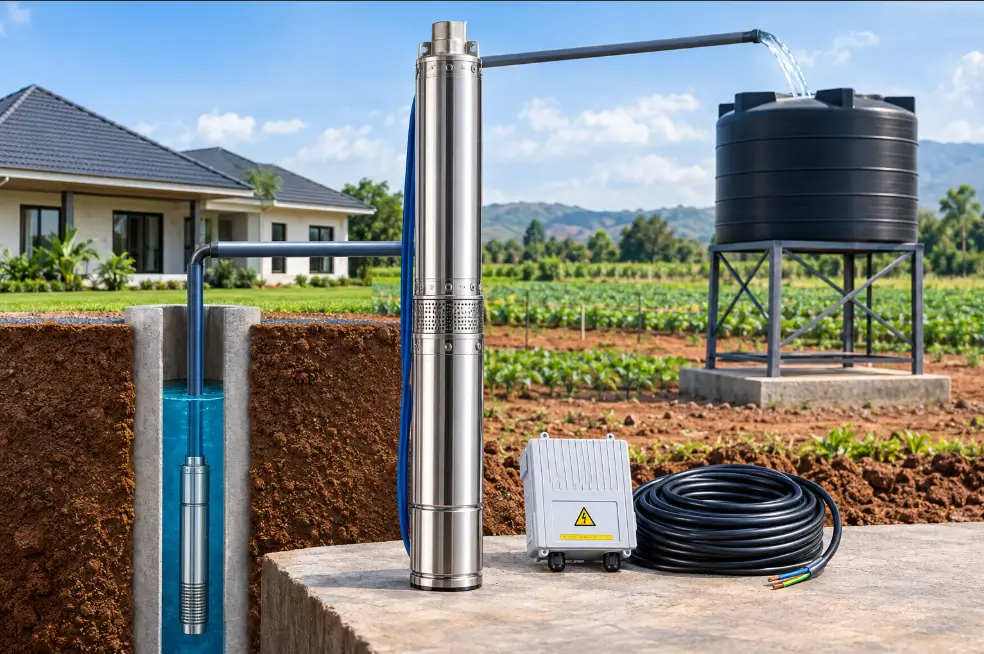
An AC submersible pump is an electrically powered pump designed to operate while submerged in water. The pump and motor are installed below the water level, with electrical power supplied through a suitable watertight cable.
Submersible pumps are commonly used to draw groundwater from boreholes and wells for domestic water supply, irrigation and other applications. A typical system combines a submersible motor with a centrifugal pump, which uses rotating impellers to increase water pressure and move water through the delivery pipe.
According to Grundfos, submersible pumps are designed for submerged installation, with the pump and motor forming an enclosed unit. They are commonly used for groundwater and water-supply applications.
For technical background on how multistage submersible pumps generate pressure, see Grundfos’ submersible pump engineering information.
How Does an AC Submersible Pump Work?
The operating principle is relatively straightforward.
When electricity reaches the submersible motor, the motor rotates the pump shaft. The shaft drives one or more impellers inside the pump. As water passes through the impellers and stages, its pressure increases, allowing it to travel upwards through the rising pipe to a storage tank or point of use.
A simplified pumping sequence looks like this:
Electrical power → AC motor → rotating shaft → impellers → increased water pressure → delivery pipe → storage tank or outlet
Multistage designs are particularly useful where water must be lifted through considerable vertical distances. Each additional stage can contribute to the pressure required to overcome the system’s total head.
This is why selecting a pump based only on horsepower can lead to poor results. The pump must also be matched to the required flow rate and total head.
Where Are AC Submersible Pumps Used in Kenya?
An AC submersible pump can be suitable for many water-supply applications where a dependable electricity connection is available.
1. Borehole water supply
Boreholes are among the most common applications. A properly selected pump can lift groundwater from the borehole and deliver it to an elevated storage tank or distribution system.
For anyone planning a borehole installation, our guide to submersible water pump prices in Kenya can help you understand the factors that influence pump selection and cost.
2. Residential water supply
Homes may use an AC submersible pump to supply water from a borehole or well to a storage tank.
The appropriate pump depends on factors such as household demand, water level, borehole characteristics, pipework and the height of the storage tank.
3. Irrigation
Farmers can use submersible pumps to supply water for irrigation where groundwater is available.
However, irrigation systems often require significantly different flow rates from domestic installations. A pump that works well for a household may not deliver enough water for a larger irrigation system.
4. Apartments and institutions
Schools, hospitals, residential apartments and other institutions may require higher-capacity pumping systems because several users can demand water at the same time.
In such cases, pump sizing should consider both peak water demand and the required delivery pressure.
5. Commercial water systems
Businesses that depend on a reliable water supply can also use electric submersible pumping systems to move groundwater into storage tanks or distribution networks.
Franklin Water notes that submersible pumping systems can be selected according to factors such as flow, head, setting depth, well casing and control requirements.
AC Pump Price in Kenya: What Determines the Cost?
One of the most common searches from buyers is AC pump price. However, there is no single price that applies to every AC submersible pump.
The cost can vary considerably depending on the specifications and application.
Key factors affecting AC pump price include:
| Factor | Why it matters |
|---|---|
| Motor power | Higher-powered pumps generally cost more |
| Pump head | Pumps designed for higher lifting requirements may have different hydraulic designs |
| Flow rate | Higher flow requirements can require larger pump capacities |
| Number of stages | Multistage pumps can provide higher pressure for deeper or higher-head applications |
| Pump diameter | Borehole diameter limits the pump size that can be installed |
| Construction materials | Stainless-steel and other durable materials can affect cost |
| Motor type | Motor design and efficiency influence both purchase price and operating performance |
| Controls | Control boxes, protection systems and related equipment can add to the overall installation cost |
| Installation requirements | Cable, pipes, fittings and labour can increase the complete project cost |
This means comparing pumps purely by their purchase price can be misleading. Two pumps with different flow and head capabilities are not necessarily equivalent even if they have similar horsepower ratings.
How to Choose the Right AC Submersible Pump
Before buying an AC submersible pump, establish the actual requirements of your water system.
1. Determine the required flow rate
Start by estimating how much water you need.
For a home, this could be based on household consumption and the rate at which the storage tank needs to refill. For irrigation or commercial applications, the required flow may be considerably higher.
A pump should deliver the required flow at the required head—not simply the maximum flow stated on its specification sheet.
2. Establish the pumping depth
Determine the depth from which the pump will draw water.
However, the water level inside a borehole can change while pumping. Therefore, pump selection should consider the relevant operating water level rather than relying only on the total borehole depth.
3. Calculate total head
Total head is one of the most important considerations when selecting a submersible pump.
It can include:
- The vertical distance the water must be lifted
- The depth at which the pump operates
- The height of the storage tank
- Pressure required at the delivery point
- Friction losses through pipes and fittings
A pump must be capable of delivering the required flow at the system’s operating head.
4. Check the borehole diameter
The physical dimensions of the pump matter.
A pump must fit properly inside the borehole casing while still allowing appropriate operating conditions. Franklin Water also identifies well casing size as an important consideration when selecting submersible pumping systems.
5. Confirm the electrical supply
An AC pump needs a suitable electrical supply.
Before purchasing, confirm the required voltage, phase and frequency of the pump against the available electrical installation. Some larger systems may require three-phase power, while other models are designed for single-phase operation.
Do not assume that every electric submersible pump can be connected to any available power supply.
6. Consider protection and controls
A reliable pumping system needs appropriate electrical protection and control equipment.
Depending on the installation, this may include overload protection, dry-run protection, appropriate switching equipment, level controls and other protective devices.
Electrical work should be carried out by a qualified professional. Kenya’s Energy and Petroleum Regulatory Authority advises consumers to use certified electricians for electrical installations and repairs and highlights the importance of proper insulation, grounding and suitable protection devices.
For broader information on electrical safety and compliance in Kenya, visit EPRA’s official website.
AC Submersible Pump vs Surface Pump
The main difference is where the pump operates.
An AC submersible pump is installed below the water level, while a surface pump remains above the water source.
Submersible pumps can be particularly useful for borehole applications because the pump pushes water upwards rather than relying on suction from the surface.
For deeper groundwater applications, this configuration can make a submersible pump a practical solution.
The best option still depends on the water source, depth, required flow, installation conditions and available power.
Popular AC Submersible Pump Options
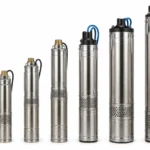
PureFlex’s current product range includes several electric submersible pump models suitable for different pumping requirements. The range includes Doyin 4SDM3 and 4SD3 models in different power and performance configurations.
Some examples include:
- Doyin 4SDM3-7 0.5HP electric submersible pump
- Doyin 4SDM3-10 0.75HP electric submersible pump
- Doyin 4SDM3-13 1HP electric submersible pump
- Doyin 4SDM3-18 1.5HP electric submersible pump
- Doyin 4SDM3-22 2HP electric submersible pump
- Doyin 4SD3-40 4HP electric submersible pump
- Doyin 4SD3-50 5.5HP electric submersible pump
For buyers who need the motor separately, PureFlex also has Doyin AC pump motors, depending on the application and required configuration.
Should You Buy an AC Submersible Pump or a Solar Pump?
The answer depends largely on the power source available at your site.
An AC submersible pump can be a practical choice where grid electricity is available and reliable. A solar pumping system may be more appropriate where electricity access is limited or where reducing dependence on grid power is a priority.
There is also a third option: hybrid AC/DC solar pumping systems, which can combine solar power with AC electricity depending on the system design.
PureFlex offers a range of solar and hybrid AC/DC pumping solutions, making it possible to consider different power options rather than treating AC pumping as the only solution.
If you are comparing the two technologies, it is important to evaluate the complete system cost rather than only the pump purchase price. Solar panels, controllers, installation and other components can affect the initial investment.
How Much Should You Budget for an AC Submersible Pump?
When researching AC pump price in Kenya, avoid choosing the cheapest model based solely on its advertised horsepower.
Instead, compare:
- Pump power
- Flow rate
- Head capacity
- Borehole diameter
- Pumping depth
- Motor voltage and phase
- Construction materials
- Required controls
- Warranty and after-sales support
- Installation requirements
The cheapest pump may not be the most economical choice if it cannot deliver the required flow at the required head.
Likewise, purchasing a much larger pump than necessary can increase the initial cost and may result in unnecessary energy consumption.
The goal should be to find the right pump for the actual water system.
Common Mistakes When Buying an AC Submersible Pump
Choosing by horsepower alone
Horsepower is important, but it does not tell you everything about pump performance. Two pumps with the same motor power can have different flow and head characteristics.
Ignoring the borehole diameter
A pump that cannot physically fit the borehole is obviously unsuitable, regardless of its advertised power.
Focusing only on maximum flow
Maximum flow does not necessarily represent the flow the pump will provide at your required operating head.
Forgetting the electrical requirements
Always verify voltage, phase, frequency and protection requirements before installation.
Buying without considering the entire system
The pump is only one component. Pipes, cables, controls, storage tanks and installation conditions can all affect the final result.
AC Submersible Pump FAQs
What is an AC submersible pump?
An AC submersible pump is an electrically powered pump designed to operate while submerged in water. It is commonly used for boreholes, wells, irrigation and water-supply systems.
What is the AC pump price in Kenya?
The AC pump price varies depending on motor power, flow rate, head, pump construction, borehole size and other specifications. It is therefore better to compare pumps according to their complete performance specifications rather than looking at price alone.
Can an AC submersible pump be used for a borehole?
Yes. AC submersible pumps are commonly used for borehole water supply. The pump must be correctly sized according to borehole diameter, pumping depth, required flow and total head.
Is a higher-horsepower pump always better?
No. A higher-powered pump is not automatically the best choice. The pump should be selected according to the actual flow and head requirements of the water system.
Can an AC submersible pump run on solar power?
A conventional AC pump requires an appropriate AC electrical supply. However, solar pumping systems and hybrid AC/DC systems can be designed to use solar energy, depending on the equipment configuration.
How long does an AC submersible pump last?
Service life depends on the pump’s construction, water conditions, operating conditions, electrical supply, installation quality and maintenance. Correct sizing and installation can help support reliable long-term operation.
Where can I buy an AC submersible pump in Kenya?
You can explore the available submersible water pumps at PureFlex Water Solutions or browse the full shop. If you are unsure which pump matches your borehole or water system, you can also contact PureFlex for assistance with selecting a suitable solution.
Choose the Right AC Submersible Pump for Your Water System
An AC submersible pump can provide a reliable solution for borehole water supply, irrigation, residential systems, institutions and commercial applications. However, the best pump is not necessarily the one with the highest horsepower or the lowest AC pump price.
Start with your actual water requirements. Establish the required flow, pumping depth, total head, borehole diameter and available electrical supply. Then compare suitable pump models based on their performance and the overall requirements of your installation.
For more options, explore PureFlex’s submersible water pump range and submersible water pump prices in Kenya.
If you are considering solar instead of conventional AC power, you can also explore solar pumping solutions before making your final decision.


Leave a Comment