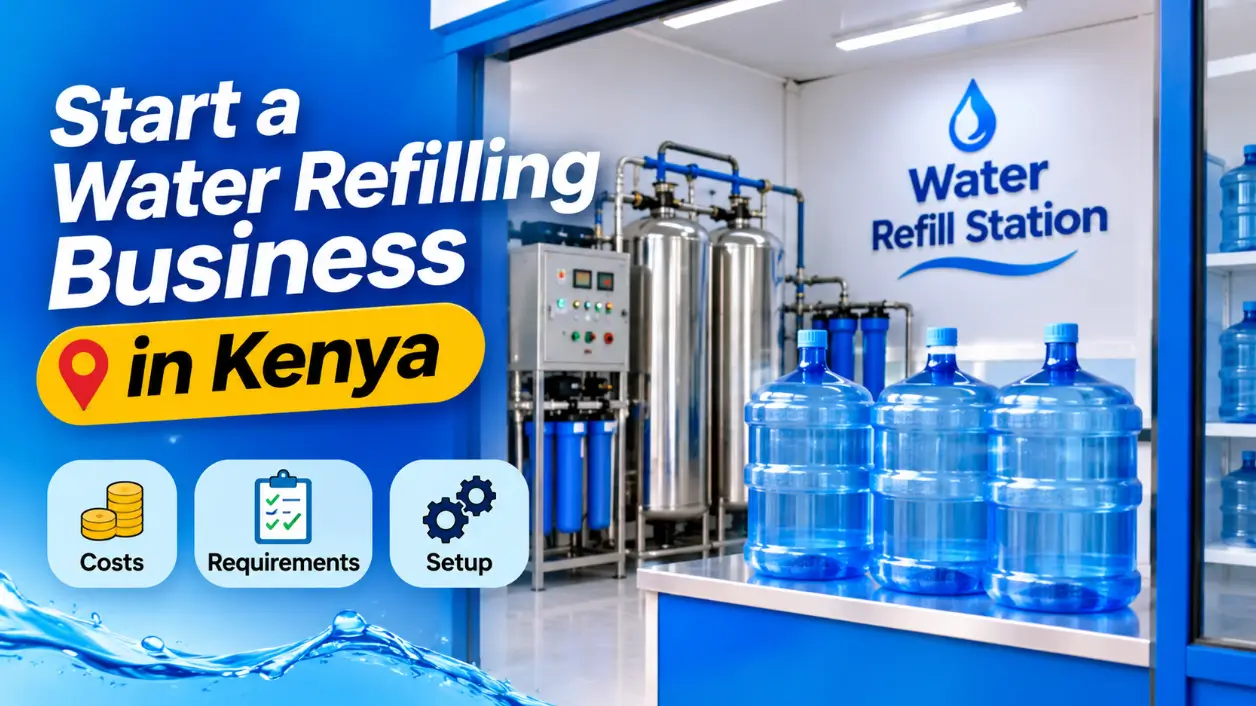
Starting a water refilling business in Kenya can be a rewarding investment. Many households, offices and businesses need safe drinking water every day. As a result, a well-positioned water refilling station can attract regular customers and generate consistent sales.
However, starting this business requires proper planning. You need the right water source, suitable purification equipment, a good location and the necessary licences. You also need a professional shop layout and a reliable way to attract customers.
So, how do you start a water refilling business in Kenya?
This guide explains the process step by step. It covers everything from choosing a business location to installing your purification equipment. It also explains how to budget, obtain the necessary approvals and build a recognisable brand.
With the right planning, you can establish a water refilling station that serves your local market and grows over time.
1. Understand How a Water Refilling Business Works
A water refilling business treats water and sells it to customers for drinking. Customers bring their own containers, such as 10-litre and 20-litre jerrycans. The business then fills these containers with treated water at an agreed price.
Some stations also offer delivery services to homes and offices. Others install automated water vending machines to serve customers throughout the day.
There are several ways to operate a water refilling business in Kenya.
Walk-in water refilling station
Customers visit your shop with their containers. You purify the water and charge according to the quantity supplied. This model works well in residential estates and busy shopping centres.
Water vending station
Customers purchase water through an automated dispensing machine. Depending on the machine, they can use coins, tokens or electronic payment methods.
Water refilling and delivery business
You operate a purification station and deliver water to homes, offices and commercial customers. This model can help you reach customers who cannot visit your premises.
Commercial water supply business
You install a larger purification system to supply institutions, businesses and other bulk water customers. This model requires careful planning because production and storage demands are higher.
2. Choose a Suitable Location for Your Water Refilling Station
Location plays a major role in the success of a water refilling business. Even a good purification system may struggle to generate sales if customers cannot access your shop.
Therefore, research your preferred location before renting premises.
Start by identifying areas with a high concentration of potential customers. Residential estates, apartment buildings and busy shopping centres can provide good opportunities.
Next, assess the following factors:
- Population: Look for areas with many households and potential repeat customers.
- Accessibility: Choose premises that customers can reach easily with their water containers.
- Competition: Research existing refill stations and their prices.
- Water supply: Confirm that your location has a reliable source of incoming water.
- Electricity: Ensure that you have a dependable power supply.
- Drainage: Provide proper drainage for equipment cleaning and wastewater.
- Visibility: Choose a shop that people can easily identify.
Also consider the size of your premises. You need enough space for purification equipment, storage tanks and dispensing points. In addition, allocate space for washing containers and serving customers. Do not choose a shop based on rent alone. A cheaper location may attract fewer customers. Instead, balance rental costs with accessibility and potential sales.
3. Identify Your Water Source and Test Its Quality
Before purchasing any water purification equipment, identify your source of water.
This is one of the most important steps when planning how to start your own water refilling business. Different water sources contain different contaminants. Therefore, they require different treatment processes.
Common water sources include:
Municipal water
Municipal water passes through a treatment process before distribution. However, its quality can change during storage and distribution. Therefore, additional filtration or disinfection may still be necessary.
Borehole water
Borehole water is common in areas without reliable municipal supply. However, it may contain excessive dissolved salts, fluoride, iron, manganese or hardness.
Bulk water supply
You may also obtain water from an established bulk supplier. However, check the source, quality records and applicable regulatory requirements before using this option.
Why should you test water before buying a purification machine?
Water testing identifies the contaminants that your treatment system needs to remove.
A laboratory analysis can assess:
- Total dissolved solids (TDS).
- Water hardness.
- Fluoride concentration.
- Iron and manganese.
- Turbidity.
- pH levels.
- Microbiological contamination.
These results help determine the right treatment technology.
For example, water with high dissolved salts may require reverse osmosis. However, water with mainly suspended particles may need sediment filtration and other suitable treatment processes.
Similarly, water with microbiological contamination requires an appropriate disinfection process.
You can learn more about how to test water quality at home before selecting your treatment equipment.
A TDS meter can provide a quick indication of dissolved solids. However, it cannot identify every contaminant. For that reason, laboratory testing remains important when designing a commercial drinking water system.
4. Choose the Right Water Purification Equipment
The purification system is the heart of your water refilling business. It determines the quality of the finished water and the amount you can produce.
However, not every water refilling station needs the same equipment. Your system should match your water source, daily production target and water quality requirements.
Essential equipment for a water refilling business
1. Raw water storage tank
A raw water tank stores incoming water before treatment. Choose a suitable food-grade tank with enough capacity to support your production requirements.
2. Sediment filtration system
Sediment filters remove suspended particles such as sand, rust and other visible impurities.
The filtration arrangement depends on the condition of your source water. Some businesses may need multiple filtration stages to protect downstream equipment.
3. Activated carbon filtration
Activated carbon helps reduce chlorine, unpleasant odours and certain organic compounds.
It also helps protect reverse osmosis membranes from chlorine damage where chlorine is present in the feed water.
4. Water softener or specialised pretreatment
Some water sources contain excessive hardness, iron or manganese. These contaminants may require specialised treatment before the main purification stage.
The water analysis determines whether you need these additional components.
5. Reverse osmosis system
Reverse osmosis is widely used in commercial water purification. It reduces dissolved salts and several other contaminants through a semi-permeable membrane.
The correct system capacity depends on your expected daily sales.
For example, a 250 LPH system may suit a business with moderate production requirements. Larger businesses may need higher-capacity commercial systems.
Pureflex supplies commercial purification equipment, including 250 LPH water purification systems.
You can also understand the technology better by reading what reverse osmosis is and how it works.
6. Ultraviolet sterilizer
An ultraviolet sterilizer provides an additional disinfection barrier against microorganisms.
However, the system must have the correct UV intensity and flow capacity. Water should also have suitable clarity for effective treatment.
7. Treated water storage tank
After purification, the water may enter a dedicated storage tank before dispensing.
Use suitable food-grade materials. Also, protect the tank against dust, insects and other sources of contamination.
8. Water dispensing equipment
Dispensing equipment allows customers to fill their containers conveniently.
Depending on your business model, you may require:
- Stainless steel dispensing taps.
- Multiple dispensing points.
- Automated water vending machines.
- Flow meters.
- Electronic payment integration.
9. Bottle washing and rinsing equipment
Container hygiene is essential in a water refilling business.
Provide suitable bottle rinsers, cleaning brushes and sanitising equipment. Also, establish a clear process for handling customer containers before filling them.
The final equipment arrangement should follow your water analysis and production requirements. This approach prevents unnecessary spending and helps you build a system that performs reliably.
5. Determine the Production Capacity You Need
How much water do you expect to sell every day?
Your answer will help determine the size of your purification system.
A small station may operate with a lower-capacity machine. However, a busy commercial station may need a larger system to meet customer demand.
Consider this example.
Suppose your business targets 500 litres of daily sales. A purification system rated at 250 litres per hour has a theoretical production time of two hours for that volume.
However, actual production may take longer. Water temperature, feed pressure, membrane condition and source-water quality can affect output.
Therefore, do not base your purchase on the rated capacity alone.
Consider these factors:
- Expected daily sales.
- Number of dispensing points.
- Available operating hours.
- Raw water availability.
- Storage tank capacity.
- Future expansion plans.
Also allow for periods of higher demand. This will help you avoid running out of treated water during busy hours.
Pureflex can help assess your expected demand and recommend a suitable purification system for your business.
6. Register Your Business and Obtain the Necessary Licences
Before opening your water refilling station, ensure that your business meets the applicable legal and public health requirements.
The exact requirements depend on your business model and county.
Business registration
Start by registering your business through the Business Registration Service.
You can register a business name or establish a private limited company, depending on your preferred business structure.
For registration guidance, refer to the Business Registration Service.
County business permit
You will also need to check the applicable business permit requirements with your county government.
The permit category and charges may vary depending on the location, premises and business activity.
Public health requirements
Water intended for drinking must meet applicable hygiene and public health requirements.
Contact your county public health office to establish the necessary inspections, food hygiene approvals and employee medical certification requirements.
You can also refer to the Ministry of Health food hygiene licensing guidance.
KEBS requirements
The Kenya Bureau of Standards (KEBS) oversees applicable product standards and certification requirements.
If your business supplies drinking water through a refill station, confirm the applicable requirements before starting operations.
For example, packaged bottled water and customer-container refill businesses may follow different certification procedures.
Check the KEBS guidance on bottled water and water refills for further information.
7. Set Up Your Water Refilling Shop
Once you have identified your premises and selected your equipment, plan the shop layout.
A good layout improves hygiene, workflow and customer experience.
Your premises should have clearly defined areas for different activities.
Water treatment area: Allocate space for the purification machine, pumps, filters and associated plumbing.
Raw water storage area: Position the incoming water tank where it can supply the treatment system reliably.
Treated water storage area: Keep purified water in a protected storage tank. Prevent contact with untreated water and other contamination sources.
Dispensing area: Provide convenient access for customers filling their containers.
Container cleaning area: Set aside a separate space for washing and rinsing containers.
Customer service area: Provide a clean area for receiving orders, handling payments and assisting customers.
Also consider the following requirements:
- Proper drainage.
- Adequate lighting.
- Good ventilation.
- Easy-to-clean floors and surfaces.
- Suitable electrical connections.
- Safe equipment access for maintenance.
Where possible, keep incoming dirty containers away from the clean dispensing area.
Plan the layout before installing your equipment. This helps prevent unnecessary plumbing changes and makes the shop easier to operate.
8. Brand Your Water Refilling Business
A professional brand helps customers recognise your business. It also creates a positive first impression.
Your shop should communicate cleanliness, reliability and professionalism.
Start with a memorable business name and a clear logo. Then develop a consistent visual identity for your premises and marketing materials.
Consider the following branding elements:
- Exterior shop signage.
- Branded uniforms.
- Customer information boards.
- Price lists.
- Branded delivery materials.
- Social media pages.
- Business cards and promotional materials.
You should also create a Google Business Profile. This helps customers discover your station when searching for drinking water services in their area.
In addition, use Facebook, TikTok and WhatsApp to share your location, operating hours and available services.
Pureflex provides shop branding and setup support alongside water purification equipment supply and installation. This allows you to coordinate the technical setup and business presentation under one service provider.
9. Calculate Your Startup Capital and Operating Costs
How much money do you need to open a water refilling business?
The answer depends on several factors. These include the size of your premises, equipment capacity, water source, treatment requirements and business model.
Instead of relying on a fixed startup figure, prepare a budget based on your actual requirements.
| Investment area | What to include |
|---|---|
| Business registration | Registration and documentation |
| Premises | Rent and security deposit |
| Renovations | Plumbing, drainage and electrical work |
| Purification equipment | Filters, RO system, pumps and accessories |
| Storage | Raw and treated water tanks |
| Dispensing | Taps, vending equipment and bottle rinsers |
| Branding | Signage, shop design and promotional materials |
| Licensing | Applicable permits and certification |
| Working capital | Water, electricity, rent, salaries and maintenance |
Remember to budget for operating costs as well. These include electricity, water supply, replacement filters, membrane maintenance, staff salaries and delivery expenses.
How to calculate the expected revenue
Consider a simple example.
Suppose your station sells 500 litres of water daily at KSh 5 per litre.
Your daily revenue would be:
500 litres × KSh 5 = KSh 2,500.
If you operate for 30 days, your monthly revenue would be KSh 75,000.
However, this is revenue, not profit.
You must deduct operating expenses before determining your actual earnings.
Also consider the amount of water rejected during purification, particularly when using reverse osmosis. This affects water consumption and operating costs.
A proper business plan should estimate daily sales, variable costs, monthly expenses and the sales volume needed to break even.
10. Market Your Water Refilling Business
Once your shop is ready, focus on attracting customers.
Remember that drinking water is a repeat-purchase product. Therefore, customer satisfaction and retention are important.
Use a combination of local and online marketing strategies.
- Local promotions: Distribute flyers within nearby residential estates and shopping centres.
- Opening offers: Introduce promotional prices to attract your first customers.
- Referral programmes: Encourage existing customers to recommend your business to friends and neighbours.
- Social media: Share photographs, short videos, operating hours and location details on Facebook, TikTok and WhatsApp.
- Google Business Profile: Add your location, telephone number, business hours and photographs. Encourage satisfied customers to leave genuine reviews.
- Home and office delivery: Where practical, offer delivery services to customers who prefer convenience.
- Customer service: Maintain consistent water quality, clean dispensing equipment and fair pricing.
11. Maintain Your Equipment and Monitor Water Quality
Opening your water refilling station is only the beginning. You must also maintain the equipment and monitor the quality of the finished water.
Create a maintenance schedule from the first day of operation.
Your maintenance routine should include:
- Replacing sediment filters when required.
- Replacing activated carbon filters according to their service life.
- Inspecting reverse osmosis membranes.
- Checking operating pressure and production rates.
- Inspecting UV sterilizers and replacing lamps as required.
- Cleaning and sanitising storage tanks.
- Inspecting dispensing taps and connecting pipes.
- Conducting periodic laboratory water tests.
- Maintaining cleaning and water quality records.
Do not rely on a TDS meter alone to confirm drinking water safety. It cannot detect every chemical or microbiological contaminant.
Instead, use appropriate laboratory tests and follow the applicable water quality requirements.
Regular maintenance also helps prevent unexpected equipment failures. As a result, your business can serve customers more consistently.
12. Why Choose Pureflex for Your Water Refilling Business Setup?
Starting a water refilling business involves several activities. You need to plan the treatment system, source the equipment, arrange installation and prepare the shop for customers.
Managing these activities separately can become complicated.
Pureflex provides integrated support to help entrepreneurs establish water refilling businesses in Kenya.
Our services cover the key stages of the setup process.
Business consultation
We help you assess your proposed business, expected production capacity and equipment requirements.
Water purification equipment supply
We supply commercial reverse osmosis systems, filtration equipment, pumps, UV sterilizers, storage solutions and related accessories.
System installation
Our team helps install and connect the purification equipment to create a functional water treatment arrangement.
Shop setup
We assist with equipment positioning, plumbing connections and the practical layout of your water refilling station.
Business branding
We provide branding support to help establish a professional and recognisable shop.
Technical guidance
We also provide guidance on system operation, maintenance and replacement filters.
Whether you are planning a small neighbourhood station or a larger commercial facility, the equipment and setup should match your business objectives.
Pureflex brings these services together to simplify the process of establishing your water refilling business.
Frequently Asked Questions
1. How do I start a water refilling business in Kenya?
Start by researching your target market and selecting a suitable location. Next, identify your water source and conduct a laboratory water test. Use the results to select the right purification equipment. Finally, register your business, obtain the applicable approvals, set up your shop and begin marketing your services.
2. How much capital do I need to start a water refilling business?
Your startup capital depends on equipment capacity, premises, water source, renovations, licensing and branding. A small station will have different requirements from a large commercial facility. Request an equipment assessment before preparing your final budget.
3. Is a water refilling business profitable in Kenya?
A water refilling business can generate recurring revenue because customers purchase drinking water regularly. However, profitability depends on sales volume, selling price, competition and operating costs. Research your local market before investing.
4. Which machine do I need to start a water refilling business?
The machine depends on your source-water quality and expected production capacity. Reverse osmosis may be necessary where water contains excessive dissolved salts. Other sources may require sediment filtration, activated carbon, disinfection or specialised pretreatment.
5. Can I use municipal water for a water refilling business?
Yes. Municipal water can serve as a source for a water refilling station, provided it meets the applicable requirements after any necessary treatment. Test the water first to establish the correct filtration and disinfection arrangement.
6. Can I use borehole water for a water refilling station?
Yes, provided the water receives appropriate treatment and meets the applicable drinking water standards. Borehole water may contain excessive fluoride, dissolved salts, iron, manganese or other contaminants. A laboratory analysis will help determine the required purification process.
7. How many litres per hour should my purification machine produce?
This depends on your expected daily sales and operating hours. Consider the number of customers, storage capacity and periods of high demand. Also remember that actual production may differ from the machine’s rated capacity.
8. Do I need KEBS approval for a water refilling business?
You should confirm the applicable KEBS certification requirements for your specific business model. Packaged drinking water and customer-container refill operations may have different requirements. Also check county public health requirements before opening your station.
9. Can I start a water refilling business in a small shop?
Yes. A small shop can accommodate a suitable purification system if it has sufficient space for equipment, storage, dispensing, container cleaning and proper drainage. Plan the layout before renting or renovating the premises.
10. Does Pureflex help with complete water refilling business setup?
Yes. Pureflex provides consultation, water purification equipment supply, installation, shop setup and branding assistance. The equipment configuration depends on your water source, production requirements and business objectives.
Start Your Water Refilling Business with the Right Equipment
A successful water refilling business begins with proper planning.
First, understand your market. Then test your water source and select a suitable purification system. After that, prepare your premises, obtain the necessary approvals and establish a professional brand.
You do not have to manage every part of the project separately.
Pureflex Water Solutions supports entrepreneurs with consultation, equipment supply, installation, shop setup and branding.
Planning to open a water refilling station in Kenya?
Get a setup assessment and equipment quotation based on your intended production capacity and water source.
Contact the Pureflex team through the website’s available enquiry channels to discuss your project.
Leave a Comment