
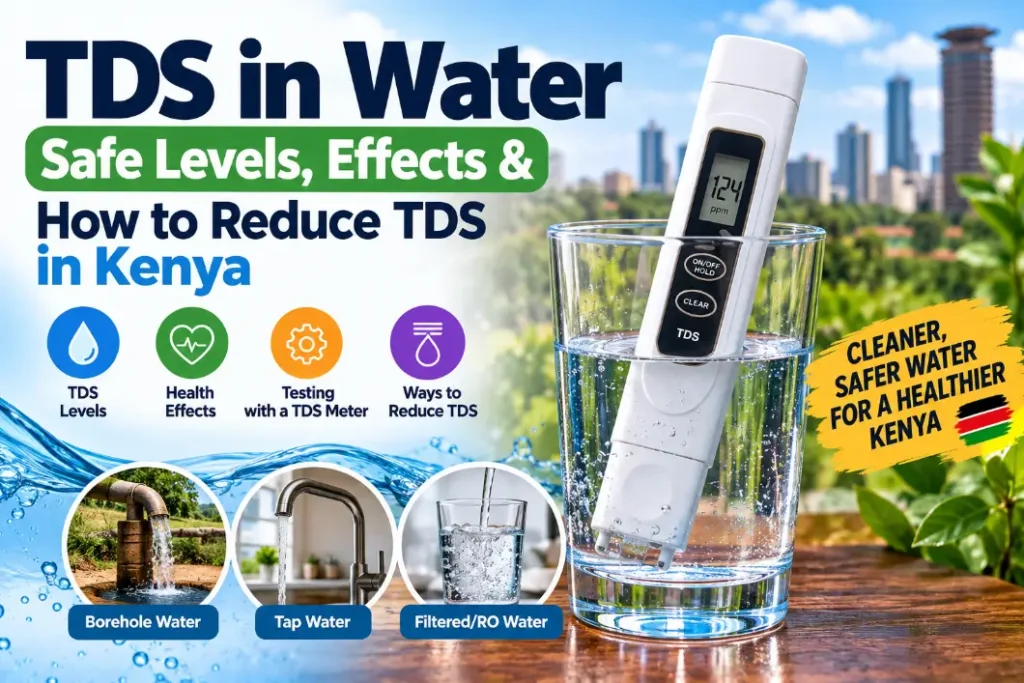
TDS in Water: Safe Levels, Effects & How to Reduce TDS in Kenya
What does TDS in water mean? Learn the ideal TDS levels for drinking water in Kenya, how to test TDS, effects of high TDS, and the best ways to reduce dissolved solids.
Water quality in Kenya is an important consideration for households, offices and businesses that depend on safe water for drinking, cooking and daily activities. Water from municipal supplies, boreholes, rivers and other sources can vary in quality. Therefore, understanding the source and testing the water helps determine whether treatment is necessary.
Water may contain suspended particles, dissolved minerals, salts, microorganisms and chemical contaminants. Some problems are visible, while others cannot be detected by looking at or tasting the water. For this reason, clear water should not automatically be considered safe for drinking.
Different water sources can present different challenges. Borehole water may contain high levels of dissolved minerals, iron, fluoride or other substances, depending on the local geology. Municipal water may contain chlorine used during disinfection, which can affect taste and odour.
Water from rivers and other surface sources may contain sediment and microorganisms. In addition, poor storage and handling can introduce contamination after treatment.
However, these problems do not affect every water source in the same way. Testing is the best starting point for identifying the specific contaminants that need attention.
Water testing helps establish whether water meets the requirements for its intended use. Basic checks can include colour, smell, turbidity and total dissolved solids (TDS). However, these checks cannot detect every harmful substance.
A TDS meter measures an estimate of dissolved solids in water. It does not identify individual chemicals or confirm microbiological safety. For a more complete assessment, laboratory testing can check parameters such as pH, fluoride, iron, nitrates and microorganisms, depending on the source and the suspected problem.
Read this guide on how to test water quality at home to learn more about initial water quality checks.
The correct purification method depends on the test results and the contaminants present.
Some water sources require more than one treatment stage. For example, borehole water with sediment and high dissolved salts may need pre-filtration followed by a suitable reverse osmosis system.
Learn how reverse osmosis purifies water and explore available water filtration solutions.
Before purchasing a purifier, consider your water source, daily water demand, test results and maintenance budget. Also check replacement filter availability and the manufacturer’s specifications.
Households and businesses in Nairobi County, Kiambu County and other parts of Kenya should choose treatment equipment according to their actual water quality rather than relying on general assumptions about a location or source.
Water quality testing provides a practical starting point for making informed treatment decisions. Regular testing may also help identify changes in water quality over time.
The most suitable solution addresses the contaminants present without relying on a single measurement. By combining appropriate testing with the correct filtration or disinfection method, households and businesses can manage their water quality more effectively.
What does TDS in water mean? Learn the ideal TDS levels for drinking water in Kenya, how to test TDS, effects of high TDS, and the best ways to reduce dissolved solids.